
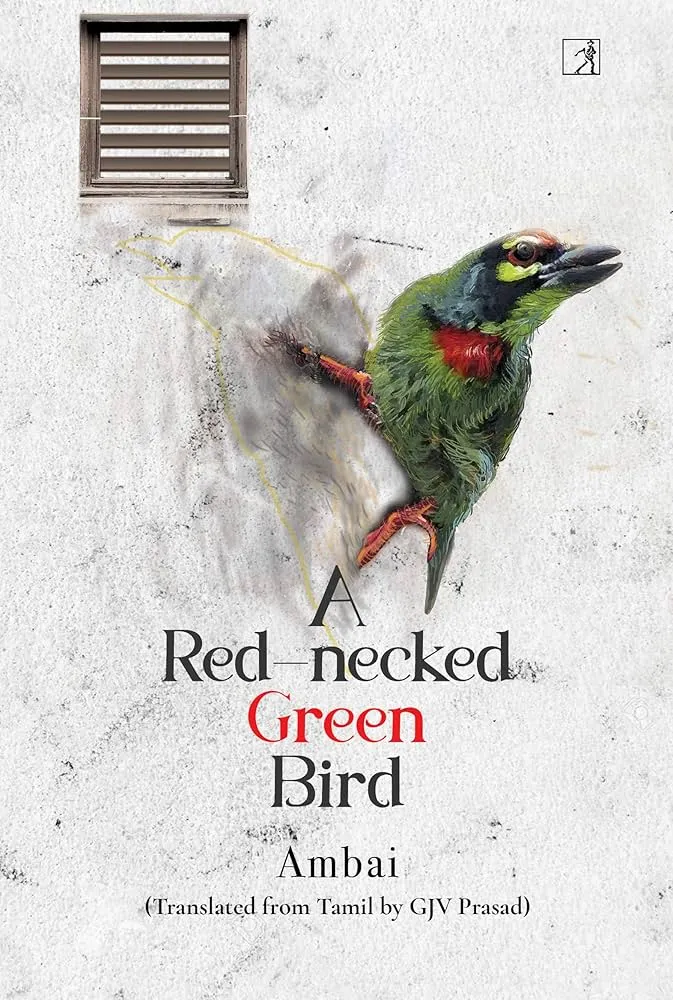
Ambai—pseudonym for CS Lakshmi—an accomplished Tamil writer, and the only one to be included in the Picador Book of Modern Indian Literature, edited by Amit Chaudhari, has always expressed her uneasiness on being pigeonholed as ‘women writers’, writing only family stories or about the politics of home. Her new collection of stories, A Red-necked Green Bird, is an unflinching reply to the critics, as she detours from the stereotyped rubrics of feminism, responding to the global politics in her subtle ways.
As in all her books, especially the recent A Night with a Black Spider, she handles intersectional feminism with quite a dexterity. In this collection consisting of 13 stories spanning over 216 pages, a reader is transported into her world, rich with allusions to Tamil music and culture, aided by a brilliant translation by GJV Prasad that retains the simplicity of her prose without tempering with the emotional intensity.
What particularly catches a reader’s attention is old-aged women, jostling with their senility as the memories of a contented past lurk in the shadows. For example, there is Kamla in ‘The Falling’, standing in a hotel’s balcony overlooking the hills, remembering the happy days with her deceased husband, and the abrasive behaviour of her son settled abroad, contemplating suicide. But there is resistance even in face of death—and this is where the reader is reminded of Ambai’s compassionate voice—that Kamla wants to die without her spine being crushed. Then there is Urmila Tai, trapped in the quagmire of exhaustion and self-loathing as she tends to her ailing mother-in-law, who, on finding no respite, decides to burn herself up.
This book also continues the string of her Journey Stories,—Journey 21, Journey 22, Journey 23— which, she mentions in one of her interviews, began as an effort to capture the momentary stirrings when she travels. In her Introduction, Stories and me, she mentions this: “I have seen the world through so many windows…That world continues to fall on my mind like sunlight in geometric shapes falling on the ground.” Journeys, undoubtedly, remain one of the strongest elements feeding into her prose, like her intimate understanding of music and the raaga.
While I liked most of the stories, I could not help but choose my favouries. The titular story, edging almost towards a novella, is a story of Vasanathan and Mythili, and their hearing-impaired foster daughter, Thenmozhi. The rift between the couple—the mother wanting her daughter to stay the way she is, and the father’s desperation to make her ‘whole’ with a hearing aid—gives a particular gendered edge to the problem at hand, that the reader is tempted to taking sides. However, towards the end, the story might tire the reader with long descriptions of the places the mother-daughter duo visit to look for Vasanthan who has left the house, angered by the daughter’s denial of using a hearing aid. There is constant mention of the travails faced by deaf children as we teach them to speak—sound falling on their ears as whips. In a letter, Thenmozhi writes to her father: “Language is communication. It can happen without sound.”
Another story that I particularly liked, ‘Swayamvars with No Bows Broken,’ is about a widow Shanti, who is tech-savvy, lives alone, and travels by herself, not letting loneliness undermine her existence. When her children suggest she find a partner through a matchmaking portal, ‘Swayamvar’, she tells them about her lover, whom she eventually marries. Fleshing out these out-of-box women, who exercise complete autonomy over their lives, calmly and in unobtrusive ways, is undoubtedly Ambai’s forte.