
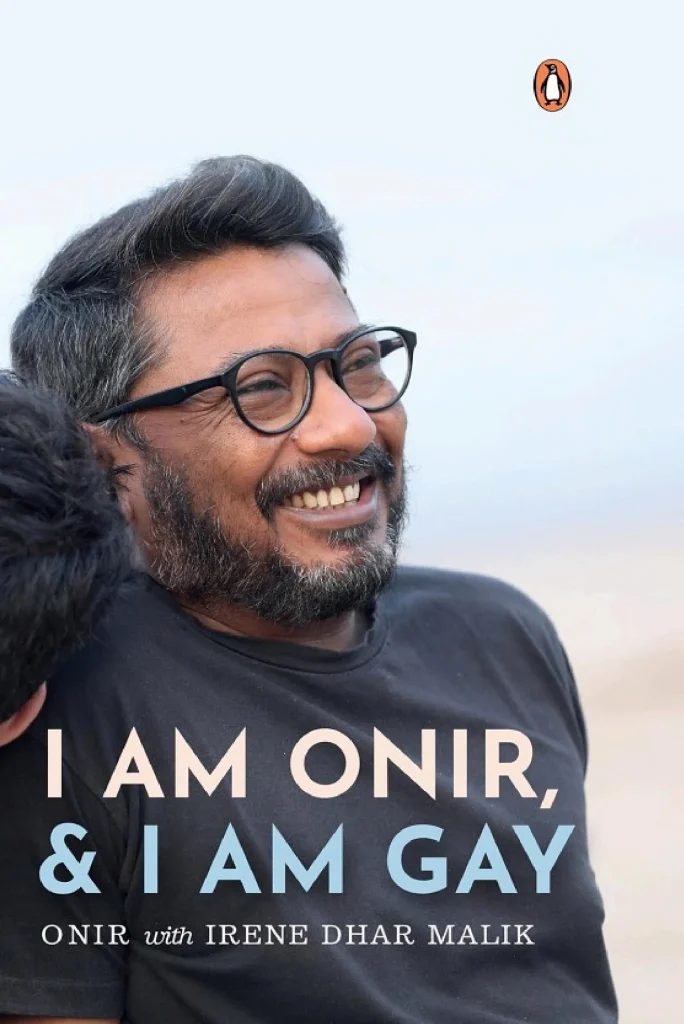
SS: The response to the book has been great. How do you feel about it?
Onir: (I was) overwhelmed with the good reviews, which were really, really nice. And also, to have gone into the second edition so fast. And, you know, it’s very obvious that they’re proud of the book, which is great. I don’t have to keep telling them anything like Why don’t you do this? They’re the ones who are actively positioning the book. You know, I was actually very very overwhelmed on the fifteenth when they sent me this video in which people were talking about Subhas Chandra Bose, Sarojini Naidu. Each book is for freedom, for somethings freedom. And then they had my book, one of the books talking about the freedom to love.
SS: I was wondering about your work? I mean, as with this book, and your cinema there’s this gentleness in the way you protest. There’s a restrained strength with which you protest and put your points across. And another point is the title of the book, I am Onir and I’m gay. I don’t know, what were people expecting? But what role do you see yourself in? When you see this? I mean, are you shouting from the rooftops in ecstasy? Or are you yelling at somebody? Or are you just telling yourself as you look in the mirror?
Onir: I’m not shouting for sure. Neither am I telling myself for sure that I think it’s just turning the othercheek, you know. And the reasons for waiting to you know… just a couple of days back, I was meeting a friend over coffee, and he’s gay. And he’s not out to his buddy. And during the conversation, he mentioned that it’s a choice. And I said, How is it a choice? Just explain to me, have you ever heard of any person having to make this choice? And because we don’t have the choice? That’s why for me, it was important to say that because I know a lot of people even now today when I’m out and proud when they talk that’s okay, so you know, you you’re making a film on that kind of unit, this sort of hesitancy to use the word. You would still use the word LGBTQI because just using words like gay, queer, most people don’t understand. Or being hesitant, especially men! I think men, oh, my god are not using this word maybe to communicate, but just use the word.
SS: Absolutely! Men also think that if they become feminists, they’ll grow a vagina. So then what do we do? And I had no idea before reading the book that My brother Nikhil, is a movie way ahead of its times. And when I spoke of your restraint, just the gentleness with which you put your point forward there is an empathy that the viewers also eventually wants that masala viewers won’t — item songs and all that. You must be they do that. But we will also want this. You must have a heart and then respond with that heart. And I think for me, I was kind of a much younger writer in 2005. I was twenty-two, but at the same time, I didn’t understand sexuality and gender outside of heteronormativity. I didn’t understand what begin a feminist was. And yet, you know that film remains to this day very clearly in my mind as a love story between Nikhil and Nigel. And of course, you know, the bond that they have is very deep. A very special. affection between those characters. And when one feels the compassion, mostly what one feels is the human tragedy of what’s happening? So when you say, I am Onir and I am gay, this is very different from the way you dealt with the sexuality of the protagonist in your first film. You did not think that at that time that it was important to go out and say that he’s gay or whatever.
Onir: See, in 2005, the reasons the tones are different. But this was one of the first mainstream films. So my main view was that the industry, or the society was not as well versed with the narrative. For me it had to be about stating it in a way where people don’t get like, Oh, my God, but doing it gently. So the tone was different. What I’m doing this time, it’s not the same tone by the Nikhil. It will be also before it’s time for this society to accept, which is constantly struggling to. Constantly struggling. There’s more resistance. And the same is happening with the queer community. And sometimes, I will do mostly, but it’s against cisgender. Me, but sometimes there is that resistance, it happens also with the women have centuries of being, you know….

SS: the internalizing of the patriarchy.
Onir: Yeah. So whenever I speak in social media, about minority rights, the first thing I’m told this, but you will get stoned to death, we go there. And that’s for me. Why are we always looking at the worst for me. Why are we always looking at the worst examples in my life? My morality does not need to be achieved by the worst. I will look for something that’s beautiful. To make myself better. So look at that.
SS: The problem is that people just want to focus on the divisions and champions, some sort of oppression, something very violent and oppressive. They don’t want to see the person on the other side. And you, on the other hand, as a filmmaker are always asking us to look at the person. Whether It’s I Am Onir or whether it’s Nikhil see the same thing in your memoir, too. It’s called, I am Onir and I am Gay, and it’s about people. Most of all, it’s about you. Your sexuality is not everything about you. Your family, your friends, especially your friends, are people who obviously matter to you a lot. What has the response from the queer community been like to this book?
Onir: A lot of people who don’t know me personally are sending me screenshots from some really remote place reading the book, telling me how much it matters. There have been women messaging me on Facebook, about how it helps them understand their son’s better. And then some really well know people from the community will keep quiet. But overall, I think everybody has been really supportive, celebrating the book from the community and also more women. Most journalists who I’ve spoken to mostly 80% have been good, and some men who come from community too have really liked it. I have been really overwhelmed seeing this because, IPS officers, IAS officers are tweeting about the book. It is hard to get those people to celebrate it, for them to make change in their own way. It was really heartening for me to see how many messages I got from people from saying that theywere very proud of me. So I find that for me, , I might not be successful, but it starts a discourse and that is important when people are talking in various spaces. That somewhere somebody needs to do somethings better.
SS: That’s also been your journey, right? I mean, if your journey has not been smooth, to say the least. You faced all kinds of trials and tribulations I mean, every conceivable kind, from personal attacks, to losing mentors and seniors to financing being pulled out at the last moment and all of that. And your message seems to be the same, you’re the reason that you keep going seems to be the same that I will the discourse. What is it that you have in mind? What is it that that is happening? At the root level, in colleges in tier-two towns with kids? Say, what is your dream?
Onir: The problem is that one is our society is really different from city to city, It’s like two different words at times. And it’s difficult, but I knew that at the same time when I see some of my close friends, and deal with my sexuality with the children, you know, with their sons and daughters, and see how comfortable these youngsters are, it gives me hope. At the same time when I see what’s happening around in general, recently of course, it felt like I was a part of this campaign. changes have come where there was this pilot who is trans. They refused him permission to fly. And we started the campaign and recently they’ve changed. So my hope is small. I was happy that when the decision on Section 377 happened and that they ended up having these talks.
So for me, it is very important to have a film that just celebrates us navigating our relationship. So it’s this person falling in love for the first time when he’s eighteen. Discovering himself much more when he’s twenty-eight. And, falling in love, figuring it out, heartbreaks and lies, and everything, and then at thirty-eight, finally, also understanding how he has become a much more cynical person. Very often in cinema, when you see how queer desire is portrayed, it reflects the uneasiness of the makers and the actors. Somehow they’ll likely be constantly subtly around it. Why? What is there to be subtle about my love when you’re not subtle? You know, why should it be any different from the way you portray any other expressions of love?
SS: So there are now shows that are coming in which are kind of embracing it, you know. I do feel like that it’s happening. Do you like any particular shows like Sex Education or something else?I was asking you about international content.
Onir: Honestly, I’ve been exposed to international content for quite some time. Right from college. And I know that the power of cinema, when you’re growing up and you have reference points. Two years ago in Miami, they had this film called Pain and Glory by Pedro Almodovar. It was beautiful, it is out in the filmmaker. If you really look at what’s happening here, and what’s happening in the rest of the world. and you look at a filmmaker like Xavier Dolan, or we keep talking about Brokeback Mountain. There is so much good cinema which portrays Queer lives. And of course, now with the OTT platforms you’ll see these series which brings it to your house, and it gives you an opportunity to people even here to watch something in such a normalized way. It’s something really important to tell people whenever you can, if you are empowered, it’s important to come out because you empowered, it’s important to come but because you empower many more people. Today to look at what happening with Instagram. A lot of it is Tik Tok and terrible, but who cares? At least you see people from remote villages. Romancing and all kinds of crazy things. But that is a move towards acceptance, and I feel that. So in a way media is a negative, but it also can be empowering in different ways. Just imagine in all these small towns, village, for a guy to even dress up as a woman and, claim his identity.
SS: Because you said this I’ll share another of my experiences. So I was in Mumbai for a while. And there was one person that I matched with. He seemed like a very sweet person, he was a kickboxing champion. And we moved on to chatting on WhatsApp. And then I said, let’s meet. And he said, ok, but I like dressing up. I was taken aback. He said, I like your picture because you were dressed in a saree I’ve always wanted, a golden dress. And then he got super anxious, . He said, no, I shouldn’t have told you. I said, see, I might not date you romantically. That doesn’t mean that we can’t meet. He said, I need to see a psychiatrist and so on. I told him that I think you need to, if anything, you need to see somebody about this anxiety that you’re going through. You need to accept that part of you. It left me with so many thoughts. I doubted myself, I didn’t want to be cruel to him or unkind to him. But then, I tried to place myself in his shoes. And he was scared because he was this kickboxing champion. What would happen if somebody would get to know that he dresses up in his ex-girlfriend dresses.
Onir: I think that she’s so empowering them to be an Olympics medalist from India to come out as lesbian. Wow! And we accepted. And we celebrated. I feel that there is no need to look at these things. And stop being so scared all the time. You know, I feel that sometimes we overdo this.
SS: And that’s the other thing, right? People will often say, oh, you’re a feminist. Why do you have to be so loud about it? Or you’re gay? Why can’t you just be? I actually want you to tell our readers, why it is important. Why it important to be able to talk about who you are?
Onir: I feel that these people are constantly on your face, right from the horrible matrimonial ads to the obsession with wedding costs to venues and jewelry. Everything today is screaming. But one small expression of pride and people say, why do you have to be so open. As if every fucking wedding is low key.
SS: I’m a woman, I have the freedom to wear what I want. And I take it for granted. But if it was snatched from me, like I say, even in the olden, days when widows were forced to get their heads shaved. A freedom was being taken away. So when we say, I want to express myself like this, that’s a basic human right. Freedom that comes with it. Why does it terrify people?
Onir: I feel that there’s so much of that. That’s why I keep saying that all minorities have to speak up together. Because I feel that we will then get to a place when people talk about us as normal people, I don’t like it when it glamorizes the idea of being in a closet saying, Oh, it’s my right to die. And of course, I understand that each person needs to figure out his or her or their journey on their own because circumstances that you have to navigate. But it is the same I feel the way people glamorize the burqa. Okay. As choice. Of course, I don’t believe in any of the discourse that’s happening now about you know, force, you know, saying that, Oh, this new ban, whatever. But who created this??
SS: Yeah, it’s the if the patriarchy. Absolutely.
Onir: So we are forgetting the problem. And of course, men are the ones who are getting more militant about it. Suddenly, you will see even little girls, everyone having to cover them up. I wonder, how much is the choice? Because choice is also about not just saying, yes, I want to, but it’s again, about patriarchy, is is your ability to question that. Whether you’re informed about how people accept domestic violence, how people accept you. So soaked in patriarchy, right from, it’s a woman, a woman will change their name.
SS: That’s a lovely piece in that segment. Very heart warming.
Onir: So, I just feel that, you known, this sort of stopped, you know, glamorizing this word choice, most of us have very little choice in life. We are mostly trying to navigate between what has been thrust on us that, this is the you should lead, even as a queer person, a lot of my friends say, Do you see a lot that you’re not clear enough? You’re not gay? Because you don’t probably enjoy sex in a certain way? Or because probably you don’t, I don’t really go to gay parties, I have to go where I enjoy myself you know? And you’re not to be in this world pretending to be you. and so, I feel that everyone is always trying to put you into this, that pigeonhole. There was a point when I was thinking do I need to say that I’m gay? And the reason I took that step is also because we have another book from India, where someone claims their queer identity, he has with the wordplay. So today I’m going to walk into a airport as a queer person. And I see feeling that I am gay, even if I’m closeted, empowers me a little that it’s there.
SS: It has been important to you to give voices to the silenced minorities, right? That’s something also that I’ve seen? Whether it’s child abuse, whether it’s women. It’s always, the marginalized that you’re trying to give voice. And our magazine, it’s a humble little feminist publication called Usawa. In Swahili means equality. And your book starts with the statement is that equality is non-negotiable. Is there anything that you would like to tell our readers?
Onir: It saddens me that on the 75th anniversary when a child is getting beaten to death, because he’s touched the headmaster’s water. What are we? What’s the point of it, you know? It just really, really saddens me that we are so preoccupied with unimportant things. You know, it’s been posted. So many Kashmiris are everywhere with the flags, and I see that the camera is only up there. Because if it turns down, it’s an empty square, and all the shops are closed. And all these people are marching, there are hardly any locals, you know? And what is the point? When there are people getting shot and everyday being killed. And keep claiming that now changes happen, where the fact remains that, you know, caste oppression has increased. The reality is that as a nation, we have become more fragmented than we were even during the partition. In the partition, there was this whole huge movement of people from the minority communities who said no to partition and stayed back. And now you have huge minority who are being silenced, or not feeling comfortable. And if you say anything about not being, I mean, why am I not? Am I being deprived of power to say, I’m feeling uncomfortable?
SS: The minute I say that, people say, oh, you should go to Pakistan.
Onir: When people tell me now about Article 377, saying what you were saying, why do you all have to say that? But what gives you that authority to decide that? My boundaries should be less than yours? why should my ability to have family be different? I mean, I’m no big fan of marriage law. But I should have the right if I want to. Or if I want to be in the army. Why not? Why not? Yeah. This is not acceptable, and I will keep talking about it. Because it’s my identity. For me, my identity is beyond. When it comes to them.
SS: So, last question. After the abortion ban in the us, we were all very, very angry. But feminism is always seen as anger and the compassion and the kindness is often covered up. Absolutely. This time we decided to go with the theme for the issues, is kindness. And you are a man who is gentle, a gentleman even. That doesn’t mean that strength is lacking in any of your expressions or your work. But there is a gentle strength with which you say whatever you say. Is there something you would like to say about kindness? And we wrap up.
Onir: You know, I always find that for me, kindness is something that…you’ll have posts coming out, now people have to constantly underlying that someone is being kind. How someone is treated once in pain or stress, or how, in Kashmir why do these things need to be underlined? They are basic human qualities, me taking care of my mom and dad is just like they have taken care of me is should be the no difference. It’s not something extraordinary that I’m doing. You know, so now it’s becoming like plus quality that you have been nurtured from the beginning. It’s not a one off. It should be a part of your being, kindness, warmth. It makes you a better person. You’re not doing anything for anybody. You’re just doing it for yourself because you become a better human being. So why is anybody thanking or making such a big deal about it? And then feel that is what one needs to feel that kindness is about you? And not about anybody else?
SS: That’s a lovely message to end on. Thank you so much. And we’ll wrap up.