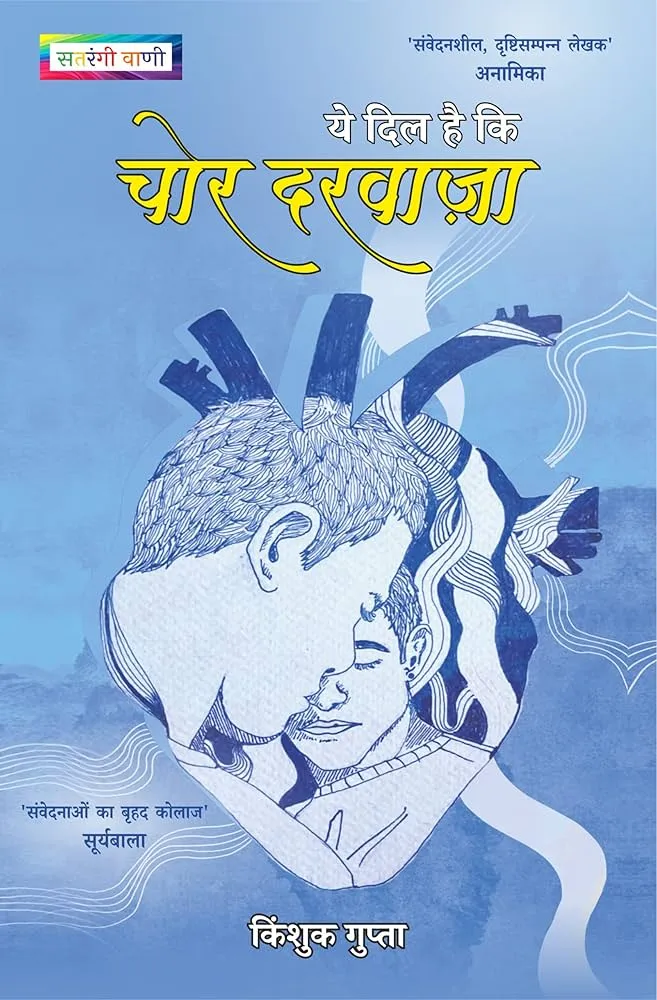
The text interrogates insidious violence within familial and intimate relationships, revealing how societal norms and moral apathy define human suffering, especially for queer individuals.
Editor’s Comment. A collection of compelling short stories that pushes us to reflect on the limits of empathy and human suffering.
As I read through Ye Dil Hai ki Chor Darwaza, I was inexplicably reminded of Albert Camus’ The Plague (1947). No work of fiction matches Camus’ masterpiece in its depiction of sheer horror, helplessness and inhumanity. The Plague turns an afflicted town into a terror pit from where there is no escape. No one is allowed to leave. Anyone who tries to, is shot. Everyone knows he is doomed to get the disease, suffer unspeakable agony, contaminate others and die. There is no escape. And yet, and yet, a day comes when people come forward to help the victims, the plague outlives itself and a new normalcy or version of humanity returns. Finally! there is redemption. That is what makes The Plague, one of the most horrifying yet optimistic literary works.
Of course Ye Dil Hai… does not have the magnificence of The Plague. In no way does it present a vast panorama of horror and suffering and violence. Why was I then reminded of it? Inexplicably true, that’s what I said, yet nothing, however absurd is beyond explanation of the sub conscious.
It was because somewhere, though on a much smaller scale, it mapped the contours of violence in totally unexpected quarters. In fact if you are too maudlin to bear disquieting shades of violence, I would advise you to avoid reading Ye Dil Hai…. But if you recognize, and are ready to accept that not only is violence an inescapable part of the human psyche, but also that it expresses itself in ways which go beyond the merely physical, mental and emotional, thus manifesting in various overt and covert dimensions; that it can raise its ugly head in an unimaginable manner in contexts bound to shake your belief in humanity or goodness in any form, then most certainly go ahead and read it!
It might just make you a better person.
Be it parents and siblings dealing with a child patient of leukaemia or a father needing a kidney, in this book, they are equally despicable. The letter i.e. old father, believes it is his right to demand a kidney from his offspring as a filial duty. The way he runs down his somewhat average son who wants to write fiction, for not being super-brilliant, makes him (the father) inhuman in a way that you lose all sympathy for him or his wife. Strangely the wife sides with the husband all the way. Any fool knows that kidney donation is much more incapacitating for the donor than the receiver. So what if an aged man dies at a less ripe age. Why disable young men and women to give him a few more years! It is Yayati and Puru from the Mahabharata all over again. Or Devavrata giving up kingship and family and remaining a brahmachari, for the sake of his old father satisfying his lust for a young women. Youth sacrificed to feed the lust of the old is part of our tradition.
In Ye Dil hai…, most characters are devoid of compassion or understanding.
But there is one who compensates for all others. Amma, in Hamare Hisse ke Aadhe Adhure Chaand [Our share of an incomplete moon], is a paid attendant who comes to look after a child, suffering from leukaemia. She treats him as a ‘normal’ child, who will recover from his illness one day and be whole and healthy. She does chant the maha mrityunjaya mantra and makes him chant it too but in a way that it becomes a game. He loves her and what’s more, can feel and bask in her love, while his family treats him like a burden. Compassion can’t be bought or paid for. It’s given gratis. Like love or God’s benediction. I think this is the best story in the collection for the depth of understanding displayed for the child protagonist. Despite the callous attitude of the brother and mother, it evokes empathy in us, at least the mother does. The brother’s extreme harshness towards the hapless brother, I think, goes a little farther than necessary.
The first story Machhli Ke Kante [Fish bones] is equally evocative.
Actually when the author is dealing with characters who are neither homosexual, nor violent, he seems a little out of his depth and becomes repetitive. That is one tendency he should avoid in his future stories. Brevity is certainly something to be cultivated towards making stories more effective. The last story Bolo Jai, Jai Prabhu Dev ki was the most difficult to get past, compared to Machhli Ke Kante, which is a breath of fresh air
For the rest, men and women are equally devoid of making a sacrifice in these stories. Love goes awry, betrayal is rampant. There is no redemption on the grand scale of The Plague, to compensate for the violence that permeates each relationship. But it’s not wholly absent. Some of the stories do end with a partial attempt at reconciliation and human redemption.
For example in the story, Rahasyon ke Khurdare Pathaar, a girl is tormented, cast aside and abused by the family for being a lesbian. When the brutal father lies dying, she’s expected to give up her share of property to save her brother from penury; a brother who had mocked and cast her aside, not bothering even to condole her son’s death. In the end, she ties a rakhi to the brother. Glory be! Turns out he had always missed the rakhi festival.
So the family is reunited briefly. But this is no redemption. One does not feel an iota of sorrow for the dying, handicapped father or the indifferent brother. The mother is different. A victim herself, she had tried to stand by her daughter. It’s the Bhabhi [elder brother’s wife] who steals the show. Though her effort in uniting brother and sister is purely selfish, she does fulfil the role of a bridge. A bridge is a bridge, however wobbly the structure.
An added feature of this collection of stories is that most of them deal with homosexual propensities and the calumny heaped by society on them. Not only calumny but active persecution. In the same story, the lesbian friend Shalini, a revered social worker of long standing is suddenly declared persona non grata as soon as she is proven to be a lesbian.
Though we must be reminded that as far as the vagaries of personal relationship go, homosexual/queer relations are no different than heterosexual ones. What makes life unbearable for the former is the societal contempt and inequitable laws. So ultimately we can say that even though Kinshuk concentrates on queer relationships, what stays with us are not the thieving hearts but the violent gateways to each of the relationships, irrespective of the sexuality they pivot on.