
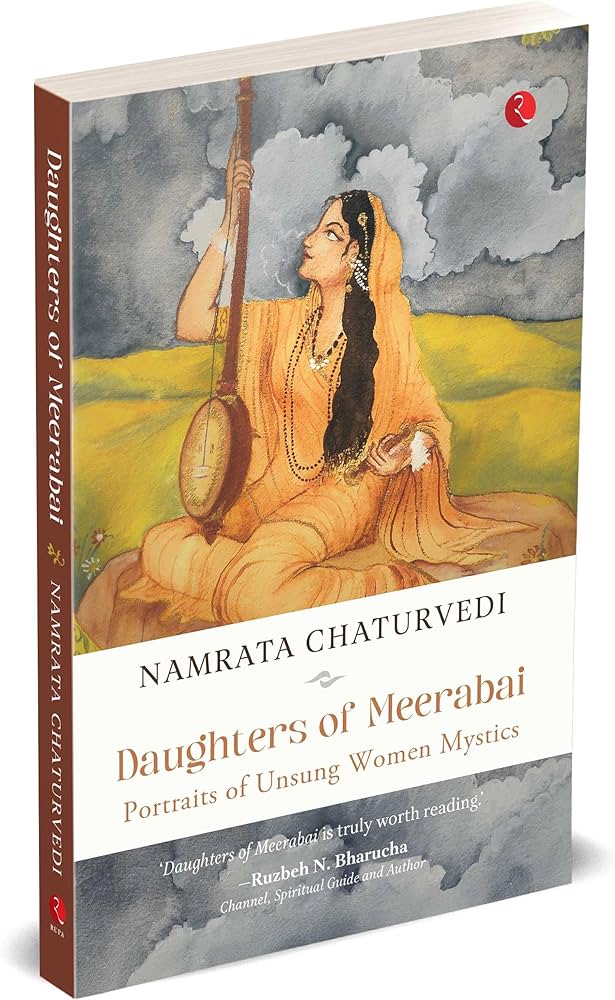
At first glance, Daughters of Meerabai situates itself within the devotional genealogy of the Bhakti movement. But on a closer look, the book firmly resists being reduced to a purely spiritual narrative. Page by page, this deeply researched archive of female devotion carves an intellectual task and asks why so many of its female voices remain peripheral in literary and academic discourse. By the end what emerges is not simply a tribute to Meerabai and the lineage of Bhaktas in the country but an attempt to trace a dispersed lineage of women whose spiritual lives reconfigured the idea of devotion itself.
The book begins with a deeply personal preface that frames the project beyond simple scholarship of researching and threading a string of female devotion. The simple assertion of devotion as a form of spiritual inheritance unfolds slowly with every chapter. Chaturvedi describes how a moment of personal loss initiated the journey into Meerabai’s world:
In 2018, when spiritual darkness gathered with the physical passing of my father, my search for light began.
This confession sets the tone for the book’s central argument—devotion is not merely historical or theological; it is experiential and transmissible across time. The Preface also articulates a crucial philosophical insight drawn from Meerabai’s life. Chaturvedi’s observation that Meerabai’s love for Krishna without ever having “seen him with her physical eyes” and yet embodied a devotion that transcended material perception is well established in the chapters. This leads to one of the most striking reflections in the opening pages: “Love doesn’t beg images, objects or sensations. It is a self-fulfilling force, and it only knows how to expand.” This formulation is central to the book’s interpretive framework. Devotion then, becomes far more than a simple emotional attachment to the Divine. It thickens to form a consciousness. This becomes the philosophical core of the book that is also the crux of the Bhakti Movement in India (personal devotion often dissolved rigid distinctions between devotee and deity, and between social identity and spiritual identity).
One of the book’s most compelling contributions is its insistence that the Bhakti tradition contains an under-acknowledged network of women mystics. The author suggests that beyond the widely celebrated figures of devotional literature lie many “soul sisters—saints, bhaktas, seekers, healers and yoginis who had walked unnoticed and unknown to many.” This also gestures towards a major historiographical problem: the systematic under-documentation of women within India’s spiritual traditions. The Bhakti movement, which flourished across the subcontinent between the 12th and 17th centuries, produced numerous vernacular poets who challenged caste hierarchies and ritual orthodoxy. Yet even within this egalitarian tradition, literary history has often privileged male voices. By framing the book around the metaphor of “daughters”, the author constructs a symbolic genealogy. These daughters are not literal descendants of Meerabai but inheritors of her spiritual defiance.
A particular nuanced aspect of the book is how it handles the question of feminism. Instead of imposing modern ideological frameworks onto historical mystics, the author situates female devotion within the broader social disruptions of the Bhakti Movement. Bhakti poetry historically undermined the authority of ritual hierarchy by privileging personal experience of the divine. For women, this offered a radical opening. Meerabai herself exemplified this defiance. Her refusal to conform to royal expectations and her insistence on addressing Krishna as her true beloved transformed mere devotion into an act of resistance. When the love for the divine expands beyond the self, it ceases to belong exclusively to any social category. Devotion becomes a universal human impulse. This duality is one of the book’s most sophisticated insights. Bhakti is feminist because it creates room for women’s voices, but it is also gender-neutral because the experience of divine love transcends identity altogether.
Meerabai, Sahajobai, Anjana Devi and Vandana Mataji, to name a few, assert the broader Bhakti aesthetic in a poetic language that is both illuminating and consuming. The lives and devotional trajectories of Bhuribai and Anjana Devi propose that many women saints remain unrecorded not because they did not exist, but because their stories circulated primarily through oral traditions and spiritual communities. Therefore, this book becomes an act of recovery. By bringing together narratives of women seekers, Chaturvedi reconstructs a lineage that has survived outside formal literary institutions. And this approach mirrors the original spirit of the Bhakti movement itself.
These women mystics are framed within a constellation of “soul sisters” who had walked unnoticed. Through Anjana Devi’s inward contemplative practice, Sahajobai’s philosophically refined bhakti rooted in the Sant tradition, Bhuribai’s lived devotion emerging from everyday spiritual labour and Vandana Mataji’s contemporary articulation of surrender, the book demonstrates how the grammar of devotion evolves powerfully without losing its essence. Sahajobai, in particular, embodies the intellectual depth of Bhakti, reminding readers that devotion was never anti-philosophical but often a sophisticated spiritual inquiry expressed through simple language. Bhuribai and Vandana Mataji, on the other hand, unpack how bhakti survives outside textual institutions, sustained through lived practice rather than literary recognition. By placing these figures alongside Meerabai, the book subtly argues that Bhakti’s most radical gesture was its openness: anyone could enter and experience spiritualism through love. In this sense, the presence of these women reinforces the book’s larger claim that devotion simultaneously creates a powerful feminist space while dissolving gender altogether — echoing the preface’s assertion that divine love ultimately becomes an experience “in which all participate.”
In the end, Daughters of Meerabai gently reexamines the spiritual landscape of Indian history and reveals how many women participated in shaping it. The author does not claim to replicate the women mystics’ experience; instead, Chaturvedi borrows a little from everybody’s fire to illuminate contemporary consciousness. Devotion, like fire, spreads through contact. Each generation carries a spark forward. Chaturvedi, towards the end, discusses how mediumship and channels helped her connect to the alternate universe of souls and this discovery led to devotion becoming her center of a larger spiritual sisterhood. The result is a work in our hands—it is deeply reflective, historical and revolutionary. Daughters of Meerabai reminds us that the Bhakti movement was never merely a religious phenomenon. It is always about reimagining who has the authority to love the divine and Chaturvedi’s craft passes that baton to us.