
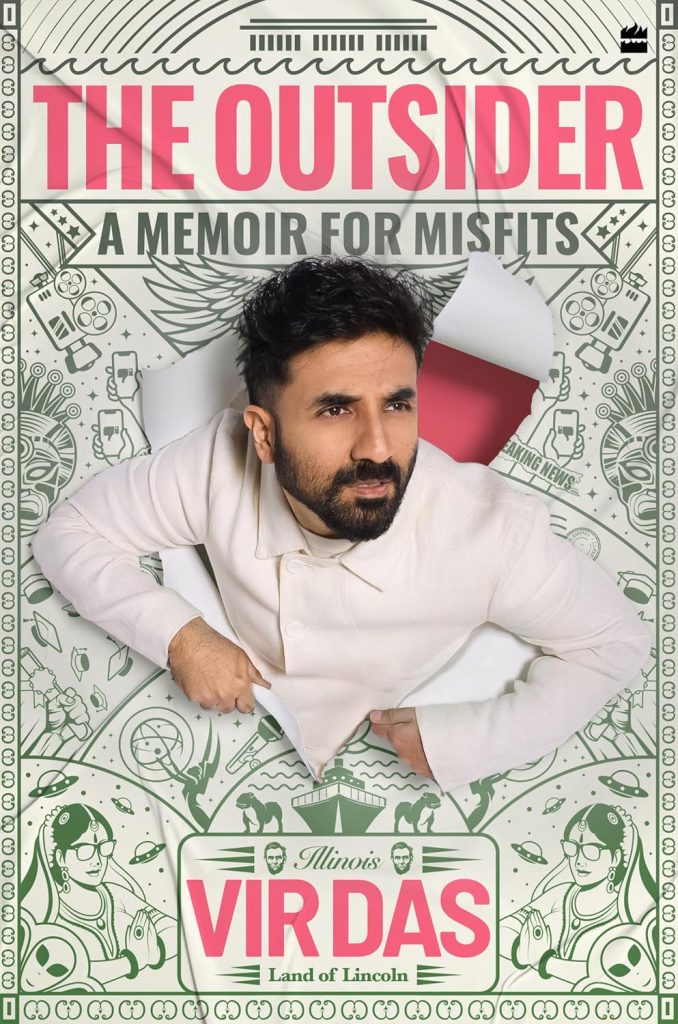
I picked Vir Das’s The Outsider: A Memoir for Misfits carrying two very different preoccupations: I had just finished reading Siddharth Dhanvant Shanghavi’s Loss and had been occasionally revisiting Mikhail Bakhtin’s (a Russian philosopher) idea of the carnivalesque for an academic paper in progress. And I did not expect either to accompany me into Das’s memoir.
A refreshing read about a life repeatedly lived by stepping outside the frame, The Outsider refuses to behave like a typical memoir. In the opening chapter, Vir unpacks a peculiar philosophy and that metaphor comes full circle when the last page is turned: the ship is always leaving and either you run after it or make something of the shore. What makes this book particularly enjoyable is the way Das refuses to turn this emotional/physical state of exile into a solemn identity crisis. He exaggerates and then undercuts himself. Vir walks us through embarrassing things, admits to spectacular failures and lets the comedian remain in the prose without allowing the comedian to swallow the person that he is.
There is a very useful way of reading Das through Mikhail Bakhtin’s idea of the carnivalesque is what I realised. Bakhtin’s carnival was a world temporarily turned upside down; this world is unstable; the respectable gentries are mocked; the fools speak with impunity; and the boundaries between the elevated and the ordinary become delightfully porous. In Bakhtin’s world, it is more than just being funny. It is about using humour, parody, irreverence and inversion to question authority and accepted ways of seeing the world. In this world, the fool can tell the truth that respectable people cannot. This is also where grotesque realism emerges. The use of vulgarity in terms of language or ideas or delivering humour on stage in the book, challenges the authority of the privileged life. As Das purports in The Outsider, the conventional Indian success story has been assigned its own hierarchy over the years—a script which has been carved in stone since decades. Study hard. Behave SENSIBLY. Make the family proud. Acquire the right qualifications. BEHAVE sensibly. Climb up the ladder a little higher than your lineage. Das sets fire to these pre-cooked rules right at the age of 9. His magnanimity and his striking ability to acknowledge the sheer scale of what he has managed to build without pretending that success makes him infallible is the bait of the book. So, in short, Das imbibes the true carnivalesque by laughing at the grand narrative. He is also the Fool in King Lear, who speaks truths to the king that others cannot safely articulate, and in return faces the music of malarkey and backlash
Extremely self-aware, The Outsider is written in a language that is far less prosaic, but the ridiculousness of the language is a gift of generosity towards the reader. Vir does not ask us to admire him from a pedestal; he invites us to sit beside him next to the pier in Mexico and listen to the history of foolery that we may all have encountered in varied degrees and versions. The fool is usually socially inconvenient but this physical, social and emotional inconvenience brings out the courage in us to accept our failures more boisterously. As readers, we learn a lot from his placelessness: his physical, social and emotional exile frames a kind of “acceptability” of non-conventional standards of leading life or finding a personal learning curve. In hindsight, the “outsider” notices things the insider has stopped observing. Belonging for Vir is not geographical or geo-political anymore, it is more vocational and largely emotional. His hamartia is his ability to “go all in” no matter what. Once an inch of his cloth catches fire, he follows the flames like fireflies in molasses. Such a kind of appetite makes his failures more intimate, because he has wagered himself on the choices he makes. This flaw cannot really be corrected. If anything, Das seems to understand and be highly aware of this total commitment to moving the engine without an exit strategy on the face of a failure. This “go big” strategy becomes the peculiar logic of Das; this “go big” is also interestingly the strategy that many misfits in the country follow blatantly. However, this conviction may not always be a guarantee of success and may make one look foolish without retreating and that, perhaps, is where the fool becomes formidable.
The thirteen chapters in this book test this bargain further by refusing the economy of respectability and this archery dismantles the traditional equations of the Indian way of life with efficacy. Successes and milestones are unpacked as possibilities, and this unearths a kind of selfhood that perhaps all should imbibe. These chapters crack open thirteen perspectives that Das approached to live his life. And each perspective modified the previous one without providing any life-altering lessons. The simultaneous self-reflection on who was I when that happened is the mitochondria of the book. These chapters form the different versions of ambitions, embarrassments, losses and reinventions: almost like a rubik’s cube—turn the object slightly and an entirely new face appears.
The last few pages are the ones that will be the most difficult to cross. Constantly reminded of Shanghavi’s Loss, I placed Vir’s grief around Mr Watson as a devastating absence. Loss, in both the books, changes the dimensions of the world. Even though the latter’s book is not specifically about death, but grief haunts the broader question of what it means to lose a version of one’s life. There are forms and degrees of bereavement that do not involve funerals. Covid was one such phase. And the power of Mr Watson’s memory stays long after the last page is turned, and this is also where the tonal difference in the book is striking. As a reader, I see the shift in Das’s lived reality. We stand closer to Das’s difficult things almost as if we are breathing in the same room and this is where Vir Das shines the brightest inheriting his grandfather’s gift of storytelling. He lets the facts of his life, breathe inside the story. The memoir, therefore, becomes more accessible rather than being simplistic. And that is an important difference. The tenderness in the last chapter is enormous. His perceived arrogance is punctured continually by self-reflection and awareness. And this is the closest he gets to being truly Bakhtian. He allows the fool in him to remain a fool even after the fool has tasted success. But his success will not erase the misfit in him.
The author’s placelessness becomes his vantage point each time. And by making us watch the show unfold as outsiders ourselves, we too can see the absurdity of the rules. And there is a strange exhilaration in continuing to watch.