
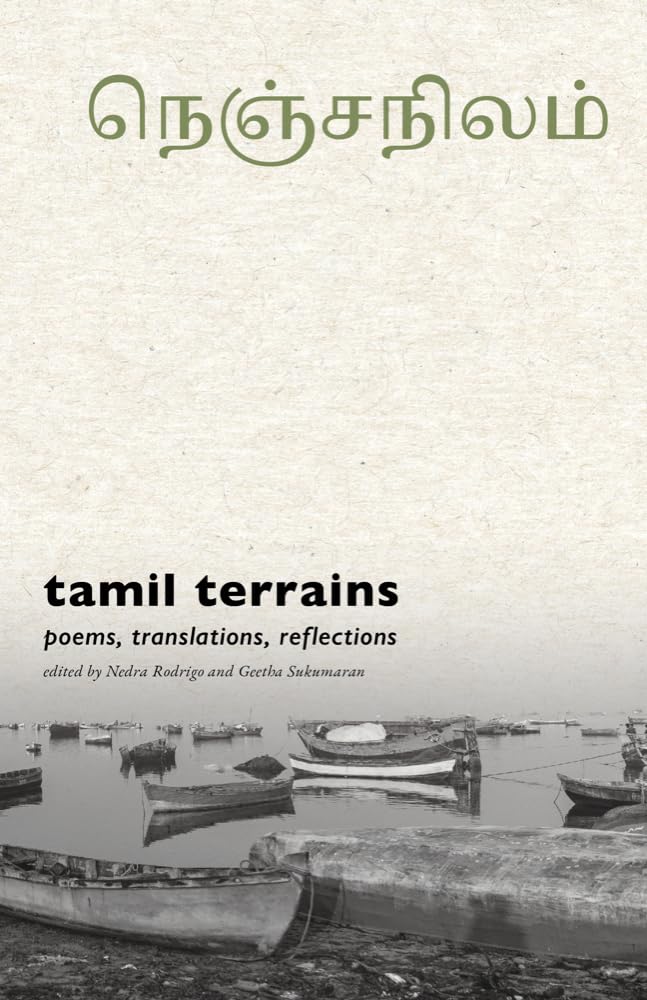
Like any other translator or a reader, I read translations all the time, but of all the explicative texts, it is always fascinating and troubling to realise that only a piece of translated work has to fend off pernicious questions of whether or not it is ethical. If it were an artist interpreting a piece of art or music, the act would be quite possible. tamil terrains is a spirited, decisive, and a precise anthology that pulls the right strings in the language to create an intellectually ambitious book that will inspire a generation of readers, inquirers and scholars. As a reviewer, it is tempting to describe it simplistically as a collection of Tamil poems translated into English by a diverse group of writers spread across India, Sri Lanka, Malaysia and Canada but such an endeavour doesn’t take root within a workshop, always. This anthology becomes an act of recording linguistic transfers, journeys of translators and reflecting on the need to translate. Such an endeavour, therefore, becomes inheritance, remembrance, ecological recovery, feminist conversation, and above all, a shared practice of dwelling.
From the opening pages, tamil terrains dismantles one of the oldest assumptions in translation studies – that there exists somewhere an “ideal” translation waiting to be discovered. This anthology cracks open such a notion right at the start by arriving at the language through different roots and different landscapes. The editors, Nedra Rodrigo and Geetha Sukumaran, refuse the colonial expectation that translation should refuse the pursuit of transparent fidelity. Their biographies, migrations, political inheritances, dialects and emotional geographies become a part of the translated poem itself, and this editorial decision was a reasonable one, for it transformed the anthology from a repository of translations into a living archive of relationships. In many ways, tamil terrains performs what Lawrence Venuti has long argued translators should do: make visible the labour of translation. The book shows that translators are co-thinkers. Their reflections are not appended as explanatory notes and function more as companion essays, documenting moments of hesitation, disagreement, emotional inheritance and political responsibility. Therefore, translation, like any other literature, will be an ongoing conversation on indigenous sovereignty rather than a ceremonial finished piece of art.
What responsibilities do displaced people bear once they themselves become settlers? Shalan Joudry’s “Another Poverty” indicts settler colonialism through deceptively simple diction:
we pick your berries for dessert
dam your rivers
catch your fish for fun and throw them back wounded
my neighbour has left you poisoned traps
while you wonder why your children die… (p.2—5)
Retaining the poem’s historical location allows Tamil readers to recognise unsettling parallels with their own histories of dispossession. Similarly, Leanne Betasamosake Simpson’s poems retain Nishnaabemowin terms such as ogichidaakwe, ziigwan and baapase rather than replacing them with Tamil equivalents. I consider this to be a profoundly ethical decision. Antoine Berman argued that translation should preserve the foreignness as not an obstacle to comprehension but an invitation to humility. Thus, for the translator, the question “how do we translate Tamil” is less of a concern. Every translator in the anthology, engages with the question “how do we translate responsibly?”. And this prepares the reader for everything that follows. By the time the anthology reaches Sangam poetry, translations become increasingly attentive to land, memory, migration, caste and historical violence. This ethical framing also allows the book to hold Indian Tamil and Sri Lankan Tamil experiences together without destroying, disturbing or overpowering the political scars. Tamil, then, emerges as a language that is neither frozen in Sangam antiquity nor reduced to contemporary identity politics. We, as readers, experience the language across coastlines, plantations, refugee camps, classrooms, kitchens, palmyras and memories. Such a reading maybe deceptive to the traditionalists but one cannot ignore how this informs and alters the reader’s relationship with translation. The independent and personal response to translation informs the act of translation and this is perhaps, the book’s defining moment.
Avvaiyar’s “What the Heroine Said” is a brief but emotionally expansive lyric situated within the Palai landscape of separation. The English translations capture the poesy entirely through the landscape and the desolate terrain performs the emotional labour of the poem rightfully.
Raging winds howl to the vakai trees as their pods tremble in fear.
The land cloaked with countless peaks
yet not an ounce of soul. (p.21, trans, Gobida Nada)
In your absence,
I will hold up this roof and four walls.
I will cup my hands around my tears,
and years for your hands over mine.
I will be your pillar,
so long as you stay
my answered prayer. (p.22, transcreated, Enbah Nilah)
Gobiga Nada’s translation here, resists the temptation to unpack the emotional heft for the readers who are particularly unfamiliar with thinai. She trusts imagery to perform its original function and the indirect pain in the poem surfaces beautifully in the devastating conclusion:
It was this cold grim path that he,
the ruler of my heart, chose
over lying in my tender loving embrace.
I could easily recall A K Ramanujan’s finest translations of Sangam poetry, where silence is a semantic rather than a stylistic device. Yet, Gobiga’s version is slightly different as she retains an angularity that reminds readers these metaphors emerge from another literary ecology. Instead of substituting a botanical equivalent familiar to English readers, she allows the Tamil landscape to remain intact and such ethical foreignisation is crucial to understanding the perils of exoticisation. Enbah Nilah’s transcreation, next appear startingly different. Her toil in translating the emotional labour into a contemporary domestic vocabulary is immediately recognisable to present-day readers. And even more compelling is Enbah’s accompanying reflection on this poem. She explains that she deliberately sought to restore the heroine’s agency because she read the original not as passive longing but with disciplined resilience. Moving forward, the most faithful voice among the contributors belongs to V. Iswarya. She rightfully states the central difficulty that Sangam translators face: much of the poetry depends upon shared cultural knowledge unavailable to contemporary English readers. The image of slipping bangles, a conventional Sangam marker of physical wasting through love, is retained rather than modernised. She beautifully plays with the lyric preserving its compression.
Mid way into the book, there is another pattern that begins to unpack. Many contributors are themselves negotiating multiple linguistic homes. And the notes alongside the poems emboss a cultural orientation. The sea that separates lovers in Neythal also separates continents and the Palai landscape of absence echoes migration. The slipping bangles, then, also invoke a historical rupture and a displacement and in these moments, it slowly dawns on the readers how Sangam speaks to modern diaspora without erasing the roots.
The next set of poems steadily moves away from these classical landscapes of thinai to present altered forms of terrains. For instance, the seashore becomes a refugee crossing, the forest becomes contested indigenous territory, the desert becomes a space of exile and the fertile field symbolises the site of labour and dispossession. In hindsight, not only tamil terrains refuses to treat translation as politically neutral, but the act of choosing what histories survive form the organic epidermis of the book. In this sense, tamil terrains recalls Bassnett’s argument that translation always participates in cultural rewriting, and this anthology does much more: it rewrites historical relationships between communities separated by oceans, borders and political violence, uncovering a social texture that the reader cannot escape.
Sukirtharani, a Dalit Tamil poet, foregrounds Dalit women experiences through a corporeal and often unsettling poetics. And translating oppression is not an easy feat. A smooth translation risks domesticating language and oppression but the three presented translations are exemplary in this regard. Preserving the Tamil syntactic energy, the translator’s poems resist immediate comprehension, but this resistance is productive. The reader is required to travel along with the poem, and it is quite a remarkable achievement.
Women translators have historically occupied an ambiguous position within literary hierarchies; it is mostly considered derivative, secondary or invisible but tamil terrains overturns the hierarchy by remaining fully present without dominating their works. By translating labour songs, folk traditions, and orally transmitted forms, this anthology asserts important questions silently:
Whose language deserves preservation?
Whose songs become literature?
Whose histories remain untranslated?
Between India and Sri Lanka, Tamil histories coexist and tamil terrains acknowledges that these histories share a language despite carrying profoundly different political memories. The language that has a literary continuity stretching back over two millennia, this editorial vision is not accidental; and this makes us reimagine how powerful translation itself can be to hold lands together.