
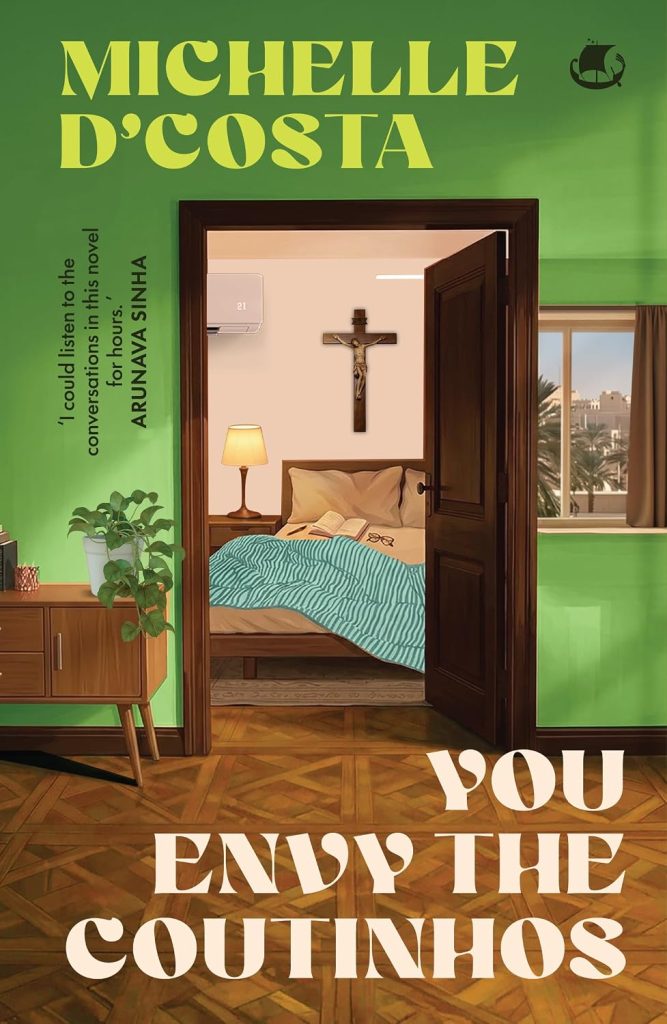
JR: Before your debut novel, you have written a number of short stories, which have been published in various publications. Your collection of poetry was also published prior to this novel. At what point did you feel you were ready for a novel?
MD: I always wanted to write one and I had written and abandoned many drafts over the years but nothing seemed to work out. I was also very impatient. Some of the ideas were just concepts and didn’t have enough meat for a novel. I improvised the way I wrote as well. I moved from being a pantser to a plotter. For You Envy the Coutinhos I had a rough idea of where I wanted the story to go and what each chapter would look like. Having a structure to follow really helped. But it wasn’t just the structure. I felt this idea had weight. Does that make sense? The other had felt feather-light. That’s how I knew this was worth pursuing.
JR: The opening is very gripping and sinister. How did the opening scene and the first lines of the book arrive? Were you clear that you wanted to open with something related to death?
MD: No, it wasn’t intentional. Any creative ambition needs support. Be it acting or writing. As it’s not a traditional 9-5. There’s struggle before you make it. And there’s no often no guarantee that you will make it. I think pursuing a creative career as writing has opened my eyes to how privileged I have been to be able to write and fail and bring myself up because of the support of my parents. It’s not easy to pursue your creative dreams without emotional, moral and financial support.
They worked very hard as migrants to give me the life I have today and I’m very grateful for that. I wanted to show Joachim’s helplessness at having to deal with an alcoholic father who has debt. I felt that India had to be a place of a love-hate relationship for him. Hate because of responsibility but love because of Bollywood. This push and pull must have made me start out with a scene where Joachim is frustrated and wishes he had some control over his circumstances.
JR: Before we talk about migration as the larger theme of the novel, I wanted to talk about family. You explore so many different family relationships: father and son, mother and daughter, mother-in-law and daughter-in-law, sisters-in-law and cousins. What drew you to explore so many different family relationships in the novel?
MD: I have always been drawn to family dramas. Who doesn’t enjoy drama? I’m guessing we all do. Probably, when we are not involved in it. I wanted the world of the Coutinhos to have conflict, and friction. Indian families are complicated. Like they say, you don’t just marry a man, you marry his family. And I wanted this to be a strong presence in the book. And some kind readers have reached out to me about it, that the drama is what they are enjoying the most. These parts are what they find most relatable.
JR: All your characters draw sympathy as much as hate. You don’t really give us heroes or villains. Was it important to you to resist making anyone entirely good or bad?
MD: I didn’t think of any of the characters as inherently good or bad. I just presented them as flawed humans, complex humans. People with difficult emotions, and circumstances. And if that’s how it has come across to readers too, then it’s great, but good or bad can be very subjective so it’s upto the readers to decide for themselves.
JR: One striking part of the novel is that most of the novel is told in the third person, but the character of Darrel is addressed as “you”. Why did you choose to tell his story that way?
MD: The novel started out with the idea that ‘someone’ is looking at the Coutinhos from far and envying them. Could it be a neighbour? Or a friend? Or a relative? I settled on a nephew because I wanted to show that despite being so closely related, we can have distorted versions of people. I wanted the second person narration to be immersive and let the reader get lost in Darrel’s point of view. And see the Coutinhos, like he sees them, as ‘others’, as something he might never be. Hence, third person. I’m happy that readers are picking up on this nuance. My initial draft was written entirely in second person narration because I’ve enjoyed writing short stories using that point of view but I had to look at the novel objectively and take hard decisions. Hope it has worked.
JR: Migration as more than physical movement — identity, belonging, dignity, family, and living at the mercy of another country. What were you trying to explore through it?
MD: I have been a migrant for most of my life. I was a second generation migrant in the Gulf and these are issues I personally grappled with. As I grew up I became curious about this, was it just me? How were other South Asian families dealing with this? How are the blue collar workers dealing with this without seeing their family for years?
And I found that none of the books I read explored this phenomena. Most migration stories are set in the US and the UK. While these stories did leave a mark on me or made me feel seen in a way- want to mention a brilliant book of short stories-Nishanth Injam’s Best Possible Experience- I felt like stories about the Gulf diaspora were missing.
JR: There are moments when the migrants are treated as though they are disposable. Yet I also felt that there was a refrain from making it too sentimental. How conscious were you of keeping the story from becoming didactic?
MD: I wrote it with restraint to show that sometimes there is no time or space to cope with difficult or mixed feelings as a migrant. You got to put on a brave face and live, there is no other option. You can’t take sick days, go for therapy or mope about it. I wanted to show the almost machine like living that’s expected from most South Asian migrants.
JR: There is also a myth of Gulf fantasy among people in India. Do you think there was an attempt on your part to break that myth of the Gulf dream?
MD: Yes, the idea stemmed from that. The ‘envy’ is because a lot of people think that families in the Gulf are happy and have money. I wanted to show how complicated lives can be, that it’s not as simple as it seems, not as glorified as it seems. Kind of like social media these days, feeds are curated and filtered to show what people want to show others about their lives, but is that the truth? For most of my life, I was looked at from the lens of the ‘Gulf NRI’ girl, and this made me uncomfortable. I wanted to explore the human side to the ‘Gulf NRI’. Yes, it has its privileges no doubt. But it also has its struggles.
JR: “Bombay is Bollywood. Bollywood is Bombay” — you write in the novel. Tell us about your fascination with Bollywood and why you decided to make it a significant part of the novel?
MD: Bollywood was a big part of my childhood. Every Wednesday, on Channel 55, they aired Bollywood movies. I would curl up on the couch and watch these with my parents. I studied Hindi in school (CBSE) and fell in love with the language. We used to watch movies in the theatre in Awal Cinema. I never felt like I was away from India. Even the Arabs love Bollywood. So it felt like the most natural thing to explore in my novel.
JR: The novel moves from 1979 to 2018 and covers a three generations, countries and relationships, yet it never feels like you’re trying to write a grand historical and family saga. How did you decide what to leave out?
MD: I was very conscious of the word count and pace of the book. I know our attention spans have deteriorated because of the way life is these days. I wanted to keep only the essential and most important scenes that showed the family dynamics but also propelled the story forward. It was difficult to cover so much in such a less word count.