
It is perhaps safe to say that within every superhero is contained an entire society’s dreams and aspirations. No society is perfect, and superheroes fill an important niche in holding society to account, reflecting what an ideal society could look like. Setting aside extraterrestrial superheroes and looking only at earthly beings, a superhero can come from anywhere, and comic book history is rife with examples of ordinary mortals who became superheroes through sheer skill and willpower – one need only look at the popular Marvel comics to note Hawkeye (Clint Barton) and Black Widow (Natasha Romanoff) as examples. However, look at comic book history long enough, and a pattern becomes evident. Cisgender, heterosexual, white men have long dominated superhero mythology and public imagination. In fact, looking at American comics, the earliest recognised female superhero, Fantomah, debuted only in 1940. In mainstream American comics, Black Panther (1966) is generally recognised as the first Black superhero, and Northstar, who debuted in 1979, could not be explicitly portrayed as gay for several years because of restrictions imposed by the Comics Code Authority, finally coming out in 1992. Looking at the intersection of these identities, America Chavez, a lesbian Latina superhero, first appeared only in 2011.
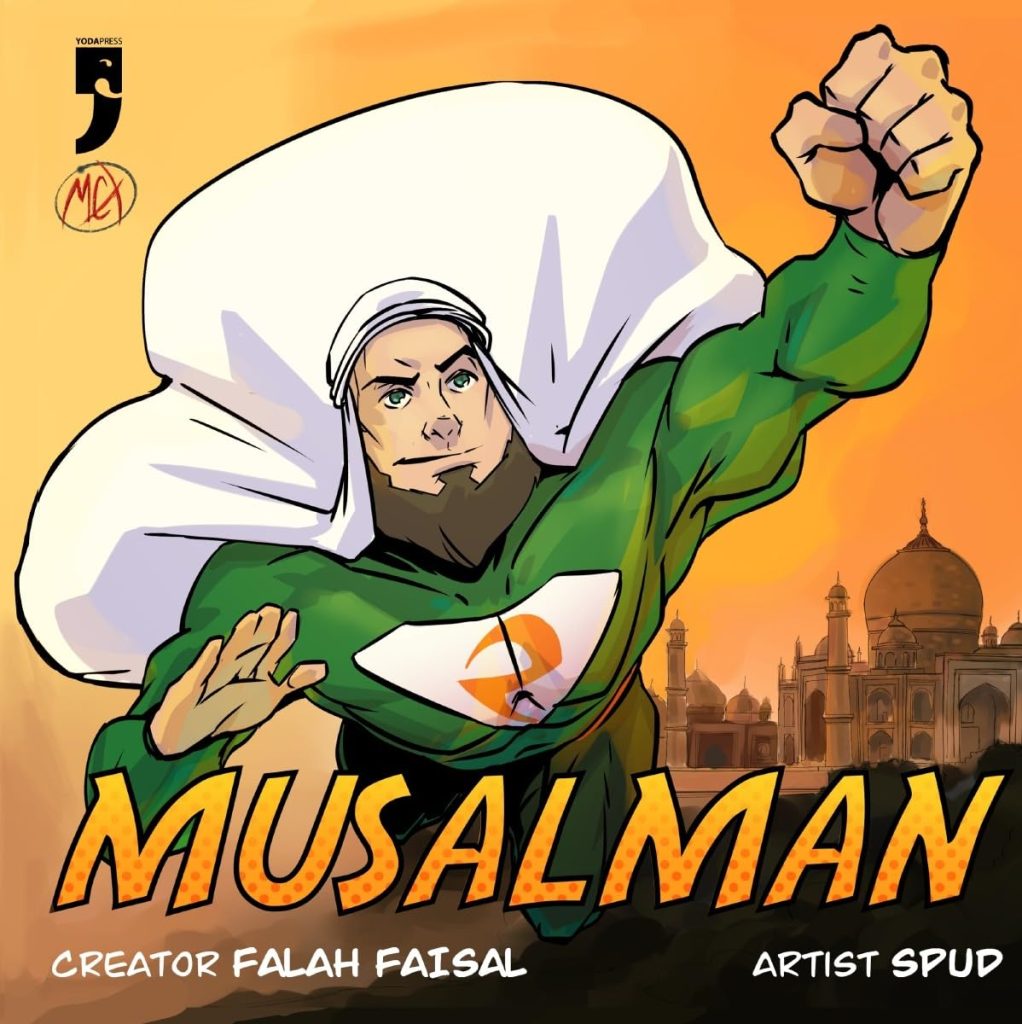
Which demographics get to be superheroes? That is the question at the heart of Falah Faisal’s ‘Musalman’, which dismantles traditional Indian superhero mythology and rebuilds it around someone who has historically been denied that role. Clad in a bodysuit with an Urdu م (‘meem’) emblem emblazoned across his chest and briefs worn over the bodysuit à la Superman, Musalman strikes an imposing figure. His distinctive skullcape, combining a skullcap with a cape and resembling a ghutrah (a draped scarf that frames the head and shoulders), completes the look. Sans mask or facial covering of any kind, he proudly sports a full beard. Faisal’s comic book is widely touted as being the first Indian comic to feature a Muslim protagonist, and the epilogue to Musalman recounts how Faisal has been consistently approached by fans who resonate with the character. However, Musalman’s complete costume, an ensemble of orange, white and green, places his Muslim identity within an unmistakably Indian visual vocabulary. The visual image of Musalman, clad in his superhero outfit, establishes familiar superhero iconography and creates an immediate sense of familiarity, before prompting the question of why Muslims have historically occupied the role of villains, suspects or background characters as opposed to superheroes. It is also worthwhile noting that Musalman does not carry armour or weapons of any sort. His is an identity cloaked in humour and satire, and the costume reflects that philosophy by remaining simple, colourful, and almost deliberately old-fashioned.
It is interesting to note here that when delving into the exclusion of certain demographics from traditional superhero mythology, the individual finally admitted into that mythology is a cisgender man. Although the Musalman-verse features strong female characters, such as Begum Badass (a burqa-clad martial artist whose husband was lynched, but who does not feature in this particular comic book), the central mythology belongs to Musalman. He is Muslim, a civilian, and is also recognisably Indian, but he is still male. Musalman disrupts a common superhero convention: the hero who emerges from wealth, status or inherited power. His civilian alter ego is gaining social visibility in the book, but he does not begin with any of these. Yet the mythology remains firmly masculine.
The book takes an episodic approach, piecing together seemingly fragmented incidents which gradually coalesce into an overarching story. Beginning with the COVID-19 pandemic, we slowly learn about Musalman’s origins, and his celebrated civilian alter ego. A couple of panels where both Musalman and his alter ego glare out from the pages in a similar fashion make abundantly clear to the readers what is not apparent to the characters in the comic. Starwoman also appears, complementing Musalman and playing a crucial role in helping him vanquish a great foe later in the story. Throughout, Faisal employs motifs and pop-culture references which root the story in a distinctly Indian cultural context, while also using self-deprecating humour to highlight stereotypes associated with Islam. For instance, he mockingly states to a reporter that he was bitten by a radioactive goat, which led to him acquiring his powers. The episodic narrative also, to an extent, mirrors the media cycle; outrage today rarely unfolds as a coherent narrative, but rather as a succession of media spectacles.
Comics are particularly well suited to political satire because dialogue, imagery and page layout can all carry the joke. Perhaps Faisal’s most blatant satirical elements are the names of different characters, some of whom also serve as antagonists – Arnab Cowswamy, Joe Togun and Melon Husk, to name a few. Other elements are more subtle, such as Musalman journeying to the Rann of Kutch in Gujarat to discover his origins. Or the two halves of a locket, when united after several years apart, forming the image of Dr. B.R. Ambedkar, linking Musalman’s mythology to an older struggle over caste, citizenship and equality. Although Musalman occupies the physically powerful body traditionally associated with the superhero, he does not resolve conflict through violence. Humour lowers a reader’s defences by prompting laughter before introspection. Faisal used to be a stand-up comedian before becoming a graphic novelist, and his comedic timing is evident in the pacing of many scenes throughout the book.
The comic tackles several important societal themes, not least of which is the one about narrative ownership – who has the right to tell the story of Muslims? News channels? Politicians? Social media? Rather than resolving that question through realism, Faisal turns it into superhero satire. Another important one is the manufacture of public fear – Musalman’s adversaries are both flesh-and-blood humans and more nebulous concepts such as television outrage, rumours, misinformation, stereotypes, and fear. The machinery that transforms ordinary citizens into symbols of suspicion is invisible to most of us, and yet is a strong villain in Musalman’s narrative arc. The COVID-19 chapter revisits the media scapegoating surrounding the Tablighi Jamaat gathering through an absurdist lens, where Musalman solves the coronavirus crisis by attracting it to his costume and drawing it away into space.
Superheroes have historically largely represented national anxieties – Superman emerged during the Great Depression, Wonder Woman during World War II, Black Panther during the Civil Rights movement, and Ms. Marvel after 9/ 11, in a period of heightened scrutiny of Muslim identities. Although Musalman belongs to that lineage, the comic book’s defining historical moment is contemporary India, beset by debates around citizenship, media polarisation, and religious identity. This is also where some criticism of Musalman could arise – it implicitly assumes that readers will be familiar with the contemporary and historical personalities satirised in the book, and therefore may not have the same effect on readers who are unaware of these figures. Some episodes may also become harder for future readers to decode as their political references recede from public memory.
For all its dependence on topical references, Musalman succeeds because its politics rarely overwhelm its playfulness; the jokes are not a distraction from its argument but the means through which the argument becomes readable.
A superhero is, ultimately, a society imagining who is worth saving and who is capable of doing the saving. Musalman unsettles that imagination by placing an Indian Muslim man where Indian popular culture has too often placed the villain, the suspect or the silent bystander. His greatest weapon is neither violence nor technological power, but the ability to respond to hatred without becoming its mirror. Yet the book’s intervention is not complete. Even as Faisal expands the boundaries of who can occupy the superhero’s body, that body remains male, and the women around him, however formidable, orbit a mythology that is still fundamentally his. Perhaps this is where the book leaves its most useful question. If a Muslim man can be written into the centre of India’s superhero mythology, who else is still waiting at its edges? Musalman does not answer that question, but it makes it possible to ask.
References:
Marvel. (2017, March 3). Flashback Friday: America. Marvel. https://www.marvel.com/articles/comics/flashback-friday-america
Marvel. (2020, June 30). Revisiting Marvel Comics’ Pride History. Marvel. https://www.marvel.com/articles/comics/marvel-comics-pride-history
Marvel. (2014, February 28). Trace the Lineage of Marvel’s Black Super Heroes. Marvel. https://www.marvel.com/articles/comics/trace-the-lineage-of-marvel-s-black-super-heroes