
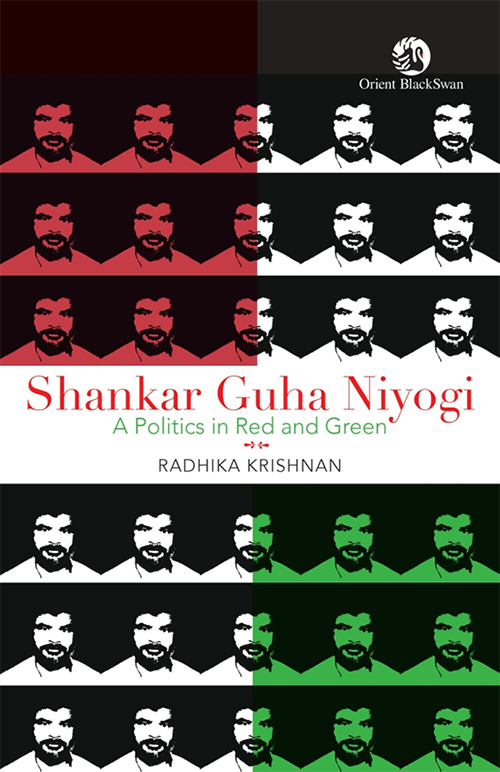
The red and green flag represented two workforces that were united under a trade unionism that looked beyond wages and worker benefits to encompass an ecological concern that was articulated in the face of a predominant development discourse prevailing in the 60s, and 70s in India. The red stood for the industrial work force of miners, the green, for the peasantry, Adivasi and forest-dwellers. And in this alliance of the miner-peasantry-Adivasi forged in the Chattisgarh region lay an attempt to comprehend and engage with their lives, realities, challenges, exploitations, health, safety, environment, nature, and their society in ways that would transform their lives. And at the helm of this alliance stood a towering figure, both figuratively and non-figuratively, of Shankar Guha Niyogi (1942-1991).
Murdered at the age of 49, Niyogi, born into a Bengali family, who relocated to Bhilai in search of a livelihood after a few years of college, led the life of a ‘shramputra’ or labourer of Chattisgarh and organized the local Adivasis, peasants and mine workers into a movement that demanded a right to a better life. His assassination masterminds, local industrialists, whose profit margins were undoubtedly affected by his vigilant trade unionism, remained at large. Niyogi’s trade unionism was markedly different and far-encompassing than the political party-backed trade unions of AITUC.
Radhika Krishnan’s Shankar Guha Niyogi: A Politics in Red and Green is possibly a timely reminder of what the fight for workers’ rights need to look like as trade union movements in India fizzle under the onslaught of unbridled crony capitalism. It tells us exactly how different Shankar’s trade union movement was under the aegis of the Chattisgarh Mukti Morcha (CMM) and Chattisgarh Mines Shramik Sangh (CMSS) where he organized the contractual work force of the Dalli Rajhada mines that supplied iron ore to the PSU behemoth Bhilai Steel Plant (BSP). The insatiable need for ore as BSP augmented its production to stratospheric levels, dubbed as the “temples of modern India” by Nehru, was met by the colony of local, Adivasi, unskilled labourers who were paid far less and were non-eligible for most of the benefits that their counterparts, the permanent migrant workforce, at the plant did. Yet it was them, the local peasants, Adivasis, landowners who contributed to the building of BSP, giving up their land, some relocating elsewhere, others who became workers in the plant and some others still who chose to be workers and farmers simultaneously. As the author writes, Bhilai is thus simultaneously a million stories of real people inexorably pushed into the vortex of industrial ‘development’.
Niyogi himself was a migrant, Krishnan points out. Relocating to Bhilai in 1961, he first worked in the coke ovens of the factory and organized a workers’ collective that was actively involved in workers’ struggle between 1962 and 1968. In the wake of the Naxalbari movement he joined the Communist Party of India (Marxist-Leninist) and got dismissed from the plant. This dismissal marked the beginning of his life-long engagement with Chattisgarh, as he travelled extensively in the area, labouring in the forests of Bastar, catching fish in Durg, working as an agricultural labourer in Keri Jungera village, grazing goats in Rajnandgaon … he also married a local Gondi girl, Asha, who was a fellow miner, thus internalizing the lives of the Adivasis, peasants and mine workers of the Durg-Bhilai belt.
Yet he did not believe in this local-outsider discourse as he propounded the concept of shramputra, those who laboured in Chattisgarh as opposed to the dominant notion of dhartiputra, who should benefit only by the virtue of being a local. Krishnan writes: The CMM … had serious issues with the ‘son of the soil’ formulations … and was involved in struggles against local industrialists.
CMM went beyond the traditional role of trade unions in seeking roti, kapda aur makaan (food, clothe and shelter) to engaging with every aspect of workers’ lives including campaigns against alcoholism, working for health and occupational safety, forming the CMM’s Shaheed Hospital funded by workers’ co-operative after an Adivasi woman died due to lack of medical facilities. But more importantly, the book highlights the CMM’s stand on development versus ecology debate and the unbridled adoption of technological innovations that were antithetical to the workers’ livelihood. In doing so, it grappled with issues like how can ecology be an ambit of trade unionism, and crucially does an engagement with ecology and environment betray the rights of the workers, as the need to protect water resources and prevent air pollution could directly threaten employment opportunities at the factory. From forest conservation to fighting industrial pollution to demanding appropriate technology that avoids large-scale retrenchment to seeking alternative livelihoods, CMM turned into a vanguard of workers’ movement.
The book carries reproductions of CMM’s posters depicting BSP as a killer giant, its Jan Shiksha poster, its forest policy poster. In an article Hamaara Paryavaran, Niyogi recounts how an Adivasi kisan came to the CMSS office asking for help as a forest department official had confiscated the timber collected by the people of his village. Niyogi thus brought to the fore the inherent class bias in the state’s forest policy whereby timber contractors, loggers and sawmill owners were not seen as destroying forests whereas Adivasis who use timber for subsistence were regarded as polluters or thieves.
Krishnan also recounts the CMM’s response to the Narmada Banchao Andolan and its opposition to the construction of large dams that primarily catered to the enormous demands of water of the BSP while displacing the Adivasis. It supported the construction of small dams, stop dams and borewalls and proposed that the large dams irrigate the farmlands too.
In the technology frontier, CMM clashed with rival trade unions as they contended with the mechanization of the mining process. Some of the mines in Dalli Rajhara were mechanized while most were manually operated. However, to keep the BSP’s furnaces going, it needed copious amounts of iron ore that human labour could not provide. The demand for mechanization grew as BSP increased its capacity from 2.5 million tonnes to 4 million tonnes in 1988. Over time and a careful study, CMM that employed IIT engineers and technologists, came up with a semi-mechanisation option that was a reordering of the industrial process that ensured greater labour participation. The CMM fought a protracted struggle to get this semi-automatic model implemented. The union argued that if technology was indeed to be appropriate, it required active and democratic participation of its users.
Culturally, the CMM helped forge the asmita of the Chattisgarhi people by invoking and reviving the legacy of Veer Narayan Singh, the leader of the peasant rebellion against the colonial rulers. At a time when the Chattisgarhi identity was being usurped by the elite malguzaars (feudal revenue collectors turned local industrialists and the rich), CMM by invoking the peasant leader, gave the Adivasis an icon to identify with. This was a rallying point too for the peasants and workers as the state of Chattisgarh was carved out of the larger state of Madhya Pradesh in 2000. The author distinguishes between the movements that led to the formation of Chattisgarh and that of Jharkhand and Uttarakhand underlining the lack of mass movement in the former while the two latter states came about after a prolonged agitation by its people. Chattisgarh was formed by carving out seven districts in the south-eastern part of Madhya Pradesh, arguably the largest state in terms of area in India, on account of logistic concerns of administration. The CMM supported the creation of Chattisgarh.
The CMM and CMSS were unions that worked 24×7, immersing in mass activity and reworking the form and substance of such activity that encompassed struggle for wages, housing benefits, formed knowledge of local forest and ecology, encouraged building of small dams, defended biodiversity, fought industrial pollution. Adivasis, peasants, and mine workers brought their concerns to the union office and soon it became apparent to Niyogi and his comrades that CMM would have to work round-the-clock to be with them in their fight for survival. The author exemplifies the CMM’s anti-liquor campaign where it tackled the problem of de-addiction rather than seeking bans on liquor shops or liquor production.
Finally, as the author rounds up her assessment of Niyogi’s legacy to say that ‘Remembering Niyogi has also been a process of forgetting’, we know that she has hit the right chord for how does Niyogi fall by the wayside in the discourses on ecology, development and technology. Today of all times, when we are hit with cataclysmic floods, earthquakes, soil erosion, heat wave, climate change that is driving migration, rendering the landless labourers without a soil to till, where mindless construction is playing havoc with the Himalayan ecology, where super huge dams are obliterating flood plains, changing course of rivers, we might just hit the pause button to look back at a trade unionist who had the temerity to stand in the way of not just local industrialists but also a public sector behemoth and stop them in their tracks to take stock of the damage they wrecked.
The book relies mostly on archival material including speeches, writings, pamphlets, newspaper clippings as well as extensive interviews with many of Niyogi’s comrades and fellow workers including Sudha Bhardwaj, Janaklal Thakur, Bhimrao Bagde, Ilina and Binayak Sen and many others.
The relevance of Niyogi is perhaps most apparent as Noida burned in April this year when largely non-unionized factory workers in electronics and garment manufacturing protested against low wages amid rising living costs.