
There is a peculiar intimacy to the way a film song stays in our minds. It is not the scene that leads to the song, nor is it about the actor that shines for those few minutes lip-syncing to the lyrics. It is largely about the voice itself. How the singer emotes the mood of the song, how they successfully let the singer feel the weight in the chest—it is that feeling that builds the intimacy between a song and the listener. Now imagine all of this with a female voice that has been etched into our minds as the default voice of the lone heroine’s thoughts. The face may differ, but the voice, it becomes an individual entity on its own.
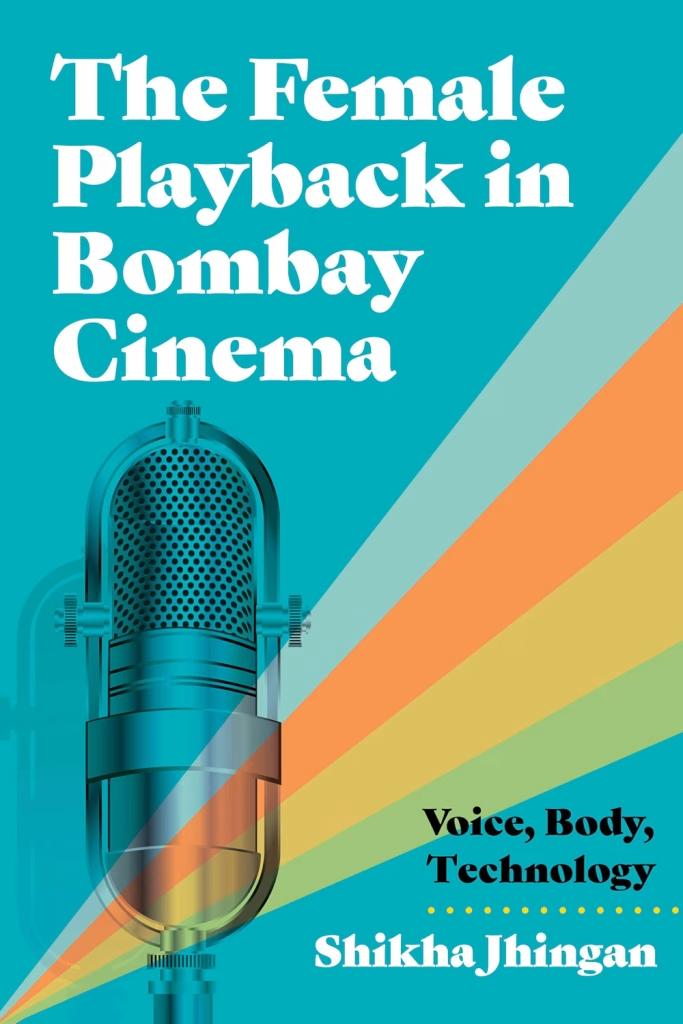
In Shikha Jhingan’s The Female Playback in Bombay Cinema: Voice, Body, Technology, the author explores the female voice over the past century—from playback singing to dubbing in Hindi cinema—while looking at the technological advancements in recording studios during this period.
For somebody who grew up far from the musical prowess that Lata Mangeshkar is, Jhingan’s exploration of female playback in Hindi cinema draws a picture so vivid that one can do nothing but draw their own parallels between the singers they are familiar with—in a multilingual nation like India, this is only a natural line of thought.
Consider an example: In the Telugu film industry, the female voices that were etched into every mind in the last few decades were S. Janaki and P. Suseela, the contemporaries whose popularity amongst the masses and their versatility can be drawn as a parallel to that of admiration Lata Mangeshkar and Asha Bhosle receive. For listeners whose knowledge in films and music is shaped by such native voices, Jhingan’s book is an introduction to Lata Mangeshkar’s journey as singer who had risen to fame with her controlled breathing, by lending a quality of ‘aphysicality’ (p.35) to the song, allowing the female actress to shine with her voice in the era of microphone recording, just after gramophone recordings and sometime before the practice of studio playback emerged.
Jhingan, an Associate Professor of Cinema Studies at Jawaharlal Nehru University, has produced a compelling study of how the female voice became one of the ‘commodities’ that sold the technological advancements from gramophones to the studio playback setup—from the Tawaifs from Calcutta who volunteered to record their traditional sonic forms into gramophones, to studio playback where the female voice is treated as an individual entity, with equal amounts of scrutiny, admiration, and even objectification, all with a sense of ownership as a listener.
One of the consistent arguments Jhingan makes throughout the book concerns the ‘intimate voice’ of Late Mangeshkar, something the veteran singer had to train herself in to better suit the microphone recordings over years, which eventually reflected upon the actresses on screen, ‘endowing them with femininity and softness of her voice’. Hers was a voice that reframed how femininity was perceived in a song, that established a standard on what makes a female singer popular, to put it in the words of Raghunath Seth: ‘Now a woman singer who doesn’t have a pitch similar to Lata is just not acceptable as a popular singer.’ The ‘graceful feminine’ voice ruled the playback industry until the composition itself began demanding something new.
The book comes to life when it arrives at the era when the genre song got popular. As Jhingan puts it, playback singing demanded the singers to emote and make gestures for a particular song to carry the energy and mood onto the screen. Thus began the rise of the groovy tunes performed by Asha Bhosle, that were performed with equal energy by Helen on screen. Jhingan explores the typecasting done here by assigning the voice of a ‘virtuous heroine’ to Lata, while Asha performed the voice of courtesans, vamps, crooners, and street singers. Jhingan reads this division for exactly what it is—the register in which a woman expresses herself is dependent on her social status. And to think such disparity was guided under the mask of ‘a developed taste’, Jhingan describes the imbibed classism and attributed moralities that blur the lines between the voice and the body. The performer of cabaret songs somehow became the ‘less respectable’ out of the two most popular female singers, and everybody else who could perform as they sang in the playback were categorised.
This sonic morality was not limited to the playback studios where the ‘preferences’ for certain voices lingered, but they transformed playback culture for the future generation of young female singers, who were expected to replicate Lata Mangeshkar’s particular sweetness, her controlled breath, and her low range pitch to become the voice of the new-generation on-screen female lead.
The rise of the radio and cassette economy happened in parallel as ‘taste’ was developed amongst the lay listeners, music elites, and critics. The listeners were most familiar with one female voice, and Jhingan explored how the popularity of one singer had hindered or delayed the exploration of other layers in a new-generation female singer’s voice, quoting Alka Yagnik who said, ‘everybody wants us to sing like Lata Mangeshkar’.
In the latter parts of the book, Jhingan’s montage of playback on Hindi cinema moves to the next intersection of emerging technology and the female voice of Hindi cinema: to the singing reality shows on television and the rise of T-Series albums. What the television singing reality shows and the T-Series-produced music albums collectively did was blurring the carefully established boundary between the voice and the face. These shows allowed the singers to perform their songs and put up a whole show altogether. Similarly, T-Series’ productions brought the playback singer to the screen.
On the surface, The Female Playback in Bombay Cinema seems like a montage documentary of how playback singing evolved over the past century. However, what Jhingan offers is an informed feminist account of what cinema lovers have always sensed but lacked the right vocabulary and evidence to put forth. The book examines popularly held notions, for instance, that Asha Bhosle’s range was treated as an excess, or that the assumed ‘standard female voice’ was synonymous with Lata Mangeshkar’s, or the pressure faced by new age singers and the agency that singers experienced because of TV reality shows, through the lens of a cinema studies scholar who supports it with empirical evidence and academic authority.