
✨ LATEST ISSUE •
From ULR
Issue 15 – REFUSE
Review: Bhima’s Wife
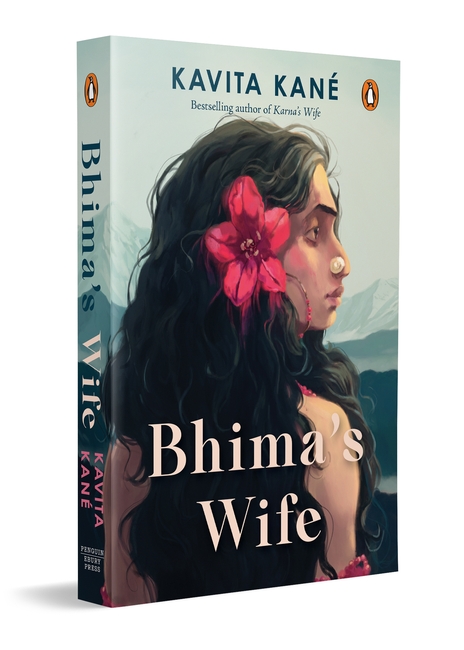
The best-selling author of Karna’s Wife, Kavita Kané, is a revolutionary author known for her fresh feminist perspectives in the genre of retellings from Indian mythology. A force in contemporary Asian literature, she is also a passionate columnist and screenplay writer. Kavita Kané’s recent launch of Bhima’s Wife is about the lesser-known female character of Hidimbi, Bhima’s wife, a demoness. Alongside writers like C.B. Divakaruni and Koral Dasgupta, Kané’s work enters a larger, growing body of South-Asian feminist retellings that resist canonical narratives. Being another of Kané’s re-imaginations, the book delves deep into Hidimbi’s emotional world, her struggles, her relationship with Bhima, which is filled with turmoil and how she was left to fend for herself along with her son Ghatotkacha.
Known for her lucid writing style, Kané’s book in particular is a powerful work on gender. It is a critique of the marginalisation of female identity and prompts readers to question why characters like Hidimbi are lesser-known in Indian mythology. Hidimbi, the protagonist, is a demoness, a tribal head who is physically abused by her brother Hidimb, and in Bhima she finds her rescuer as he goes on to kill Hidimb. However, Hidmbi does not receive her due share of honour or rights, being a woman of tribal origin. Hidimbi can marry only on one condition set by the matriarch Kunti: that as soon as her firstborn arrives in the world, Bhima will leave her and join his brothers on their forest-dwelling journey.
With a dedication to all mothers, especially those who have reared children alone, the book uncovers the social reality of single motherhood, the emotional toll involved, and the resilience of single mothers despite the odds they face.
The book invites an in-depth analysis of abject identities, those that have been pushed to the periphery by patriarchal structures in mythologies. Hidimbi is a potential case of study for the marginalisation of tribal identities, as she claims, “I am not a blue-blooded, I am the lowest of the low in your royal esteem; I am just a wild mountain tribal for a prince.” It foregrounds issues of cultural identity in India and its representation in Indian mythology, and explores female autonomy and the reclamation of identity.
In a country where caste issues assume utmost priority, the issue of tribal identity discussed in Kané’s novel rings true for readers. It highlights the existing socio-political realities of India and attempts to trace caste issues to its very core in mythic traditions. With Hidimbi’s voice being at the center of the narrative, Kané’s work becomes an important study of intersectional feminism in a world of myths that had caused the erasure of the female voices, especially the tribal ones. The story effectively captures loneliness, fear, and maternal emotions from a feminist perspective.
Readers might find the short, linear narrative quite limiting. Character arcs like Ghatotkach’s might feel too rushed and incomplete, with little emphasis on the mother-son relationship. Bhima’s limited psychological depth might not sit well with readers of Indian mythology. However, in doing so, Kavita Kané has tried to do away with a hero-worshipping culture that has long marginalised female identities in their epics, treating them as outcasts or just pawns in their larger story. The sharp binary between Hidimbi and her emotional interiority and Bhim and his physical strength may be felt throughout the narrative. Kané does not seem to engage with Mahabharata’s deeper philosophical layers of dharma, fate or even cosmic consequences. The narrative also endorses endurance over resistance, which is not entirely acceptable to feminist critiques.
For readers across the Asia-Pacific region, and even beyond, the novel offers an entry point into the mythic narratives of South Asia, with ample references to its parent epic, the Mahabharata. Overall, the book stands out for its brilliant overarching themes of feminism, caste issues, and tribal identities, all of which converge seamlessly in the narrative. It acknowledges Hidimbi as a human being of individuality who has an identity beyond that of the ‘forgotten wife’ or the ‘forsaken daughter-in-law’. The book’s quick pace and emotional depth make it a very potent retelling.
~
Purchase the book here.
