
The Man Who Predicted His Own Death
Defiant bodies and chained women protect mother rivers, warning of earth's rage.
Read more →Reclaiming India's oral traditions challenges literature's written bias, demanding a hybrid model integrating technology to redefine academic responsibility and cultural understanding.
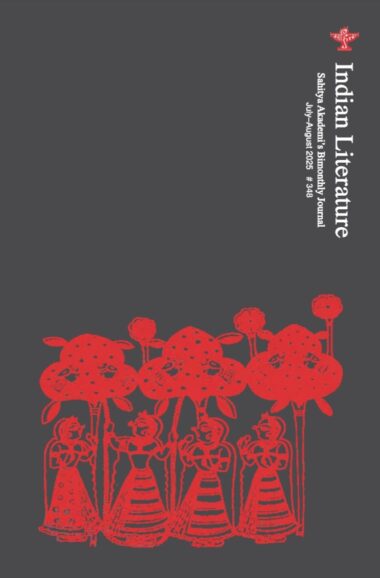
Any account of contemporary Indian literature would and should be incomplete if one does not consider the incredibly rich oral tradition that it draws from. While the distinction between oral and written cultures has been explored by academics, for instance, in Walter Ong’s Orality and Literacy (1982), and work has been ongoing lately to give oral traditions in India the respect it deserves, more can be done in this area. This is especially true due to the importance that has been given to written traditions historically.
As mentioned in the editorial by Dr Sukrita Kumar, in the comprehensive double issue of Indian Literature (July-August 2025; No 348 and 349), “… written literature began to be privileged heavily, in the name of the modernity and progress…While oral traditions continued to thrive in the domestic as well as the socio-cultural domain, it was written literature that gradually became centre-stage and commanded respect as ‘literature’…”. Also, “While the practice of oral traditions across caste and class prospered, the study of the same remained in marginal spaces in literature departments as merely “folk literature” … they were merely showcased as exotic cultural expression…Academic responsibility has rarely been endowed upon this phenomenon…”
Yet, with the advent of technology and emergence of fields such as digital humanities leading to improved research and archival of oral traditions, there is a shift in this focus. That is why, as the editorial mentions, “…The recent past has witnessed some scholars beginning to value this area of study as culture studies, sociology, or literature.”
It is within this context that this special, double issue of Indian Literature, “Oral Traditions of India: A Rich Legacy”, is both a timely and an important initiative. It covers a wide range of oral traditions from different regions of India. The organization of the content shows care and offers selections of oral traditions throughout the country. The first issue comprises the legacy of oral traditions from the Andamans, Southern and Western Regions, and West Bengal; while the second issue has Northern, North-Eastern Regions, and Central Regions. Besides short stories and poems, there are essays that inform the reader about the history of the storytelling of the region as well as a compilation of the traditions from there. Both the issues have a Miscellany section comprising contemporary poetry, short stories, and essays as well.
While it would be difficult to showcase all the selections here, some glimpses of the oral traditions are as follows:
Three Mangoes from “The Legendary Stories about Banjaras” (language: Gorboli, translated by Ramesh Karthik Nayak) is about a woman Dokri who finds the mangoes that she had placed under a tree missing, and blames it. The sequential, and seemingly simplistic tale shows the interdependence of the animal and human world, and also offers a lesson about how our emotions are projected outwardly, and if uncontrolled, can lead to chaos and destruction. This interdependent sequential storytelling with an implicit lesson is also found in Mr. and Mrs. Rat: A Kashmiri Folktale— original title: “Gagur Te Gagur” (language: Kashmiri, translated by Mumtaz Mohiuddin; originally transcribed from Kashmiri by Ghulam Mohiuddin Lone) as well, which shows the quarrel between Mr. and Mrs. Rat about something minor. And when she goes from one source to another to get her ear adorned with gold and leave for her natal home, only to lose her life, Mr. Rat realizes his mistake and he is doomed to dig underground in grief and remorse.
“Dancing Dunes and Singing Sands” (translations and transliterations by Kaushalya G. Rajpurohit) gives an interesting summary of the folklore and storytelling traditions from Rajasthan, and “The Epic of Phabuji” (translated by John D. Smith) shows the coming together of singing, performing of the tale of the Rajput warrior Pabuji, as well the painting of the “phad”.
“Sindhi Folktales” by Menka Shivdasani, describes the reclaiming of the cultural heritage of the Sindh heritage through traditional folktales and the women-centric work of Shah Abdul Latif, Shah Jo Risalo. Similarly, “Oral Literature and Memory” by Vislavath Rajunayak discusses the significant Telangana storytelling communities, and how the engagement of these communities with oral histories brings out not just ancestral memory but also the contemporary struggles and resistances that are being faced, and in that sense, oral traditions address “aspects of everyday life…making it problematic to label them as purely traditional”. Thus, understanding oral traditions requires understanding the context and local history as well as the current struggles and lives of the people from that region.
Not just that, as Ong had emphasized, orality emphasizes memory, communal participation, and incipient performance. This is brought out by the fact that the same story might have different variations, as for instance, the Haryanvi story about the crow and sparrow. Yet, the connect between different regions is also brought out by the section, “Across the Country”, which feature the poems, “Barahmahsa – A song of Twelve Months” by Vinita Agarwal and “Kabir: Walking with the words” by G. J. V. Prasad.
Finally, the essay, “Poetry in an Era of ChatGPT” by Sachidananda Mohanty is a nod to these times of ‘artificiality’ and leaves one with the hope that poetry will not just survive, but thrive despite the automation of everything around it.
Last but not the least, a word for the translations of the selections: These have been done in a way that the authentic edge of the original tradition, with all its flavours and impacts, is not lost, yet the stories, poems, or folk tales are understandable and readable to an audience that is not familiar with the original language. A section with the links, if possible, of the original work might be added if these issues are digitized or archived in the future.
Conclusion
As mentioned in the editorial, a lot of work is still possible in the space of the rich and complex oral traditions in India, and for that, we need to come up with a hybrid model to think about the orality and textuality and combines both oral and written parts (Gopal, 124). This means that besides Ong’s thesis, Goody’s critique of the oral-writing divide is also a perspective to be considered. We also have to include the impact of technology, such as games, AI, multi-modal virtual models, and social media (Donald). These comprehensive issues brought out by the Indian Literature editor and team are a valuable resource and leave one with the hope that these timeless traditions will continue to enrich, engage with, and inspire our lives.
References
Jonaki Ray was educated in India (Indian Institute of Technology Kanpur) and the USA (University of Illinois Urbana-Champaign). A scientist by education and training, and a software engineer (briefly) in the past, she is now a poet, writer, and editor in New Delhi, India. She is a 2017 Oxford Brookes International Poetry Contest, ESL, winner, and has been shortlisted for multiple other awards, including the 2021 Live Canon Chapbook Contest and the 2018 Gregory O’Donoghue International Poetry Prize.