
Review: Santiniketan: Nature’s Gateway to Spirituality
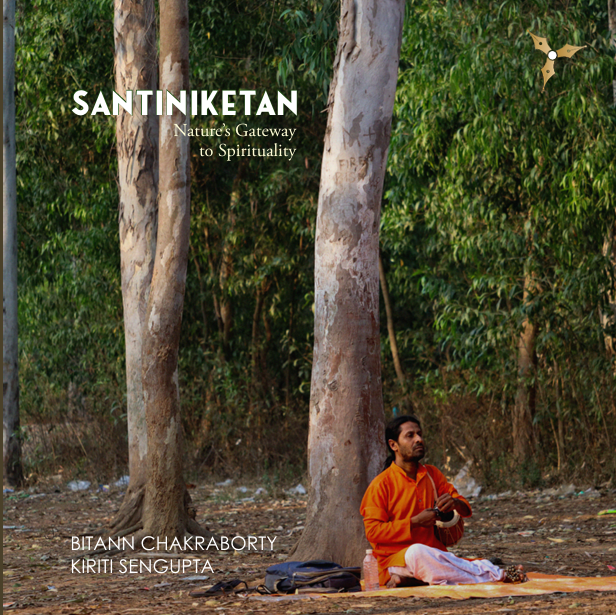
The Baul heritage of a restless search for the Divine is captured in the stunning cover of the book, Santiniketan: Nature’s Gateway to Spirituality. Unusual and deeply impressive in concept and production, Bitann Chakraborty’s photographs and Kiriti Sengupta’s writing synchronise perfectly, reflecting Rabindranath Tagore’s philosophy of a symphonic harmony between nature and human beings. Tagore’s belief in a Moner Manush (the divine within me) is based on a popular Baul song ‘আমি কোথায় পাব তারে, আমার মনের মানুষ যে রে’ (where will I find this divinity lodged in me?) and Chakraborty’s cover design, depicting a saffron clad Baul singing in the Sonajhuri forest, captures the mood of the book brilliantly. Signifying the eternal seeker, the wandering minstrel appears in several photographs inside the collection too, and Kiriti Sengupta gathers the essence of such amorphous piety in his poem ‘Nourishment’, ‘Prana endures eternally — mortals require / sustenance for survival — music lingers’.
The photo-book is unique in emphasising nature’s bounty in Santiniketan rather than the oft presented architecture, art and sculpture. Bitann’s camera plays with the nodes on tree trunks, a mesh of roots snaking on the ground, horizons edged by paddy and mustard fields, stalks of water lilies, mysterious forest paths and other such evocative images. Kiriti maintains a parallel pace, as in the poem ‘Quietude and Loneliness’—
For God’s sake, don’t take silence for granted.
It is loud, hypnotic and overrated.
It has a spiritual world charm attached to it;
you never know if it will declare you dead.
The synchronicity between the poet and the photographer is as fascinating as a jugalbandi between two musicians, each picking a cue from the other and displaying mastery over their own instrument. Many pages depict skyscapes, that ever-changing panorama. A dramatic photograph of a mottled golden moon centred on a black square could imply purnima or full moon, shunya or zero, a bindu or a cosmic dot. Each of these symbols carry mystical connotations. The accompanying poem ‘Moon, the Other Side’ is among the longer expressions in the book, perhaps because Sengupta wishes to glide through these complexities and add a few more. The footnote cites Sukanta Bhattacharya, a people’s poet who wrote ‘the full moon resembles a toasted bread.’ The promise of multiple interpretations appears in the opening lines:
Memories unveil themselves through snapshots;
The moon has its glory
Pinned in poetry.
Nature’s spiritual face also includes human beings, but not the elite ones. Rural women bending over rice fields, Santhal dancers, dhoti-clad men keeping a watch over their herd. One photograph that haunts me is of an empty chair and carelessly flung, shabby, footwear. Where is the user of these items, my mind asks and then slips into speculations on the absent-present, the enigmatic moner-manush. In Tagore’s words selected by Kiriti, ‘What emptiness do you gaze upon!’
This book is laudable for visualising Santiniketan as a cultural legacy larger than Rabindranath’s Visva Bharati. Rightfully, the first photograph is of Chhatimtala, the magnificent tree where Maharshi Debendranath Tagore, Rabindranath’s father, had meditated. In 1863, Debendranath acquired 20 acres of land from the local talukdar. He built a small home called Santiniketan and a Upasana Griha/prayer hall in multi-coloured glass. The adjoining area of Bhubandanga was occupied by a gang of dacoits. Under the Maharshi’s enlightened guidance, it is believed that the dacoits laid down arms and pledged to develop this terrain. In 1901, Rabindranath started a Brahmacharya-ashrama on this land and it acquired the name Patha Bhavana. With a nature-oriented curriculum, the campus grew till it became Visva Bharati or a world university in 1921. This sketchy background is necessary for appreciating how the book Santiniketan blends, visually and textually, the attributes of nature, spirituality, and holistic education. It helps understand why the soulful photographs of Kalo Bari, Shyamali, Taladhwaja and other landmarks merge with the verdant environment. To this day, the curriculum includes variations of performative styles, art, languages; and the academic calendar marks the cycle of seasons with vibrant festivals.
The village arts were never left behind, and the Sonajhuri haat continues to display dokra, leather batik, textiles, woodwork, and other hereditary crafts of the tribal communities. While paying tribute to Rabindranath’s vision, leadership, and innovative ideas, this book articulates Santiniketan’s diversity through word, image, and text.
Rabindranath’s versatility turned a tract of red soil and leafy forests into an educational hub that linked humanity and the environment. He famously said, ‘Faith is the bird that feels the light and sings when the dawn is still dark.’ With such a spiritual lead, the aficionados of Santiniketan, poet Kiriti Sengupta and photo-artist Bitann Chakraborty have partnered their talents in creating an exquisite collection which is to be treasured.

Malashri Lal
Malashri Lal, with twenty-six books, retired as Professor, English Department, University of Delhi. She is an avid reader and a prolific reviewer of books for global journals. She serves on the jury of several literary awards. At present, Lal is the Convener of the English Advisory Board of the Sahitya Akademi, and the Chair of the English Board of Bharatiya Jnanpeeth.