
Supriyo Chakraborty in Conversation with Aditi Dasgupta
Chakraborty positions Penprints between cultural necessity and market viability, navigating the tension…
Read more →Examining Mumbai through its food reveals how culinary evolution exposes colonial legacies, environmental shifts, economic commodification, and deep-seated societal stratification, challenging conventional urban narratives.
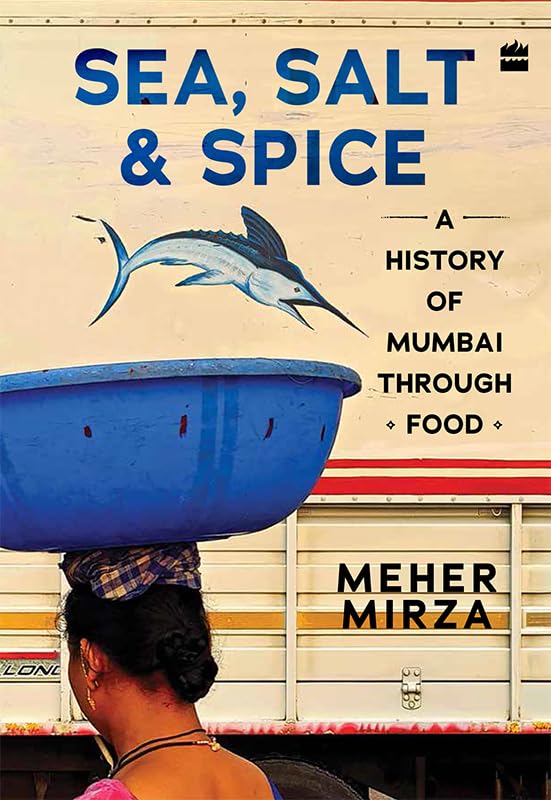
Mirza’s Sea, Salt & Spice: A History of Mumbai Through Food is a necessary compilation of Mumbai’s gastronomical historical density. Cities have most often been studied through maps, monuments, wars and annexations and Mirza’s thoroughly researched narrative threads the large canvas of food histories into one. This book helps us understand the deeply entrenched network of kitchens, markets, fishing boats, toddy palms, railway platforms and the things that have been put upon its plates.
This book has an audacious premise. Food histories can easily become an agreeable procession of recipes and nostalgia, and this is also how I approached the book in the first few pages. But Mirza’s mastery over the cityscape is more ambitious: compiling the culinary biography of the city that thrived from the Satavahanas, British Raj and the Mumbai we see today, is commendable. The book not only flays open what Bombay ate, but also what the city grew, who harvested it, who taxed it, who sold it, who was permitted to eat it, who was made to live beside its smells and who had the authority to decide what constituted a respectable way of eating. Mirza begins with a sombre narrative of the city’s pre-colonial past through Portuguese and British rule and rivulets its way into the modern metropolis. After the last page is read, no ordinary street corners of Mumbai look the same, its ordinariness unpacking differently each time we walk past it.
Food is not a static object, and this is what makes the narrative of Sea, Salt & Spice especially pleasurable. Food here, is the flaneuse. It crosses docks and boundaries and slips through the then-ironclad walls of colonial kitchens and simmers in the pockets of migrants to finally thrive in clubs and chawls to leave its fingerprints upon the architecture of the city. Through food, the veins of the city become visible.
The earliest Bombay in these pages is almost unrecognisable for the modern marathi manus: seven islands, salt pans, mangroves, creeks, orchards, fishing settlements and agricultural lands forms the structure of the city which history births. Before the city’s boisterous gothic buildings and grand avenues came into existence, there were Koliwadas, coconut groves and communities whose lives were intimately tied to the sea and soil and Mirza’s research spotlights the same intricately: Jambulwadi recalls jamun orchards; Narielwadi, coconut; Phanaswadi, jackfruit; Ambewadi, mango; Charni Road, cattle grazing. At times, reading the book, felt like visiting the old pantry in its street names. And this is where the book resurrects its importance assertively: Mumbai’s food history is also the history of the land. It was interesting to see how the Britisher’s reclamation of the islands sustaining marshes and mangroves were eventually flattened, salt pans and paddies were transformed into an increasingly rigid urbanscape. Mirza rightfully narrates what looks like an engineering triumph morphing into a lopsided alteration of ecology, livelihood, ownership and economy. For instance, the tree tax and the tapping of palm tree becoming taxable reveals how the colonial state turned the food economy into a thriving accounting unit. And this is also where the book becomes a history of Mumbai’s present. Replete with amusing historical details, this book, therefore, becomes the tiny aperture through which one sees the economic imagination that would make Bombay such an expensive city. A tree could be taxed because it produced something, lands could be reclaimed because it could be made to produce something, and eventually every inch of Mumbai could acquire a price because the city itself had become the commodity.
The city bearing the birth of the pav, mothering the bhel in its own way, marking the Parsi corners with its food, and charging its way through the Milk Revolution, Mumbai flays open an empire of its own claiming its identity through municipal regulations, caste and community. The famous Bombay Duck or the Bombil Tak (the most significant edible map of Bombay) becomes a splendid example of the absurdities of colonial naming. Bearing several anglicized variations, Mirza writes to showcase how the Bombil was distorted by “the thick tongues of the British” into an English-sounding expression. But naming is power and even though the linguistic comedy is worth revelling in, it reveals how a local fish enters the imperial vocabulary and emerges with a new identity that travels far beyond Bombay. But Mirza’s deft research carefully refuses the neatness of a single origin story as well. She gives us competing explanations, linguistic accidents and historical uncertainties with such great clarity that it makes the book a true gastronomical marvel. Such intellectual caution is one of the hallmarks of a true researcher.
Another microcosm that Sea, Salt & Spice brilliantly handles is how food remarkably simmers caste narratives around the same dish. What food confers what status unpacks the markets of community identity. Mirza shows how vegetarianism itself became freighted with ideas of status, while meat and fish could become social signifiers of impurity in early Bombay. The dining table in the city is, therefore, never a neutral place. This also makes the book a compelling achievement – showing food as a political act.
An immersive reading, particularly from a Bombayite’s point of view, Mirza’s history feels wonderfully close to the tarmac beneath our feet. Firing the hunger in our bellies, we walk through the city’s architecture and eventually made to stand around the eating spaces that were a physical consequence of labour and community. The same eateries and refreshment houses crack open the stellar Taj Palace hotel, mainstreaming ice creams and tadgolas bringing in a new narrative of the architecture of aspiration. Western cutlery entering Indian homes, restaurants refashioning eating outside for leisure, Indian elites offering oysters, steaks, pies, pastries and puffs bring in a new social order. Yet these advancements and cosmopolitanism dominantly played as strong instruments of exclusion. All this, along with the Britisher’s strong distaste for sprawling hawker culture of the city, is a wonderful little lesson in the city’s temperament: Mumbai has always resisted being entirely tidied up! And perhaps this is why the book feels so alive. Sea, Salt & Spice is a history of movement, food and commodities and Mirza’s methodology matters the most because the book’s greatest pleasure is its accumulation of apparently tiny details. Every miniscule detail seems insignificant until Mirza places it beside another and suddenly a city begins to emerge. Mumbai is not the postcard version anymore; it is also not a city of Victorian facades, Bollywood, monsoon and millionaires. It is a city repeatedly made and remade by people who relocated, the Kolis, the Agris, Bhandaris, the Portuguese and Parsis. And that is why Sea, Salt & Spice leaves one with the peculiar sensation of having eaten one’s way through history.
By the time one reaches the doorstep of the maximum city we see, Mumbai no longer looks accidental. Its density, inequalities, appetites and astonishing ability to absorb newcomers all have antecedents. The city famed for its appetite turns out to have been ironically eating itself for centuries while continually reinventing what it means to be a Bombayite. And once you have read the city Mirza’s way, the city is not busy any more; there is always another side of Bombay waiting to be served.

Aditi is an ordinary feminist with an extraordinary hunger for stories. A researcher at heart, her MPhil in English literature delved into postcolonial traumas in Indian literatures. She honed her craft through a Diploma in Translation & Creative Writing at Ahmedabad University, a residency at Yale, and the Institute for World Literatures at Harvard. Her book, Silencing of the Sirens , has drawn critical acclaim, and her words echo in Borderless Journal, The Wise Owl Literary Magazine, The Hoogly Review, WritingWomenCo, InkNest Poetry and The Writer's Hour Magazine, weaving history, pain, and resilience into narratives that refuse to be silenced.