
Review: The Ambedkar Nietzsche Provocations: The Genius of the Chandala & the Gospel of the Superman
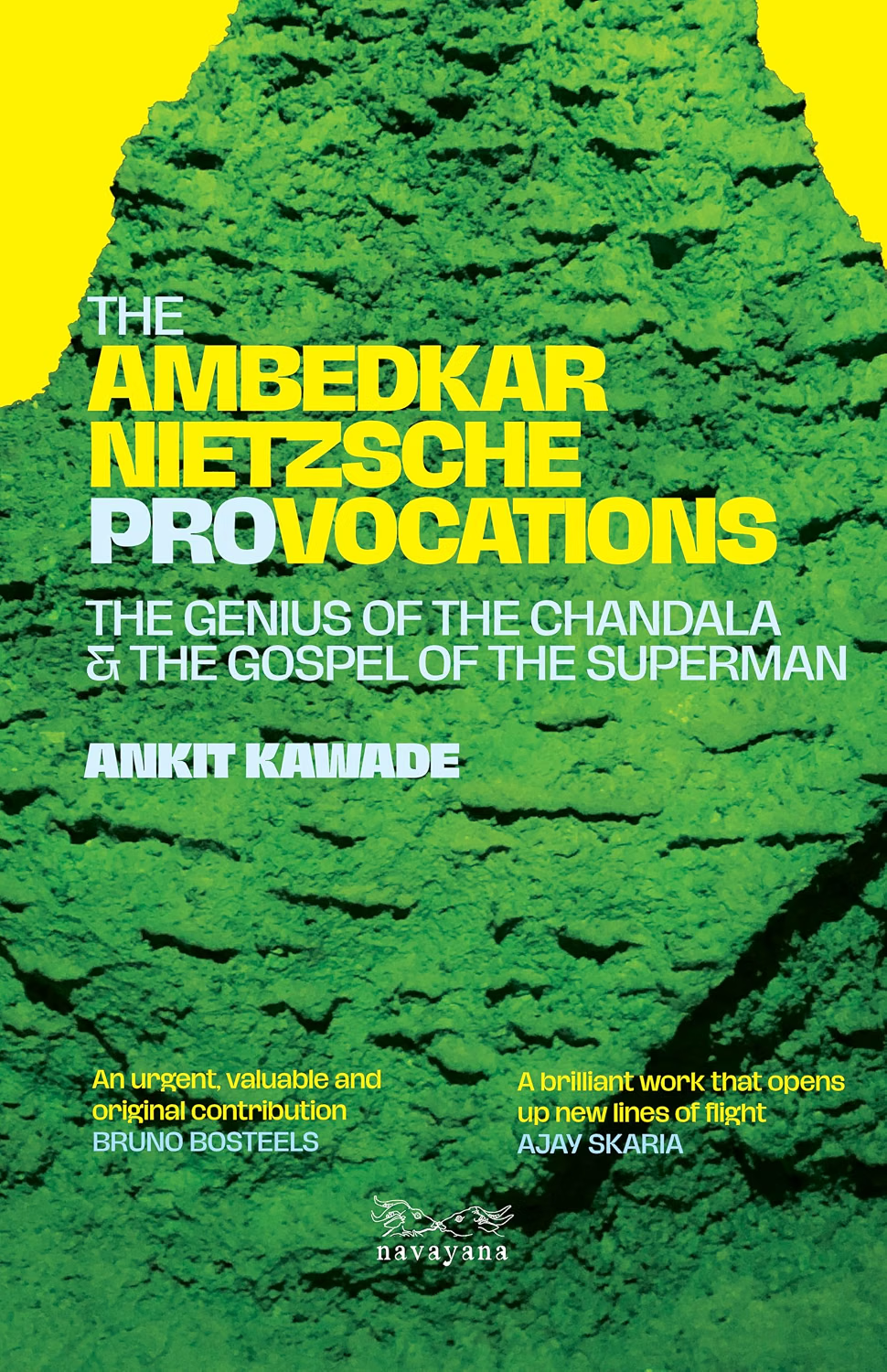
There are books that invite us into a conversation, and others whose very titles unsettle our intellectual certainties. Ankit Kawade’s The Ambedkar Nietzsche Provocations: The Genius of the Chandala & the Gospel of the Superman announces an encounter between two thinkers who challenged inherited moral orders but imagined radically different possibilities for human freedom. Bringing B. R. Ambedkar, the uncompromising critic of caste hierarchy, into conversation with Friedrich Nietzsche, the philosopher of power, self-overcoming, and the revaluation of values, raises an uncomfortable question: can the pursuit of human greatness be separated from the social conditions that determine who is permitted to become great?
At first glance, the comparison appears improbable. Ambedkar devoted his intellectual and political life to dismantling a social order that denied dignity on the basis of birth. Nietzsche, meanwhile, questioned egalitarian ideals and frequently associated exceptional human achievement with distinctions of rank. One struggled against the historical dehumanisation of the oppressed; the other challenged conventional morality and the limitations it imposed upon human possibility. Yet both recognised that values are neither eternal nor beyond interrogation. Their philosophical proximity, however, should not obscure the considerable distance between their ethical and political commitments.
The word Chandala carries the accumulated violence of a civilisation that transformed human difference into hereditary degradation. To be placed outside the recognised boundaries of caste was to experience exclusion not as an occasional injustice but as an organising principle of everyday existence. The body became a marker of pollution, labour an inherited obligation, and dignity something systematically withheld.
Ambedkar understood this violence through experience as well as intellectual inquiry. In Annihilation of Caste, he exposed the religious and ideological foundations through which graded inequality reproduced itself across generations. Caste, for him, was not merely a division of occupations but a division of human beings, sustained through separation, unequal worth, and the denial of fraternity.
The phrase “Genius of the Chandala” therefore suggests a striking reversal of the historical gaze. The person whom society has declared inferior emerges not as an object of pity but as a producer of knowledge, criticism, and social transformation. Yet this reversal demands caution. Celebrating the exceptional individual who rises above oppression can inadvertently obscure the structures that continue to constrain countless others. Ambedkar’s significance does not lie simply in his extraordinary achievements despite caste discrimination. It lies in his insistence that nobody should have to become extraordinary to be recognised as human.
Nietzsche complicates this conversation considerably. His critique of conventional morality asks whether inherited values enrich human existence or diminish its creative possibilities. The Übermensch, often translated as the Superman or Overman, embodies the possibility of self-overcoming: the capacity to transcend inherited limitations and create new values.
There is something compelling about this refusal of resignation. Human existence need not remain confined to conformity or passive acceptance. Yet Nietzsche’s vocabulary becomes troubling when placed alongside the historical experience of caste oppression.
His suspicion of egalitarian morality cannot be comfortably reconciled with Ambedkar’s commitment to social democracy. More significantly, Nietzsche’s engagement with the Laws of Manu and his references to the Chandala in The Antichrist reveal an aristocratic fascination with hierarchy that resists any straightforward association with anti-caste emancipation.
The philosophical tension therefore lies not in whether Nietzsche can be made compatible with Ambedkar, but in what their confrontation reveals about freedom itself. Self-overcoming carries different meanings for someone already endowed with social privilege and someone whose humanity has been systematically denied. The freedom to create oneself presupposes opportunities that are never distributed equally.
Ambedkar and Nietzsche can both be understood as critics of inherited moral authority, but their rebellions move toward different destinations. Nietzsche asks how human beings might free themselves from values that constrain creativity, vitality, and exceptional achievement. Ambedkar asks how society might free itself from institutions that distribute dignity unequally.
To describe both as revolutionaries is insufficient. Revolt acquires meaning from the world it seeks to create.
For Ambedkar, liberty was inseparable from equality and fraternity. His commitment to constitutional democracy rested on the conviction that political rights could not survive indefinitely within a society organised around everyday humiliation. Democracy required a transformation of social relationships, not merely a redistribution of political authority. Nietzsche’s philosophical project inhabits a different moral universe, where the pursuit of excellence does not necessarily provide a foundation for universal dignity.
Their differences become particularly visible when we consider the body. In Nietzsche, the body represents vitality, instinct, and creativity against philosophical traditions that privilege abstract reason and otherworldly consolation. In a caste society, however, the body is never simply one’s own. It is classified, regulated, and positioned within a hierarchy before the individual has the opportunity to define themselves.
The Dalit body has historically been subjected to restrictions governing touch, proximity, space, and participation. These restrictions demonstrate how thoroughly social power inhabits ordinary human interactions. Ambedkar’s philosophy consequently demands more than psychological self-assertion. Reclaiming oneself requires challenging the social world that has already assigned meaning and value to one’s existence.
This distinction becomes especially relevant today, when resilience and individual success are frequently celebrated without questioning the circumstances that make such resilience necessary. Society admires those who overcome adversity while leaving its institutional foundations largely untouched.
The notion of revaluating inherited values offers another meaningful point of comparison. Nietzsche’s critique of established morality invites us to examine how certain values acquire legitimacy. Ambedkar’s interrogation of Brahmanical authority similarly reveals how practices defended as sacred tradition can conceal relationships of domination.
Yet their moral objectives diverge. For Ambedkar, caste represented an ethical failure because it denied equal human worth. His eventual embrace of Buddhism was not a withdrawal from politics into private spirituality but an attempt to construct an ethical community grounded in reason, compassion, and fellowship. Nietzsche’s critique of Christianity and compassion-oriented morality moves in another direction, questioning whether such traditions diminish human strength and creativity.
Their disagreement over compassion is revealing. Within a caste society, solidarity with the humiliated need not represent weakness. It can become an act of collective resistance. Charity may preserve hierarchy by allowing the privileged to remain benefactors, whereas solidarity challenges the arrangements that produce dependence. Ambedkar’s emancipatory project cannot be reduced to sympathy. It demands justice.
The intellectual appeal of placing these philosophers together lies in the audacity of the comparison. Yet such comparisons also carry responsibilities. The European critique of modern morality and the Indian struggle against caste oppression emerge from profoundly different historical experiences. Treating them as interchangeable risks stripping both of their complexity.
There is another danger: making Ambedkar’s philosophical significance dependent upon his resemblance to an established European thinker. Ambedkar does not require Nietzsche to become intellectually important. Indeed, a more productive approach might reverse the customary direction of interpretation. Rather than asking how Nietzsche illuminates Ambedkar, we might ask what Ambedkar reveals about the limitations of Nietzsche’s philosophical imagination.
Such a reversal is important in an intellectual culture where Western philosophical traditions have too often provided the standards through which other forms of knowledge are judged.
This encounter also resonates with contemporary societies that celebrate merit, excellence, empowerment, and self-realisation while frequently overlooking the unequal conditions under which these ideals operate. Individuals are encouraged to pursue limitless possibilities even as caste, class, gender, disability, and inherited privilege shape the boundaries of their aspirations.
Under these circumstances, the ideal of the self-created individual becomes politically ambiguous. It may inspire resistance, but it may also legitimise inequality by interpreting success as personal merit and failure as individual inadequacy. Ambedkar unsettles this reasoning. The question is not simply whether individuals possess the strength to transcend their circumstances, but whether society has the moral right to impose those circumstances in the first place.
The value of the Ambedkar–Nietzsche encounter lies not in discovering an effortless reconciliation but in sustaining the discomfort generated by their differences. The Chandala and the Superman represent more than opposing figures of humiliation and transcendence. They expose competing understandings of the relationship between human potential, social power, and moral responsibility.
Ultimately, their confrontation leaves us with a question: can human greatness possess ethical meaning if the conditions of its achievement depend upon the degradation of others?
Kawade’s provocative framing opens a space for precisely this philosophical interrogation. Its most compelling possibility lies in challenging readers to reconsider the meanings of dignity, freedom, hierarchy, and human possibility without assuming that these concepts must lead toward the same political conclusions.
Perhaps the deepest lesson emerging from such an encounter is that a society should not be judged by the exceptional individuals who manage to transcend its cruelties, but by whether it allows ordinary people to live without humiliation. The true measure of human greatness may lie not in rising above others, but in refusing to inhabit a world where others must remain beneath us.

Pallavi Sanil
Pallavi Sanil is a writer, literary critic, and reviewer whose work explores the intersections of caste, gender, disability, human rights, and social justice. Her writing moves between literary criticism, reportage, and reflective essays, with a particular interest in how personal narratives illuminate larger social and cultural realities. Over the past three years, she has reviewed non-fiction manuscripts for publishers and academic journals and published more than a dozen book reviews for diverse readerships. Her essays and articles have appeared in national publications, including *ThePrint*. An engaged reader of literature, memoir, narrative non-fiction, and social thought, she approaches writing with intellectual curiosity, critical sensitivity, and an attentiveness to voices and experiences often overlooked in mainstream discourse. For her, reading and writing are not merely literary pursuits but ways of questioning established narratives, confronting inequalities, and understanding the complexities of human experience.