
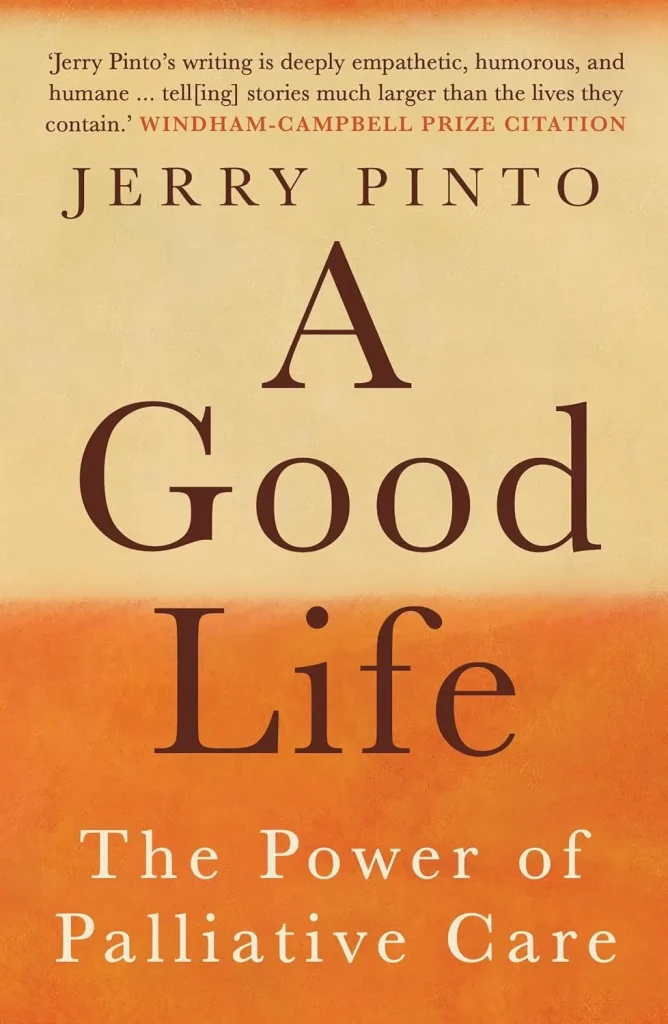
Anybody who has dealt with illness or death in the family would have probably encountered the term ‘palliative care’, though in the Indian medical system, such terminologies might not be as ubiquitous. What is palliative care? How does it help? How is it different from cure or curative care? What does it actually mean? And more importantly, where can one find it.
Jerry Pinto, the author who gave us a deep dive into bipolarity through his dark-comic debut novel Em and the Big Hoom, answers all the above questions and more as he fills a vital lacuna in medical literature with his latest book A Good Life: The Power of Palliative Care. Palliative care is a specialized medical approach that focuses on improving the quality of life of people with serious or life-threatening illnesses by providing relief from symptoms and side-effects of treatment. Its goal is to relieve the patient of his/her suffering, and ensure the patient lives more comfortably. Based on extensive research work, interviews, visits to emerging palliative care institutions, accompanying care workers during their patient house visits, Pinto has travelled length and breadth of the country to comprehend, probe, experience, absorb, empathize and finally write about this mode of care that is sorely needed to bridge the gap between curative care and holistic healing with patients and their families at the centre.
That palliative care is not an end of curative treatment, that it should begin right from the diagnosis itself, that it entails not just drugs and prescriptions but also counseling, hand-holding, earning trust and confidence, and helping not just the patient but also his family negotiate the process of healing has been expounded and underscored in this book. And who better to do this than Pinto, who has experienced the life of living with a mental health patient, his own mother from a tender age and had the courage to put it down in a book.
Pinto’s gaze travels from the Cipla Palliative Care Centre, Pune to the Tata Memorial Hospital, Mumbai to Maulana Azad Medical College Hospital, Delhi to Karunashraya and NIMHANS in Bangalore, Kerala, Assam and all other places. In these places, he has found doctors, nurses, care givers, counselors, patients and family members who have shared their stories. These narratives of people from all walks of life give a rich account of how medical care is and where it is heading. From the sprawling and bursting-at-their-seams government hospitals to the Tata Medical Centers at every metro, to the district level health care centers, to the private health behemoths, the book gives an experience of how palliative care is slowly becoming mainstream in the Indian health care system. What I noticed is the complete absence of West Bengal and several other states in this picture of palliative care, probably because Pinto might not have had access to people or institutions in these places.
Vividly told stories and experiences of patients and their family members emphasize the excruciating need for such care to become widely prevalent and available. It is not surprising that most of the life experiences that the author narrates are those of cancer patients. There are others too, like patients with Thalassemia major, Parkinson’s Disease and other life-limiting, life-altering conditions. He speaks of an octogenarian grandmother in a Kerala village and her struggle for her eight adult grandsons with congenital neurological deficiencies. He gives detailed accounts of the children’s cancer ward in Tata Medical Hospital in Mumbai. In all these, the patient and the family members get centrality not just in Pinto’s narrative but also in the various stakeholders of the palliative care system that the author enumerates.
What is important is the ability of people to differentiate between palliative and end-of-life care. Often the two terms are used interchangeably or patients believe that palliative care is what end of life care is. However, that is not true. Palliative care is needed right from the time of diagnosis and not when there is no curative treatment left. It is only when palliative care along with cure delivers a holistic treatment that life for patients becomes bearable. They begin to heal properly, if the two align to deliver the best care possible.
The author also brings in the economics and financial aspects of treatment into the picture. In a country with a staggering number of the population barely subsisting on below or a little above the poverty line, a health condition and its financial implications can be as overwhelming as the effects of the disease itself. The need to address the economic burden of maladies is more prescient than ever and the author and his sources try to provide answers in community-based solutions. In his argument of home care being more expensive than institutional care, I find a flaw, particularly in respect of corporate hospitals with their sky-rocketing charges.
The centrality not just of the patient but also of the family is what makes this book an honest account. While pain is inevitable in any disease, suffering is not, the author intones. As of today in India, the patient along with the carer undergoes a debilitating suffering that should be ameliorated. Whether that happens is yet to be seen, as palliative care still remains in its infancy at least in this country. When it is fully integrated, perhaps a lot of suffering and the unbearable burden will lessen.
Pinto lives in hope as he witnessed firsthand the take-off of the care system. There is still a long way to go as more non-curable diseases take on the form of epidemics like Dementia and Alzheimer ’s disease. The burden of caring takes an immeasurable toll as livelihoods are lost, lives are affected, resources dwindle, mental health takes the brunt and families are devastated. While there is ongoing nation-wide study being done by the Indian Council of Medical Research (ICMR) on the burden of caregivers, a numerical matrix will probably not tell the full story. It is good that the National Health Mission takes cognizance of palliative care but much more needs to be done if India is to negotiate the crisis of healthcare.
Pinto holds out an immeasurable amount of hope in his book and it feels good to read about the strides made in this sphere of medical care. The book primarily fulfils the need to make readers aware of this aspect of healthcare and one will hope they will seek it out and demand it whenever they need it.
You can purchase the book here.