
Aditi Dasgupta : Your book restores narrative weight to a woman’s history that was never thought worth recording. When did you first realise that what was dismissed as “ordinary” in your grandmother’s life was, in fact, structurally political?
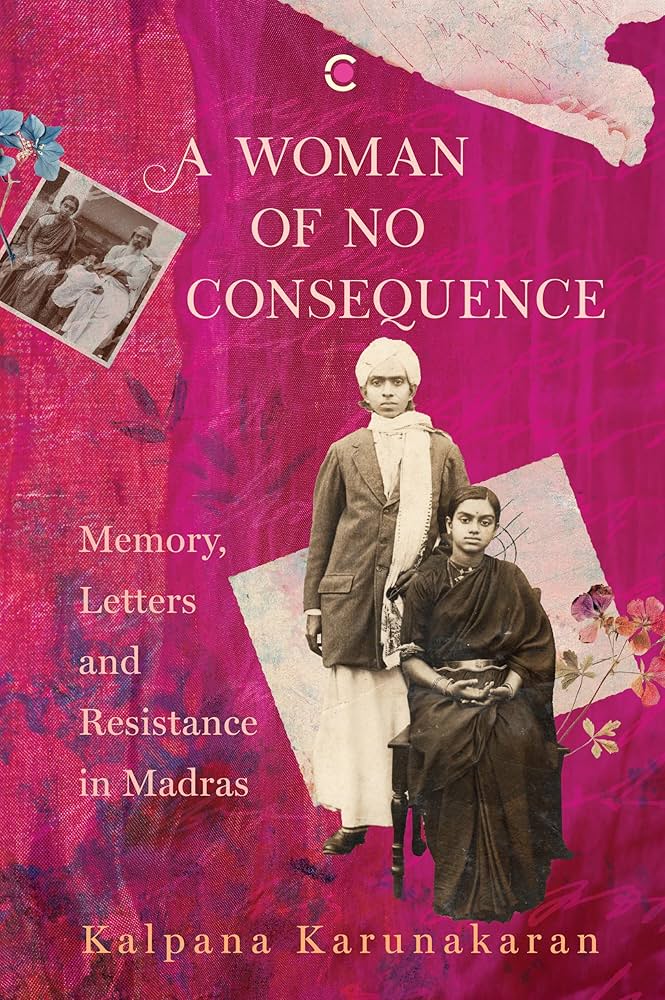
Kalpana Karunakaran : Was there a first ‘aha’ moment when I realized this? Hmm… I’m not sure. But there were several early goosebump-inducing moments as soon as I began to read my grandmother Pankajam’s autobiography. She begins to write about her life at the age of 38, when her fifth and last child Mythily (my mother) is finally sent to school after years of home-schooling by her mother. In a Foreword that she writes for her autobiography, Pankajam directly poses the question of how dare she write about her life when she has accomplished nothing of consequence and is not even ‘a woman of our time of national struggle’ (the year is 1949). I thought it was striking that she identifies herself as a non-entity, ‘an utterly ordinary housewife’ and immediately turns this location to her advantage by defending her right to recount a story of the ‘everyday’ and the ‘ordinary’ because, after all, history must be told from the vantage point of those who manage households, birth and raise children, cook and clean, and feed and care for others. The official records of written histories must not be monopolized by the kings and princes who make wars, conquer lands and build empires, she asserts. I was struck by how she reverses a hierarchy so neatly here – of what is worth chronicling, celebrating and preserving for posterity. I saw at once that she was referring to the inner domain of the household and domesticity where women like her spent much of their lives in obscurity and where much of the reproductive labour and care work (phrases that are much in vogue today) take place. We have barely begun to acknowledge how fundamental this labour is in sustaining national economies and the very fabric of human life…
As I read more, I began to see that my grandmother’s writing was not about celebrating motherhood (although she enormously enjoyed being a mother) or merely declaring that the inner/ domestic domain was worthy of note. The purpose of her writing was to show how her ‘soul has been ever trying to soar up and break the bondage of the flesh’, although housework keeps the soul fettered down, as she writes in her Foreword. Once again, the goosebumps! Through the centuries, women were dissuaded and even forbidden from cultivating their mind or their intellect, from reading and writing, pursuing scholarship, having independent opinions and arguing with men in public (or private) spaces. These were seen as eminently unattractive qualities in a woman that would distract and divert energies from what was expected of her – the bodily functions of biological and social reproduction (‘the bondage of the flesh’). In the Tamil social universe, the four traditional qualities that were idealized as the embodiment of femininity include an exaggerated modesty/ coyness and a feigned ignorance by playing dumb or downplaying one’s intelligence so as to not challenge men. And here was a woman born in 1911 who was hungry for knowledge and stole time for herself from a family of five children and a tyrannical husband to expand her knowledge of the world, discuss books and new ideas about the cosmos, black holes, Stephen Hawking and pretty much any other theme in science, history, geology, literature with anyone who would give her five minutes of their time, even though she had had no more than 6 years of school education herself…
AD: While writing, did you ever sense that Pankajam’s archive fell silent or refused coherence? How did you honour that resistance on the page?
KK: Well, yes. When she writes about her marriage and conjugal life, it was on a sheet of paper that was torn, almost as if she had torn away and destroyed something else she might have written. Her prose is usually so eloquent, but she ends that particular piece rather abruptly by writing ‘They [my children] tied me down to hard realities, gave me no time for anything else. Made me endure things.’ What were the things she was forced to endure? I realized that she would/could not say anything more in the first-person retelling of her life. And to my great surprise, I found that her auto-fiction or the fictionalized autobiographies of her life filled the gaps and silences with utter, unflinching honesty. These are the short stories of Kamala, Meena and Lakshmi, fictional characters who are, in fact, Pankajam, my grandmother. These stories tell us all that the autobiography does not. And therefore, the story of a young woman’s quest for romance, intimacy and companionship is a part of this book, showing us how conjugal battles inside the bedroom were fought in the 1930s and 1940s.
AD : Family histories either arrive softened by affection or sharpened by grievance. What was the most uncomfortable truth you encountered about Pankajam?
KK: I must say that what was personally less than comfortable for me was my grandmother’s willingness to disclose everything that had happened in her life and her marriage! Like I said, this was in the auto-fiction, not in the autobiography. But nevertheless, she had written it. Therefore, there was no question of my evading the truth, however unsavoury some parts of my family’s history have been. The proverbial skeletons rattling in the family closet had to come out, I realized. And so they have in this book.
AD: A Woman of No Consequence sits at the intersection of love, lineage and literary responsibility. Were their moments when being a writer came into conflict with being a granddaughter?
KK: Yes, I had my share of questions and conflicts around the power that I had in re-constructing the lives of so many people close to me, who could no longer speak for themselves and attempt to set the record straight or maybe even disagree with my interpretation of their actions. I am the granddaughter of not only Pankajam, but also Sivaraman, her husband. They had a troubled marriage, to put it mildly. The readers have to read the book for more detail (no spoilers here!). My grandfather passed away when I was 6 years old, but I recall that he was very fond of me. I loved him and I still do. When I was writing the sections about their marriage and conjugal life, I felt that I was betraying him. The discomfort was acute for a few weeks and even physical to the point that I fell ill.
But this book (I had to remind myself) is a piece of social history. I was writing about a time when men (especially from the dominant castes) were allowed to have complete control over their wives who had no exit options, lacking the means to walk away from unhappy marital situations. The impunity and power that men such as my grandfather exercised over their wives was made possible by the unreformed structures of caste and conjugality, weren’t they? And therefore, in a manner of speaking, my grandfather was not such an extraordinary or unusual villain or reprobate, even if he may have appeared so in the eyes of my grandmother. This reasoning helped me come to terms with writing the emotionally difficult parts of the book.
Also, when writing I consistently used my protagonists’ first names in the book, never referring to them as thatha, paati, amma, periamma etc. This served as a kind of distancing strategy that allowed me to see my aunts, uncles, parents and grandparents as historical characters who I must locate with reference to time and place and social context and so on. All this helped deal with the emotionally unsettling process that the writing has sometimes been, apart from the great joy it has given me of course.
AD: In reclaiming Pankajam’s story, you also reframe motherhood, daughterhood, conjugality and inheritance. What changed in your understanding of your own life once this book was finished?
KK: When finishing one of the chapters in this book (‘A woman who stood alone’), it came upon me in a flash that at least four generations of daughters in my family had shared a household with their mothers (and grandmothers) for most of their adult lives. This could not have been easy in a social context where married daughters routinely moved to their in-laws’ homes and a woman could not accommodate her parents in her marital household, even if they may have needed her care and attention. In the late 1940s, Pankajam brought her ailing mother Subbalakshmi to live with her and care for her till she passed away in 1978. Two decades earlier, from the late 1920s onwards, Subbalakshmi’s mother Kamakshi had been living with her two married daughters, alternating between their homes and helping raise their children. When Kamakshi passed away in 1950, she had spent her last years with her daughter (Subbalakshmi) and granddaughter (Pankajam) in the house that Pankajam had built with great difficulty so that she could move her mother closer to her. My mother Mythily shared a household with her mother for decades until Pankajam passed away in 2007. I have not bucked this trend either. Following the footsteps of my mother who brought her husband into her (extended) natal household in 1973, I did the same in 2001. And I have therefore shared a household with my mother all my life until she passed away during the second wave of Covid.
When I look back now at this astonishing pattern that began in the 1920s and has recurred across generations, I wonder how this came about. In each of these cases, there was of course a specific reason or circumstance – early widowhood of the mother and the absence of an adult son, a mother’s debilitating illness that demanded a daughter’s care-giving or, alternatively, a daughter’s need for her mother’s care labour to help raise her child. But I suspect that it was more than just the force of circumstances. I believe that none of these mothers and daughters could live or thrive too far away from the generation that preceded or succeeded each of us. And whatever relationships we have had with the men in our lives (as fathers, husbands, sons), we gravitated towards our mothers and daughters like homing pigeons, seeking our anchor and keeping them close.
What this has also meant is that by virtue of sharing homes with our mothers for most of our adult lives, we have inherited tin trunks and wooden boxes of books, papers, fragments and writing from our grandmothers. I continue to keep and preserve the papers, diaries, letters and books of Subbalakshmi, Pankajam and Mythily (three generations of my maternal ancestors). This has been a great challenge especially when I have had to move 4 houses in the last 10 years! But I realize now how fortunate I have been to inherit this peculiar family legacy mostly consisting of dusty, crumbling old parchments and sheafs of papers. After all, it has made books like my mother Mythily’s (Fragments of a Life: A family archive, Zubaan) and mine (A Woman of No Consequence, Westland) possible. I think I have begun to appreciate the full import of this matrilineal inheritance only after my book was fully written and published.
AA: Having written so compellingly about Pankajam, could you share when can we, as readers, might hope to encounter Mythily’s life trajectory who was a major influential powerhouse?
KK: Honestly, I don’t know! I have nearly three cupboards in my office room filled with her papers, files, typescripts, diaries, published and unpublished writings in Tamil and English, notes for meetings, letters from friends etc. This material is still awaiting the formidable task of classifying, indexing and categorizing… It is daunting to say the least. As her daughter, I must confess that I do admit to feeling overwhelmed when I start to think about sorting and making sense of all this material. For me, working on the Pankajam book was joyful. About Mythily, I am not so sure what that emotional experience is going to be like. Well, let’s see if I am cut out to undertake this task in this lifetime!