
Usawa Literary Review is headquartered in Mumbai, India.
PIN Code: 400050
Interested in working or collaborating with us?
Contact Us
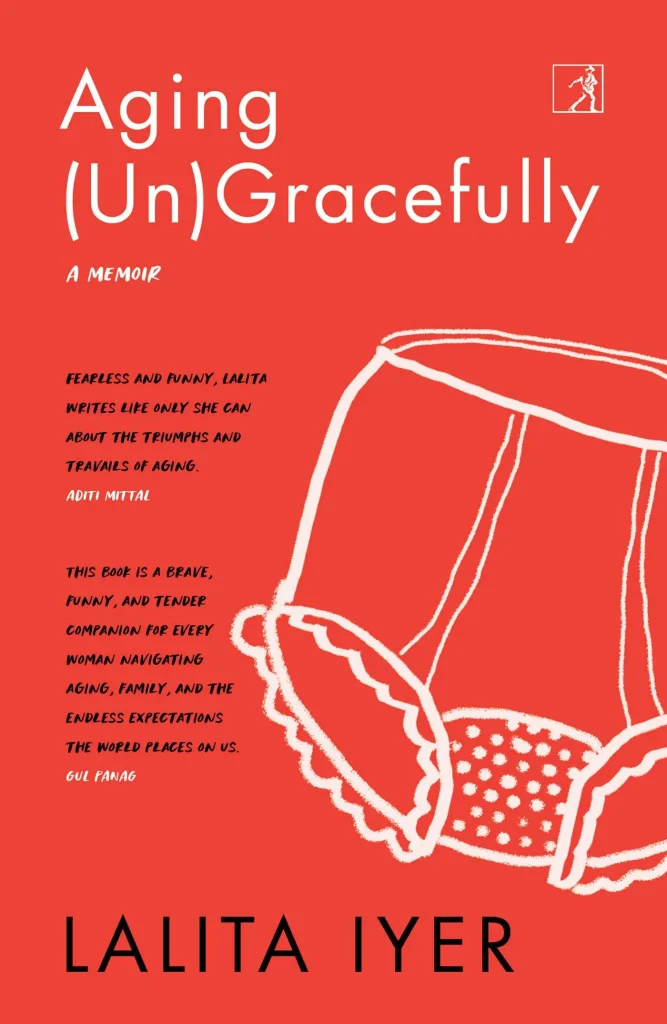
Cover of Aging (Un) Gracefully by Lalita Iyer

Aging (Un) Gracefully

By Lalita Iyer


Aging is the ultimate disruption, a chance for women to reclaim themselves. Because really, at what age do you become 'old'? How is 'coping' with advancing age any different from coping with, say, puberty? While our bodies are rapidly losing estrogen, we notice our patterns, find our most authentic selves, take a friendship inventory occasionally and build new ones, realise that finding our tribe is always a work in progress—there are so many surprises to pack in. Being liberated from the womb coincides with a new kind of learning, unlearning, and relearning, an acceptance of ourselves and our bodies, and infinite awe and gratitude about the many things we take for granted in our youth. In this memoir, Lalita Iyer takes a deep dive into the many ways in which ageing is both a ‘growing up’ and a liberation.

Review: Aging (Un) Gracefully

Iyer’s memoir critiques the systemic pressures on aging women, positing individual autonomy and chosen solitude as crucial acts of liberation against entrenched societal expectations.

Virginia Woolf’s use of the metaphor, “Angel in the House” was a contemporary response to the long, gruelling struggle for women’s rights and equality. The speech was delivered in 1931, but the idea of the ‘angel’, a systemic set of expectations that burdens women, remains relevant deep into the 21st century. Woolf was addressing the woes of working women, but it is an affliction that runs riot across our socio-cultural-political-economic spheres of being. While gendered roles and expectations stymy women at almost every stage, perhaps it is most obvious in their struggle to exist as individuals and as women climbing the age ladder. 

Lalita Iyer’s Aging (Un)Gracefully – A Memoir, addresses this dual struggle through the lens of the woman’s body and the perception of women as they choose to walk alone and to age in their own ways. 

The title stakes a claim; it challenges unsaid taboos around the concept of women’s aging. Claiming the self is in itself a horror that defies notions of womanhood that veer between the image of woman as devi and woman as a witch. For the woman claiming the self is protest, proclamation, assertion that ‘I am enough in myself’. 

Sometimes, this journey from perception/ expectation to belonging-to-the-self comes through small mundane, everyday acts of resistance and discovery.

I have discovered my own capabilities—how to build a home and a network everywhere I go, how to negotiate paperwork, how to advocate for my child in school, how to make him advocate for himself and for others, how to stand up for myself in spaces where I was once made to feel small. I have learned that I am enough – I always was (pg. 14).

The realisation of one’s potential and promise need not be tragic or humourless. It is a journey of discovery, and discoveries come in all forms and hues – some difficult, challenging, demeaning, enervating, but also those that are simple, energising, uplifting, comical. The folds of skin, wrinkles on the face as a woman ages, are natural, but for some, these could be nightmarish. For others, like the memoirist, acknowledging and accepting this ‘more’ on the body is liberating. 

Less is more and more is good enough: This could well be the book’s defining idea. Paring down, cleaning up, jettisoning – these rituals of living lighter, of living with the self rather than with things and with others, is something many women in their fifties arrive at naturally, as if the body or the mind sends out a signal to lighten up, to dismantle and recreate with fewer resources. Simultaneously, there is a sense of ‘more’ that seems less intimidating: more flesh and weight perhaps, more time for the self, more thoughtfulness, more mindfulness, more immersion in the present. 

None of this is handed on a platter. One has to work at it, daily, every hour. The yearning to be with oneself takes courage to acknowledge and accept. It takes much more courage to speak it aloud to the world that expects women to be always and only ‘giving’, taking care, thinking of others. That a woman may want only herself is an abomination in the eyes of the world. 

Most of the time people are mystified that I can be alone and yet lead a fulfilled, creative life that doesn’t feel incomplete. My son will leave the nest in two years and I will be done with the daily motions of motherhood. By then, I am guessing one or both of my parents will be gone too.
And it seems almost ungrateful and cold of me to say that I cannot wait.

Because, for a woman to be alone and happy without anyone to look after is against the order of life, is it not? (pg. 167)

Iyer’s memoir could be the memoir for generations of women, an individual voice expressing a collective response to life, living, loving, nurturing, being. It also contains a retrospective judgemental look at the past, at youth and being young that does not always cut ice, but when it returns to the present, an evolving time of self-growth and self-discovery, it offers women everywhere a way of looking at the act of living without guilt and the baggage of other people’s opinions and wants. It is this that the ‘angel’ finds the most difficult to achieve.   

Iyer’s book splits this journey across 18 short chapters that are intensely personal. Yet, the personal is also the universal, the narrative thread looping and winding its way around collective experiences and recollections of aging. For the memoirist, finding joy and satiety in solitude is one of the discoveries in the process of growing older. The satiety is underlined by the rediscovered joy of housework, of slow time and conversation. Of watching the plants grow, the dough rise, the sun set. Of noticing the tiny details, the repetitive rituals that make a home of a house. And in so doing, of choosing to be a ‘domestic goddess’, rather than being forced to be the angel. 

This difference between choice and compulsion is a marker of women finding themselves, of feminism’s heft. It balances the tension between agency and conforming to social mores, making the act of nurturing therapeutic rather than rushed and compulsive. An immersive-ness that helps to slow down, get in touch with one’s inner world, understand what one really wants without ‘reinforcing patriarchal norms’.

Iyer brings the lens to various interpersonal interactions and relationships that mark and guide our lives: Friendships. Family equations. Marriage. Sex. Bodily changes. Personal needs and urgencies. Memories that the body keeps count of … and through it all, the constant need to take stock, to ‘recalibrate’, to reclaim. It takes a toll and one learns to step back or work harder. For most women, growing into the 50’s is a lot about looking back and mourning – ourselves, our pasts, relationships, losses – then looking into the present and remembering to count one’s blessings in the evolving moment, to cut down on expectations, to express ourselves to our children, parents, our friends, to let go. 

And early along this muddled, uncertain path, comes the sombre reality. Menopause. To many of us who have retained our sanity through this oft-prolonged period, it is one of the most liberating experiences, in spite of the trauma it entails. Suddenly, we are free. Suddenly, we are unafraid. Suddenly, we are ready to be gloriously invisible, the invisibility not a facade or a shell or even an armour, but we ourselves, confident in our skin, the scars on our bodies and minds signs of having struggled, fought, and emerged victorious for ourselves … 

My heart soared as I read some of these chapters, my mind screamed, Yes! That’s me, too. But then there are the chapters where the writer looks back at youth and its many “un-necessities”: its fears, uncertainties, insecurities, challenges, worries, arrogances, conceits… The narrative around this seems to put youth and aging on a see-saw, allowing for youth to weigh down with too much negative retrospection, making it tonally too flat to sustain. But it’s a memoir, and one gives a wide berth to individual remembrance and remembering.

The book meanders with equal amounts of seriousness and humour through the writer’s professional and personal experiences, a failed marriage, child-rearing years as a single parent, caring for parents, and dealing with financial worries … with searing honesty and with trust in the reader to understand this odyssey in all its glamour and its ugliness, its exhilaration and despair. The personal narrative constantly draws upon the possibility of collective memory, and this approach of suggesting that we are in this together, that we have been together, makes the narrative accessible for readers who are either on the brink of this crossing or those who have walked across already, and it offers them a different possibility. It enables other readers to understand a woman’s physical, mental and emotional shifts as she grows into her fifties, of her ability and right to live alone and contented if she so chooses, of defying norms and expectations, of setting her own goals, choosing her own path. It provides a perspective into the idea that liberation is not something that one has to be given but a way of being that one can create. 

That’s the thing about being young-old. It is not a descent into irrelevance. It is a rebirth, a reclaiming of the self. It is a declaration of independence from the expectations of youth. It is the moment you stop striving and start being. And in that, there is liberation (pg42).

Looking for more Books?

Browse the Bookshelf →

Lalita Iyer in Conversation with Rituparna Mukherjee

Iyer's memoir refuses the polished narratives of graceful aging, locating instead a middle space where nothing collapses spectacularly but everything quietly shifts. Her account insists on the messiness preceding freedom, the grief embedded in recalibration, and the gaslighting women face when they resist disappearing politely.

RM: Hello Lalita! It’s so good to talk to you. Thank you for taking out time to talk to us and hearty congratulations on your memoir Aging (Un)Gracefully. It is earnest, engaging, witty and a really good read. You mention at the very beginning how certain points in your life brought about major shifts and moved you to take a stock of your life. What spurred you to write this memoir?

LI: Thank you, Rituparna, that’s lovely to hear. I think the book emerged from a series of quiet reckonings over a few years rather than one dramatic moment. There were enough life events – parenting a teenager, watching my parents age, leaving cities I thought I would grow old in, work that no longer thrilled me in the same way – for me to realise that the old templates no longer applied. I was still functional, still competent, still productive and alert, but something inside me was asking for a slower, more honest audit.

Aging, I realised, wasn’t something that was happening to me—it was something I was actively navigating, resisting in some places, embracing in others. I wanted to write about that middle space where nothing is falling apart spectacularly, but everything is quietly shifting. The memoir became a way of making sense of those shifts, of naming the discomforts and the unexpected freedoms, and of saying out loud what women are often encouraged to smooth over or keep private.

RM: Recently, Lisa Roy was talking about the lack of representation of women in their 40s and 50s in the fashion industry, which she finds ironic because it’s the women in that age group who have the means to purchase high-end fashion. You talk of aging as a thing of beauty and joy, and I especially loved what you say about the clarity, perspective and freedom on the other side. How important has it been for you to be upfront about your experiences, expectations and struggles in this context with the readers in mind?

LI: It felt essential to be upfront because there is so much gaslighting around ageing—especially for women. We are told to be grateful, to age “gracefully,” to not complain, to disappear politely while still looking effortlessly put together. I wanted to resist that neatness.

There is beauty and freedom on the other side, but it doesn’t arrive gift-wrapped. It comes after a sense of loss or grief, a realisation that there are versions of yourself that no longer exist, and a recalibration. This is messy. Being honest about the messiness felt like the only ethical way to write this book. I didn’t want to sell empowerment as a lifestyle upgrade. Clarity and perspective arrive because you’ve waded through confusion and self-doubt. Freedom comes when you’ve stopped auditioning for roles that no longer fit. If the book does anything, I hope it reassures readers that they’re not late, broken, or failing – they’re just in the middle of becoming or unbecoming, depending on how you look at it.

RM: City life, the nature of most jobs at present and the conditioned construct of hustle and overextending ourselves to achieve goals has led many to burnouts, especially for women who are additionally tasked with emotional and domestic labour, often under-appreciated at best. You mention that your time in Goa and the shift to the hills has been key in slowing down, finding satiety and happiness. Although COVID has been a deeply unsettling time for us, do you think it also enabled most of us to recalibrate, to use your term, and rethink about the quality of our lives and slow down even if a little? Would you consider slowing down a privilege and what does slowing down mean for you personally?

LI: COVID was deeply unsettling, but it also stripped away a lot of the performative urgency. It forced many of us to confront how much of our busyness was habit rather than necessity. That said, slowing down is absolutely a privilege, and I’m very aware of that. Not everyone has the option to step off the treadmill without consequences.

For me, slowing down has less to do with doing nothing and more to do with doing fewer things with greater attention. Living in Goa and later in the hills recalibrated my sense of time. Days stopped being measured by productivity alone and started being shaped by weather, meals, walks, silences. I became more alert to satiety – not just in food, but in work, relationships, ambition. Slowing down, in that sense, became an act of refusal: refusing exhaustion as a badge of honour, refusing to overextend emotionally, refusing the idea that worth is tied to constant output.

RM: I am so glad that you talk extensively about emotional labour and caregiving, of the depletion of our emotional reserves, the challenges of caregiving and the many sacrifices it necessitates, especially from women who are for all intents and purposes primary caregivers in most cases. I really feel this is an aspect that is not talked about much. What I found remarkable is how you differentiate between the love for one’s child and the love for the act of parenting that is often conflated. What has helped you to navigate your own caregiving responsibilities along with holding on to a firm sense of self? How has your own writing factored in this mix?

LI: I think separating love from labour was a turning point for me. Loving my child has never been in question, but loving the work of parenting—its relentlessness, its emotional negotiations, its invisibility—has been far more complicated. Once I allowed myself to admit that without guilt, things became clearer.

What has helped is acknowledging my limits and resisting the idea that good caregiving requires self-erasure. Writing has been central to that resistance. It has been the space where I am not needed by anyone else, where I am not useful in the traditional sense. Writing insists on solitude, on attention, on taking my own thoughts seriously, and allowing myself to sit with them. In a sense, it has functioned not as an escape from caregiving, but as a reclamation of the self alongside it.

RM: You mention how a return to your roots has been important to you to come fully into your own—rebuilding your relationship with the food you grew up with, decluttering and minimizing objects, gardening, enjoying the quiet rhythm of banality—how has a life in the hills brought about a shift in perspective, especially in terms of creating a work-life balance?

LI: The hills reintroduced me to banality, and I mean that as a compliment. There is a steadiness to everyday life here that cities rarely allow. Spending time in the garden, even if I am not growing anything actively, restoring and repairing through my mending projects, baking sourdough, cooking familiar food, living with fewer objects – it all brought me back to a version of myself that wasn’t constantly overstimulated or aspirational.

Work-life balance stopped being a theoretical ideal and became something more tactile. Work found its place rather than bleeding into everything. There is less urgency, fewer distractions, and a greater respect for natural rhythms. I stopped trying to optimise my life and started inhabiting it.

RM: In talking about domesticity in one of your chapters, you speak very candidly about how feminism is often misunderstood as a radical position that puts constraints on choices. Do you think there is a gap between a perceived stance on feminism and real feminism? There is a certain dichotomy with which the professional and personal choices of women are viewed even by the most well-intentioned friends. I found your earnestness about freeing yourself from the constraints of 9-to-5 jobs, valorised motherhood and performative sex particularly meaningful in this context. What has been your strategy in bridging the gap between perceived feminism and real feminism?

LI: There is a significant gap, and it often shows up in how women’s choices are policed—especially by other well-meaning people. Real feminism, for me, is not about prescribing correct choices but about expanding the space in which choices can be made without punishment or moral hierarchy.

My strategy, if I can call it that, has been to live my contradictions openly. To step away from the 9-to-5 without romanticising precarity, to question valorised motherhood without rejecting care, to opt out of performative sexuality without shaming desire. Bridging the gap has meant refusing to explain myself endlessly and trusting that coherence doesn’t have to look tidy from the outside.

RM: In talking of your conflicted relationship with your body and your loving acceptance of your “wobbly bits”, you take us on a journey most women traverse every day from a locus of desire. What has been your greatest tool in disassociating yourself from the societal gaze and the preparedness for that gaze? 

LI: Time, mostly. And fatigue. Walking inward reintroduced me to parts of myself that I would choose any day over sterile company. At some point, the effort required to constantly monitor and manage the gaze becomes unsustainable. I grew tired of rehearsing myself for visibility. Accepting my body didn’t come from self-love affirmations but from a quieter truce—this is the body that has carried me through, and I no longer wish to be at war with it.

RM: Bell Hooks says sisterhood is power and you have often fallen back on your female friends for advice, support and a general good time like most of us do. You also talk about various kinds of friendships and how they need to be nurtured or forsaken with time. Writing is essentially a solitary activity and you talk of the necessity for ‘aloneness’ for summoning your truest self. Alongside, writing also flourishes in and sometimes necessitates a community. As a private person how have you balanced this tightrope? Also, why do you think as a culture we are so afraid or suspicious of the need for ‘aloneness’?

LI: I’ve learned that aloneness and community are not opposites—they are interdependent. Writing requires solitude, but living well requires chosen kinship. I rely deeply on my female friendships, even when I retreat from them temporarily. The balance lies in honesty—being clear about when I need company and when I need quiet.

As a culture, we are suspicious of aloneness because it resists consumption and control. Aloneness is often mistaken for loneliness, when in fact it can be a deeply generative, stabilising state. For me, it has been essential—not as withdrawal, but as grounding. A woman living by herself, mostly content and thriving is unpalatable to many. 

Looking for more Books?

Browse the Bookshelf →
Back to Issue

Support Our Work

If you enjoy our content, consider supporting us.

Support Us

We are an unfunded, independent feminist publication. We need your support to continue our work.