
Usawa Literary Review is headquartered in Mumbai, India.
PIN Code: 400050
Interested in working or collaborating with us?
Contact Us

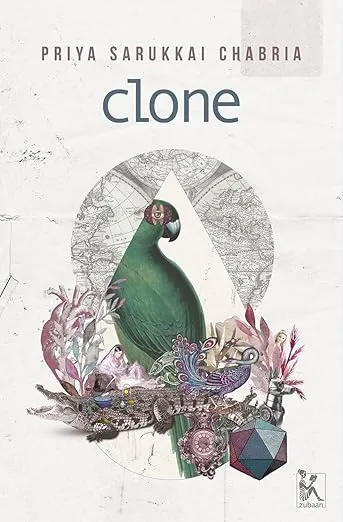
Clone

By Priya Sarukkai Chabria


A revolutionary take on the classic dystopian science fiction novel, Clone inaugurates a new kind of writing in India. Priya Sarukkai Chabria weaves the tale of a fourteenth-generation clone in twenty-fourth-century India who struggles against imposed amnesia and sexual taboos in a species-depleted world. With resonant and allusive prose, Chabria takes us along as the clone hesitantly navigates through a world rendered unfamiliar by her expanding consciousness. This slow transformation is mirrored in the way both she and her world appear to the reader. The necessary questions Chabria raises revolve around a shared humanity, the necessity of plurality of expression, the wonder of love, and the splendor of difference. Clone’s adventurous forays into vastly different times, spaces, and consciousness—animal, human, and post-human—build a poetic story about compassion and memory in the midst of all that is grotesque.

Excerpt: The Clone

Experiencing forbidden memories, a futuristic clone delves into an ancient world of Buddhist artistry and divergent perceptions, challenging its understanding of self and reality.

Prologue

  I am a fourteenth generation Clone and something has gone wrong with me. Not that my DNA is altered. Not that I am a mutant. Not that any function need be eliminated. It’s nothing obvious.
It’s terminal, and secret. Let me put it this way: I remember.
  My consciousness is morphing in an unplanned way. I’m also very lonely. It’s not pleasant to have memory and no one to share it with. I don’t dare. Which is why I’ve decided to keep a diary hidden as a cellchip in my system. So far undetected; so far, so good.
  The first strange thought I had was of a dodo. It was the last dodo and I was it. This thought-experience rushed with adrenaline. I was feathered, flightless and fleeing.
  The thought passed. Others followed. Each disconcerting, each more detailed. I thought I was going insane. I went to check out with my Elder, the thirteenth generation Clone. But I was late. My Elder was a saintly member of our community who had recently signed up for the Exhaustive Organ Transplant Scheme. I reached a liver, one eye, two feet, three metres of skin and perfect clavicles.
  The only option left was to research my Original, to check out if these visitations have something to do with transmutations in her neurological circuitry. Or maybe something was overlooked in the cloning process. This is not supposed to occur. But neither are we to carry memory traces beyond the second cloning.
  Ours is an open society. Everyone—Originals, Superior Zombies, Firehearts and Clones—has equal right to access information. Nothing is prohibited, but there are consequences. However, I have decided to take the risk. Initial investigations suggest my Original was a writer living in the late twenty-first century. Maybe she should never have been cloned.
  It’s curious. I’m getting into what I suspect was the Original’s life, or possibly her writing life, depending on how one wants to view it. These are strange ideas for a Clone. But strangest of all: I remember.
  My consciousness has morphed.

*
The Painted Caves |
Buddham Saranam Gacchami
Sangam Saranam Gacchami
Dhammam Saranam Gacchami

  The words. The way the words echo through the prayer hall, echo as if my chest were the cave wall, as if all the bhikkus were inside me, chanting as I chant. But that is exactly what my Teacher says: everyone is inside me and I am in everyone as well, because we are bound together living in this sorrowful
world which is like a burning house, full of flames.
  I like to squeeze open my eyes, one after the other, very slowly after the prayers. Then the monks really look like flames in their orange and red robes, like the little flames that dance on top of oil lamps and torches. All the murals on the wall also dance. They sway and float with the flickering torch-flames.
Everything moves.
  Jewellery dances most of all. Pearls and gems which nymphs, emperors and queens wear throb and recede with each step the acolytes take as they carry flames. I think the flames run fastest as the acolytes pass before the paintings of the Bodhisattavas Padmapani and Vajrapani. How wonderful they are. Their half-closed eyes glow, their crowns shine, their pearl necklaces flame and dance like so many raindrops running on a string.
  My mother wore a necklace of big red beads. Each was a full seed. She would let me touch it. My mother wore marigolds, the colour of the Buddha’s robes, in her ears, and in her hair. I still remember this. I had a brother and two sisters. My youngest sister would eat mud off the floor of our hut. She’d put everything in her mouth. Even goat shit; Black-One’s, who would be tethered to the doorpost. How she’d bleat!
  Now I don’t have a family. The Sangam is my family. I am a junior acolyte. The name given to me is Dhammapada. My hair is shaven, like Majjhima’s. He is my best friend. In seven years’ time we will finish our nissaya-training and become junior assistants. When we are even older, we want to become the best Navakammikas—like our Teachers—and work together supervising the best works. Two caves are being commissioned near Seven Step Waterfall to our left. After the monsoon, woodcutters will begin clearing the rock face of one site; in the other, workmen with pickaxes will start digging out the ceiling.
  We are so excited. Majjhima is very clever; he has secretly designed the whole cave, even our cells. I agree with all his plans—except I wanted the Miracle of Sravasti to be painted not on the right-hand wall but opposite my cell so that each morning the first thing I see are hundreds of Buddhas glowing peacefully. I said I’d be in charge of preparing the walls, finishing the lime coat and mixing the dyes. I’ll become an expert in colour. My Teacher hardly sleeps when a new cave wall is being coated. He is always touching the pastes, feeling their thickness, their stickiness, and suggesting, “Add more rock grit! Some more paddy husk!” He walks up and down, inspecting the textures of the cave walls, the texture of the covering pastes.
I follow him.
He never shouts at any worker.
  Recently, he has become even quieter because he is in slight disgrace. Because of the incident with the doorjambs. But it is not his fault. The woodcarver promised to carve dragons on all sixteen doorjambs, just as my Teacher instructed. Instead of working here he took them to his village because he wanted to look after his sick wife, he said. My Teacher allowed it. When the woodcarver returned, the doorjambs held kissing couples. Front and back. All sixteen! He said he could only see mithuna couples trapped within the wood. He said the wood would have split if he had tried to carve anything else.
  The Head Priest of our vihara-hall is very strict. He says he will now have to be careful where he touches the doorjambs. He made the woodcarver do two lion-claw stools as penance. Later I ask my Teacher if the wood for the doorjambs is magical. My Teacher says he saw coiling Guardian Dragons in it, but the woodcarver saw lovers. It was a matter of Inner Vision. What you see depends on who you are. He says if I am good I will see goodness everywhere, dhamma everywhere. When my Teacher speaks like this I feel dizzy with joy.
  On the last full moon night, Majjhima and I quietly run down to the sandy strip near the river. All is blue and silver and sparkling— stars, trees, white sand, even the sound of the river. Majjhima draws a beautiful lotus bud by throwing water on the sand. It is perfect. Then the design sinks into the ground and disappears, as if it had never been.
  But it was just like the lotuses we see painted on the vihara-hall ceilings as if each one is bobbing on a breeze that is waving over a lake. Except of course the ceiling paintings are upside-down, as if the whole world is topsyturvy, as if I am a heron flying on my back through the air seeing the water’s face in the sky.
  When I had newly joined, often when I was eating I’d glance up at the ceiling. Quickly. See all the lotuses and geese and bulls and elephants bobbing and waddling and running and swaying. Look down quickly, into your bowl and you’ll see all the flowers and animals inside, inside your bowl of gruel. Look up again—they will be back on the ceiling. My Teacher noticed me looking up and down. Up and down. He said I should not be distracted by transient pleasures. So I stopped.
  I should not lie. I do it slowly. But then I can’t see lotuses floating in my bowl of gruel. It happens only when you are fast. In a flash. Suddenly you see white lotuses within the palm of your hand.

Looking for more Books?

Browse the Bookshelf →

Review: Clone

Clone scrutinizes how memory and art resist a posthuman dystopia, challenging humanity's definition amidst power structures that erase individual and Global South histories.

Mutation of an Artist

Erudite Priya Sarukkai Chabria works on a vast creative canvas; she writes delicate poetry, scholarly essays, translates world and classic Tamil poetry, and writes fiction too.

Priya has brought out three novels so far, the last two of them quite strongly in the speculative genre. Her repertoire perhaps deserves to be evaluated as one whole and not different individual units; because her women protagonists do evolve as they survive through the narratives and exhibit a sense of freedom which has sustained through their mutations.

Priya has had an unconscious artistic plan in place right from the first novel, The Other Garden. This is continued in the second novel Generation 14. And in the third novel, Clone (which is a finely edited version of the second), the writer has a continued and frenzied engagement with an extraordinary narrative that defies definition. It would be worthwhile to take a peep at the plots.

The Other Garden is a highly stylized story of the unconventional Anasuya, a protagonist unsure of her identity, yet fiercely protective of her independence. Her resistance to conforming to anything conventional, progresses into a narrative which plays with form and tone. Anasuya, as she negotiates with the world around her in her celebration of doubts, goes on to earn a space which hangs precariously at the edge of normalcy. ‘She’s strange, she’s white and old, she talks to clouds and trees’ says one of her later narrators. Her anxiety (the artist’s anxiety actually) with the world that has chosen to forget is reflected in her metamorphosis as a character, which is illustrated through various chapters narrated by various raconteurs. But she survives with plenty of energy intact. The unrelenting Indian philosophical quest of the self is an evident thread throughout the book. This novel may not be classified as pure SF, but the mutation of a lone character is merely not physical here, it happens at an atman level.

In the second novel Generation 14, Priya takes an obvious deviation from mainstream fiction while continuing her experiments with language. This is the story of Clone 14/54/G, a fourteenth generation clone, living in the twenty-fourth century. The writer merges fantasy and history and also accommodates the ‘today’ that is blurred by the conscious efforts of a society by repressing and suppressing individual choices. A globalised world that turns its back on plurality or otherness and falsifies history is showcased in a manuscript which bends forms and structure once again to sketch a bizarre political satire. For example, the novel is not written with a beginning, middle and end, in that order. The shorter form is used to support the framework of the main story and emotions are the pegs on which each of the stories hang. As the writer says, the stories are set in the past while the experiences of the protagonist happen in the future.

The third novel, Clone, is a reworked, updated edition of Generation 14. She, (yes, it’s not a gender-fluid world yet) is unique because she remembers; and this is a world where memory is taboo. Plus she has her sexuality in place, another taboo. It’s about a ‘species-depleted world’ and struggles against the imposed bans, and it has the Originals who are the gene pool, the Superior Zombies who are the militia, the Firehearts who are the poets, the Torturers and of course the Worker Clones. The main protagonist is at the lowest rung in hierarchy and imminent fault lines of the centuries ahead are used to mirror the dystopias that threaten to inhabit our worlds. Both the books are about the making and building of a world to reflect an intensified version of the current conflicts in the contemporary world. But Clone comes clearer in its intentions.

It’s a terrifyingly orderly world which suffuses the perfect system of a bee or ant colony with one lone human element, viz. hunger for power, that too in its universal version. The primary question the novelist raises here is what is that which makes us human. She also asks how we can resist violence. Can we use art for that, or should it be responded to with violence alone? How can we stop seeing the next person as an ‘other’? Sounds quite contemporary? Indeed!

Opting for the genre of SF allows the writer the advantage of using fantasy as a tapestry while dealing with perfectly human attributes like love, loss and anger. There is freedom but with limited choices, like choosing your method of torture. Priya establishes the world order in the ‘Global Community’ right in the opening pages.

I am a fourteenth generation clone and something has gone wrong with me. Not that my DNA is altered, not that I am a mutant. Not that any function need be eliminated. It’s nothing obvious. It’s terminal, and secret. Let me put it this way: I remember.

The consciousness of the protagonist then morphs ‘in an unplanned way’ and she starts feeling lonely. It’s not pleasant to have a memory and no one to share it with. I don’t dare. Which is why I have decided to keep a diary hidden as a cellchip in my system.

Memory manifests in ‘Visitations’ of happenings across millennia. The Indian subcontinent emerges in these visitations – one geography at a time, one era at a time. And we start understanding those lessons in history that the 24th century should but doesn’t know. This essential commentary on the strength of memories that entire governments spend their resources on suppressing and erasing is crucial to the purpose of this novel – only the storyteller’s words tell the truth, such as Aa’s memories and pillow book, a truth that only the Clone is privy to. The reader senses the inevitability of violent censorship that would ensue, but doesn’t know how, in this new world defined by unknown rules.

As the story progresses she goes ahead to do more than remember. She starts desiring too, and is shown writing on the walls with lipstick. Animal and post-human narratives run in parallel with human voices as Priya folds these into allusive prose. But is ‘Clone’ only about saving memories and talking about falsifying histories? Will Artificial Intelligence ever take over humans completely? As a race, will we ever surrender the burden of our emotions and opt for the power of the machines? Running as an underlying thread, there also seems to be an inadvertent discussion of Chathurvarnya in the hierarchy of the ‘Global Community’.

Clone is not a fast-paced read, and not a ‘single story’. Most times, it is a difficult read and one senses the writer has consciously made it so; every read but opens up more possibilities of its layers. And even then one senses the book has more to say, yet. The very fact that the author did not write a sequel to Generation 14, but went on to work on an already published book and re-release it, says volumes about the writer’s inner angst about a character she has created and let out into the world already. And that each book from her has a decade plus between them indicates the silent churning in the mind of this indefatigable artist.

Priya is one of those indomitable flag bearers who continue to shine the light for those who follow her. The path she treads is not one that’s marked, she has chosen ‘the road not taken’ and it’s purely by intuition that she leads and marches on. Priya Sarukkai Chabria is continuing to do to Indian English fiction what Shashi Deshpande did before her, make feel the presence of a genre which has no name yet, which few are prepared to acknowledge for fear of its annihilating what was there before it. I would not call it genre-bending, I would go with the word genre-creating.

Clone now stands as a unique work, a collage of the thoughts that emerge from a responsive mind that’s well versed in art and philosophy and exposed to the best of Indian writing. It cannot fit into the defined genres, it can only defy them.

Looking for more Books?

Browse the Bookshelf →
Back to Issue

Support Our Work

If you enjoy our content, consider supporting us.

Support Us

We are an unfunded, independent feminist publication. We need your support to continue our work.