
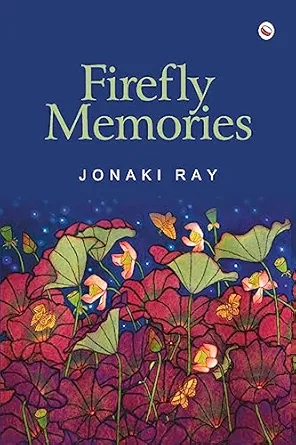
Remembering Fireflies: Jonaki Ray’s study of the light in dark times
It was August in Dharamsala and bucketing torrents as usual. Though I had spent many of months of my childhood in India, this was my first monsoon, my first journey ‘back home’ without my Mum and it was about to be my first Independence Day. It felt significant. We had a corresponding holiday from the school for Tibetan refugees at which I was teaching infants Creative Arts, so I decided to take a journey, a journey that could be completed in a day (or so I thought at the time). I would board the narrow gage railway train at Kangra and keep going until the end of the line, to the remote and exciting-sounding distant location of Jogindar Nagar. I would take my camera and my diary and return again by evening.
The journey, though delightfully slow enough to take a great many photos on the move with my old-school manual Nikon as we trundled through lazy forests, past farmsteads, through temple towns, was tempered with a faint anxiety as I realised that darkness was falling and we were still nowhere near the temple town of Baijnath Paprola. ‘Another two hours’, the TT declared. This train definitely would not be back in Kangra any time soon. I stared out through the bars of the glassless window, kicking myself for having left my passport in my old battered leather suitcase, back at the hostel in Dhasa. No passport would mean no place to stay. I sighed. Then suddenly caught my breath. There had been a twinkle. The coal black railway banks were lighting up, first with one, then five, then a thousand tiny sparks. It was as if they were telling me koi baat nahi, enjoy the journey, sparkle for your brief moment, just like us. Who were they? In a flash, it came to me. Fireflies! Dancing, illuminating, creating magic for a stretch perhaps a kilometre long. Whatever happened next, this journey had been worth it.
This memory of fireflies resurfaced, naturally enough, as I read and re read Jonaki Ray’s acclaimed book of verse, Firefly Memories. When we discussed the poem within that collection entitled ‘Fireflies’, which I read as a poetic biography of Ray’s late father, I asked her how important, given that the book is dedicated ‘to Ma, always’, she felt the generational memories from both the patrilineal and matrilineal lineages to be: how much did they need equal representation?
‘Fireflies represent dreams in dark times,’ Ray states. ‘At the time the book came out, my father was still alive, and I wanted to acknowledge my mother’s significance in my life, hence the dedication to her. I do believe that both the lineages are equally important, but my mother’s contribution to my life perhaps needed more highlighting given that innate patriarchy around us’
In the light of my now-distant Kangra journey – and given that I have since travelled by road and rail probably a hundred times more through that particular valley and never seen a firefly since – I wonder whether Ray considers the tiny insect to also represent a vanishing, even a cultural erasure of magic and light from our existences. Ray, who has lived in both the US and Europe as well as India, indicates that our experiences on Earth are becoming increasingly generic when she writes in ‘Talk About Trees’, ‘Delhi becomes Kashmir becomes Louisiana becomes Michigan becomes Florida becomes Kerela‘, and this reminds me of Ranjit Hoskote’s (by now famous) line, ‘Everywhere is Gaza‘. I ask Ray what impact she feels our collective exposure to human tragedy, climate change, habitat loss, digitalised language and political dictatorship through lived events or media is having on our evolution as a species? Is our depleted ‘extinction of experience’ (to quote Yuvan Aves) to be feared? Does Firefly Memories come with a warning label, reminding readers to guard against mental and cultural annihilation?
‘It’s a sharp downward slope at the moment,’ Ray says. ‘Unfortunately, as my poem (and Ranjit’s) bring out—it’s not the actual names, but the commonality of tragedy that is making us go backward in evolution. And whether it is climate change, the digitalisation of not just language but our responses, a lack of compassion and empathy seems to be pervasive around us. And just like fireflies are becoming extinct, so too are our “human” qualities.’
Reading Ray’s poems about people with dementia whose fading worlds and latterly eccentric experiences resonate deeply with anyone who has witnessed extreme memory loss in close relations (‘This is a Country for Old Women’, ‘Schrodinger’s Human’, ‘Multiple Choices Nostalgia’), opens us up to the predicaments of amnesia, dementia and diminishing referents in both an individual and on a societal level. How much, I wonder, does writing a poem, writing poetry, guard against this inevitable loss and erasure? And as a poet, how conscious is Ray of documenting vital social and familial history?
‘Poetry is definitely a therapeutic tool as well as a coping mechanism against grief and loss,’ Ray tells me. ‘A lot of my poetry was written from that perspective, initially. I also see the common patterns of injustices in the world and think art, especially poetry is a way to highlight and document those. As poets we need to testify and speak up against wrong.’
I am guessing that this is what motivates Ray to write about particular stories and incidents from the daily news, instances of horror or sorrow which haunt, however fleeting their print versions last in our everyday world. I ask Ray how and why she chooses particular stories for ‘poetic reportage’ in poems like ‘Missing Child Report, Amar Colony, Delhi’ and ‘Normal Acts’; and I want to know which is her preferred way of accessing ‘news’: through physical newspapers, journals, radio, TV, apps, or every day conversation?
‘It’s mostly through physical newspapers and every day conversation—I usually write about something that evoked a response in me, and then conduct some research and write in more detail based on it,’ she replies and I remember at this point, that it was through the print version of the Hindustan Times that I first connected with Ray’s work, when HT’s iconic Delhi Walla’s column featured a poem Ray had written one year after her father’s passing. I was as arrested by this poem as by the sight of fireflies, since it spoke loud and clearly about Delhi life and the emotional impact of loss in the big city. As my own poetry had also been featured in this column some months previously, I suddenly found myself reading in a new light: one in which poets were documenters for our turbulent times, keen-sighted hawks swooping down on choice metaphors and snapping up unexpected rhymes and half-rhymes from amongst the medley and debris.
I turn to the glossary at the back of Firefly Memories and see how many Hindi and Bengali words I recognise after thus many years living in Rohtak, Delhi and Manali. I am reassured to find that I recognise the names of trees and food (Neem, Jamun, Semal; Sandesh, Rosgolla, Biryani, Gur, Daal, Namak,), and am dismayed to find that my understanding of simple phrases is lamentable. I commit to memory ‘labar labar’, ‘Ghar ke maamle’ and ‘kalbaishakhi’, hoping to fully earn my ‘Overseas Citizen of Indian’ status – as baffling as that title always is me, since I actually live on Indian soil and am not over any sea at all. I flick back through the collection and notice that within the poems themselves the Hindi and Bengali words are also italisized. Even when Ray writes about Italy and the US, her poetry is infused with memories of India, strong and unwavering. I wonder if when writing poems abroad, Ray felt the need to ‘translate’ for a non-Desi crowd, and if so, where she envisaged that the majority of her readers would be living.
‘I didn’t envisage the audience per se,’ admits Ray, ‘but some of the poems had been published in journals outside India and had included a glossary. I therefore decided to retain it.’
Perhaps the breathing space between parts of a line is an even better indicator of a poet living and writing between worlds, between cultures: there are certainly moments when the gap- blank- memory loss- switching off of the firefly’s light occurs in ‘Dreamland’ and ‘(Be) longing’. I am curious to know whether these and the more obvious shape poems like ‘What Remains’ are particularly close to Ray’s heart, both for what they say and for how they visually appear on the page. ‘I find shape poetry tremendous in its potential because even the space around words can be used to communicate,’ elucidates Ray. ‘I always write longhand—and then add spaces when I type the final poem on my laptop.’
Before closing the book, before concluding the article, I decide to do one more read through to find how many instances of light, how many memories of fireflies, I can find: I discover ‘the neighbours’ lights-turned-to stars,’ ‘snow angels’, ‘orange and gold autumn nights’, ‘light-harvesting bacteria’, an aunt’s sari on fire, ‘slightly dirty full-moon babies’, ‘crystal globules floating from the ceiling’, the gleaming bronze scales of a dragon, kingfishers ‘flashing their blue’, sunshine on a ‘gang of schoolboys’, a grandfather’s pyre, ‘silver moss filigree’, ‘buttery light pouring over miles of yet-to-be harvested farms’ moonlight seeping through the cracks and of course, ‘fireflies lighting the night’, the same fireflies after whom the poet was named.
In spite of the dark times, it seems that light seeps through the fabric of this particular vision: and though we live through amnesiac, erased times, Jonaki Ray’s firefly memories may well hover in the collective periphery vision for a good few many moons to come.