
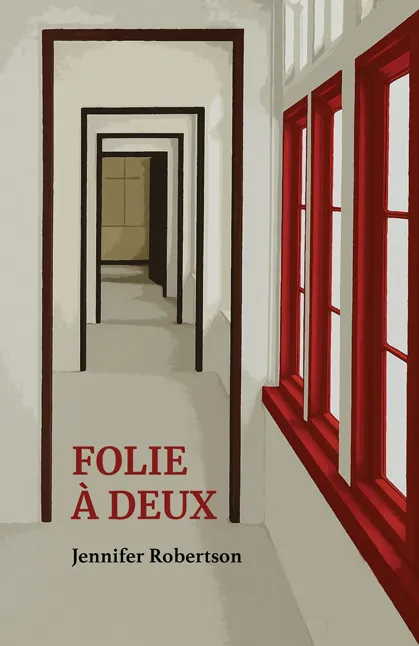
The hallmark of an excellent poem is that you want to read it again and again. And if a bunch of such poems are brought together in a collection, then you are truly fortunate. Folie À Deux by Jennifer Robertson is one such collection where you go back to every poem, with wonder and delight, every time.
The purpose of a review is to let a reader know in advance what she is getting into. To get a sense of what the texture of this collection is, I find it best to begin with a poem. I begin with their opening poem, Bleu:
Somewhere in the distance,
a leaf falls
and displaces its shadow.
I have been looking for that shadow
and writing of that fall.
If it were a pronouncement (I’m sure it is not) no one would have held it against the poet. Almost every poem in this collection has that quality of being a thought that is so much larger than the words it is encased in.
Theme
There’s a myriad of themes explored in the collection. It’s hard enough to ascribe a specific theme to an individual poem, let alone the collection as a whole. So let me try and describe the texture of the themes. There’s domestic violence (without ever naming it), there’s grief, loneliness, and at times a political unease. As a poet, Robertson mostly begins with the specific and ends with the general. At times in a very dry, deadpan manner:
I could talk about the woman
who had facial scrapes, bruises and cuts.
All minor injuries.
But let’s talk about the SONY India web page instead.
At times as a subtle observation —
I like the tiny economies of restraint
of not knowing the size of your fist
when the doorbell rings.
These images also introduce a turn in each of the above poems, which brings me to what I found the most remarkable thing about this collection.
Craft
Language is a sense-making tool. The more seamlessly ‘sense’ travels through a sentence, the better the prose. In poetry, however, language also has its music. The sounds, or more particularly, the arrangement of sounds, can create a unique experience that goes beyond sense, and at its best, the musical experience and the sense-experience travel together.
Silence
and chrysanthemums rush in
The sibilant sound is so neatly arranged that the sudden jump in sense from ‘silence’ to the name of a flower is not noticeable at first — by the time you register the sense, the sound has already lulled you into acceptance.
I hear the free-fall when you pray.
Levity lulls your words
in songs you often slay.
Each line is a consonantal sound cluster. The first with its ‘r’ sound, the second with ‘l’, and the third with ‘s’ sliding into ‘sl’. This is not the only place in this book where one encounters unexpected sound-play. In a poem called ‘Filming Amnesia in panch-phoran‘:
fragrant fennel with a buzz of black mustard; a pinch of nigella; a fallowed flourish of fenugreek with a bit of cumin candour.
This is the most obvious example of deliberate arrangement of sounds. The book is full of such sound pockets that silently work on you: ‘your palms might mask a meandering intermezzo’, ‘buildings, baby bones baffling stone heads’, ‘subtly, you say, bit by bit’.
It is easy for poets to keep self-indulgently playing with sounds, and even some sense, without having any insights from the experience. Robertson does not just play with sounds; her poems have those sudden, piercing insights that make you stop. In a poem that begins with a memory:
In the year 1987, I was riding pillion and my Dad was saying something; his voice was incoherent, I remember. I put my ears against his back. His voice remained muffled but the volume got amplified.
The amplification of a muffled voice is something we all must have experienced but to accidentally find it in a poem, especially as a beginning to something larger and more complex, is astonishing.
it throbs,
like an incision
a master stylist
approaching the sublime.
Sublime is nothing but throbbing of the void. Robertson gives it a concrete form by calling it an incision. It takes an exceptional poet to do this.
This collection is also a constellation of different interesting forms. For example, there is a poem called ‘The Relevance of Ibuprofen’ which begins almost as if it were a technical manual and ends up being anything but — it shows us the horror of domestic violence through the specific lens of a product manual. This is unique.
The only thing that miffed me about this collection are the allusions, especially to movies. The poet seems to have taken for granted that a reader will know what ‘a metaphysical moment in a Weerasethakal film’ is. This is a bit alienating.
For people in love with poetry, especially with the craft of it, this collection is a gift. It was refreshing to read something so well-crafted and imaginatively rich as this. I look forward to reading more from Jennifer Robertson.
Poems from the collection
- I Bleu
- II The Afterlife
- III The Tiny Economies of Restraint
- IV For I Am a Rain Dog Too
- V Always Your Diction, Never You
- VI Becoming Lydia Davis
Bleu
You approach me with
an intimate strangeness.
A deeper shade of blue.
You are not constant.
I wonder if I am.
Somewhere in the distance,
a leaf falls
and displaces its shadow.
I have been looking for that shadow
and writing of that fall.
The Afterlife
You move from tongue
to silence with a wanton ordinariness.
I draw a blur across my
face line after line after
line.
This is how we perish
and knock on window panes
like secret,
convulsive
winds.
This is how we mend
a secondary storm: chipped
and clairvoyant.
We then call it beautiful, eternal
unable to find a
synonym or a fluted
word that
disappears
lingers stays.
The Tiny Economies of Restraint
I like not knowing your
coldness or the length of your
shadow
or the haunted architecture of your face.
I do not want to know the names of cemeteries
you’ve been to, or how the dead walk on
knives.
I like the tiny economies of restraint,
of not knowing the size of your
fist when the doorbell rings.
For I Am a Rain Dog Too
I think of poets
as hoodlums, in rolled up sleeves
and chalky-hands delivering
delinquencies as inheritance,
in containers of
time definite wounds
carefully labelled as:
fragile, benign, malignant.
And yet the writing keels over
a capsized ship,
contaminating the sea with
hazardous cargo.
Fuckin’ Poets. Always making the sea Red.
Always Your Diction, Never You
There is a
crescent-shaped void –
that
overlaps
sometimes
unwittingly.
It sleeps on red
bricks, burns
like charcoal
on sand,
raining
rapidly on my mind.
It’s a thirst that
lip-syncs, in quick
succession.
An unapproved mumble
There’s an emptiness:
suave,
incisive
torrential
It refuses to fill, refuses to
die. it throbs,
like an
incision a
master stylist
approaching the sublime.
Becoming Lydia Davis
‘What concerns me is that man, unable to articulate, to express himself adequately, reverts to action. Since the vocabulary of action is limited, as it were, to his body, he is bound to act violently, extending his vocabulary with a weapon where there should have been an adjective.’
— Joseph BrodskyI could list down how Ibuprofen
could be a useful drug:
Non-steroidal, anti-inflammatory. I
could
talk about the man who advised
icing the bruise.
I could talk about the woman
who had facial scrapes, bruises and
cuts. All minor injuries.
But let’s talk about the SONY India web page instead,
that instructs its users to call
1800-103-7799 on all seven days, 9 a.m.
to 7:30 p.m.
So, the man called the toll free number
and reported that his 32 inch EX420
series BRAVIA LCD TV was severely
damaged and was not half as bright as it used
to be.
He was advised that he could either
take the TV apart, sell the PSU
board on OLX.in
or get a second-hand replacement
LCD panel. He decided to sell
the parts and dump the
carcass.
Now, the woman could’ve
caterwauled like a cat in heat but
the woman was smart.
She knew that
vinegar is a good
astringent.
It helps the blood to congeal
Excerpted with permission from Folie À Deux by Jennifer Robertson, published by Paperwall Publishing, 2025.
↑ Back to poem list