
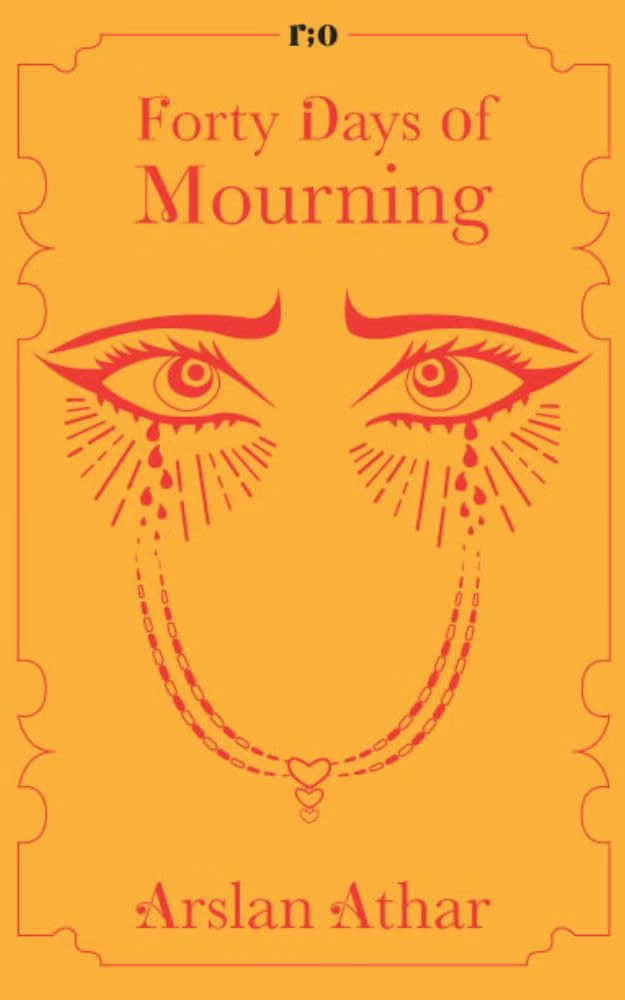
Having read Forty Days of Mourning, Furqan Ali found himself returning to its characters, questions and historical world long after finishing it. What began as a reader’s reflections gradually took the shape of a conversation with Athar, offering both the interviewer and the author an opportunity to revisit the novel from different perspectives. In this email exchange, they discuss the ideas, histories and creative choices that went into its making.
FA. Ye sard raat ye āvārgī ye niiñd kā bojh / ham apne shahr meñ hote to ghar ga.e hote (‘This cold night, vagrancy, and the burden of sleep / I would have reached home if I were in my own city’). Ummeed Fazli’s couplet captures the anxiety of being a stranger so well – the feeling of belonging to one place while being estranged from another, its people and culture, and even its gradual disappearance. In your novel, when your protagonist Saleema finds herself away from her homeland, in the unfamiliar terrain of Lahore, her ‘city’ no longer exists, much like in the film The Terminal (2004). Since you now live in Lahore, do you find yourself longing for Hyderabad Deccan, the state to which both you and Saleema are historically connected?
“I know that if and when I do go, neither the Hyderabad of Saleema nor the one my family remembers will greet me. I will have to go and find it on my own, which is both a tantalising prospect and a sobering thought.”
AA. This is a very interesting question! You might be one of the first people to directly link me to Hyderabad Deccan. Most people trace my connection to the city through my grandparents, so the conversation often veers towards their longing for the home they left behind. My longing for Hyderabad has always had to do with my family and our family history. Hyderabad existed for us through culture, language and food, but our familial Hyderabadi-ness eventually merged with our Pakistaniyat. Our identity changed, but our foundations remained rooted in Hyderabad Deccan.
Now, my longing for the city is also tied to Saleema – she showed me her city, and I wanted to see how much of it I had got right. All of this is tinged with reality, though. Hyderabad Deccan, the State, no longer exists; it has been replaced by Hyderabad, the City. The Hyderabad of today is a different place, with different connotations in the larger politics and economics of the modern Indian state. The city is also a site of the BJP’s larger politics of Muslim erasure, and its very fabric is at risk. I also wonder whether the larger Hyderabadi diaspora and I have lost the city we belong to, little by little, each day.
I know that if and when I do go, neither the Hyderabad of Saleema nor the one my family remembers will greet me. I will have to go and find it on my own, which is both a tantalising prospect and a sobering thought.
FA. I recently read an interview with Arvind Mehrotra, the 80-year-old anglophone poet from India who lost his city – also Lahore – during the Partition of 1947. I found his understanding of the idea of a nation extremely fascinating:
‘You see you are associated less with a country and more with places. Country is too abstract a thing. It does not mean very much. You associate not even with a place but with a mohalla…you have nothing to do with the rest of the world. So basically, the two or three streets in which you live, that becomes your universe. The whole idea of a nation is so abstract.’
However, your novel’s narrative encompasses the entire state rather than being confined to a particular locality. What do you make of the tension between local and political belonging? Did Saleema’s elite upbringing enable her to imagine Hyderabad on that larger scale?
AA. At one of my book events, I was asked what qualities Saleema and Hyderabad (as both a concept and a character) had in common. My response was ‘delusions of grandeur’. Saleema represents the elite mindset and dissonance of the time; she sees the Princely State as unique and the Nizam as its natural and only leader.
Historical texts show that much of the infighting in Hyderabad at the time had less to do with which new nation to join than with the question of equality within Hyderabad’s existing system. The Princely State and its people were responding to the very new and abstract ideas of borders, nationality, nationhood and patriotism. The idea Arvind presents was not one being discussed in the moment of 1947–48. That moment demanded that people make a decision. They found their identities in the mohalla, but they were forced to choose a nation, and in choosing a nation, they chose an enemy, too.
Hyderabad becomes an interesting no-man’s-land in that moment. By refusing to choose, people within a newly formed border – given that India had become united around it – came to constitute an entity together. They fought among themselves, but the consensus was Hyderabad first. This tension is also what drew me to this period in the first place.
There is also the question of Saleema’s position as one of the highest-ranking women in the hierarchy, below only the Nizam’s family. She represents the cohort of people who believed in the Nizamat unflinchingly. Her faith in his leadership and in his nation also drives her overall thought process.
FA. I want to discuss the different lenses through which you view the world in relation to others. Unlike authors who problematize the prevailing discourse that sees Hindus and Muslims as inherently opposed and Partition as the inevitable outcome of Independence, your novel does not approach the Two-Nation Theory as a cul-de-sac to be thoroughly scrutinised and excoriated.
Although Pakistan and India, the Hindu–Muslim divide and the bloody Partition are mentioned, they do not constitute the central conflict. Had the princely state remained as it was, the division of the subcontinent, or the idea that Hindus and Muslims constituted separate nations, might not have mattered much to the protagonist. Why did you choose to focus your story primarily on the princely state of Hyderabad Deccan? Was it a question of avoiding the complications that such an expansion might introduce as a writer or did you want to tell a story about Hyderabad Deccan without many deviations?
AA. I think it is a bit of everything, although it isn’t very authorly to admit that you wanted to avoid making a story messy by adding political nuance.
Regarding 1947, the larger body of Anglophone fiction has focused on the main theatres of action: the divisions of Punjab and Bengal, which arguably witnessed some of the greatest violence leading up to and following Partition. There are fewer stories about families who moved later or those who found themselves stranded somewhere. Urdu and Hindi literature have explored the varied experiences of Partition more extensively than English-language fiction has in recent years, and I wanted to see how far I could go in telling this story without allowing the ‘typical’ narrative to take over.
By focusing on Hyderabad, I could also explore ideas surrounding Partition without having the characters approach them through the lens of violence. Removing that element allows one to think more closely about how someone decided to leave or stay.
Furthermore, Partition did not end in 1947. The newly formed nations had to consolidate power, and they did so through methods inherited from their colonial masters. Pakistan incorporated the princely states of Balochistan, including Kalat, in 1948, in circumstances that remain contested, and exerted power over parts of Khyber Pakhtunkhwa. India took over princely states along its borders, with Junagadh being a prime example, before Hyderabad was taken over. Both states also went to war over Kashmir within months of their formation. The narrative of nation-building extends well beyond 1947, and I wanted to push that conversation further.
FA. Just as poetry carries something beyond the accumulation of words, a story, too, contains an excess – what might be called a metalinguistic value. Capturing this excess is a formidable yet fruitful undertaking. In this regard, you mention in the acknowledgements that it took you several years to shape this story. Could you help me understand, in the context of your book, this alchemy of creating chronicles? Or are you still in the process of exploring it?
AA. I am underqualified to answer this! But I can tell you what helped me keep going. Writing a book is no easy task, and much of the time, you don’t know whether what you’re working on even has the merit to become a full-length novel.
There is, however, something that shifts inside you (and this is where my answer will become more meta than useful). The story either comes at you with its full force, demanding to be written, or takes its time to take over you entirely. In my case, Saleema took some time, but once she had become a fully formed character in my head, she was the one who forced the story onto the page. The characters, the plot and the scenes – all of them call to you to finish the project. I would be praying, taking a shower or sitting in a work meeting when inspiration would strike; what followed was a feverish need to jot down the idea that had come to mind.
So, yes, sometimes the work becomes the engine itself. Beyond that, the alchemy, as you call it, boils down to consistency, resolve and an unwavering dedication to craft – not to the audience or the market, but to doing the best you can for the story and creating something meaningful. Writing a novel, screenplay, novella, short story or poem ultimately comes down to how much you love your craft and how committed you are to improving it. That love affair with craft eventually produces a completed work and, hopefully, good work.
As a creative person, however, you will never be entirely satisfied with anything. All that happens is that you eventually realize that each new edit is making the work worse – and that’s a good sign that it’s time to stop!
FA. A cursory reading reveals the novel as a journey of desire which, despite the twists and turns of fate and the admonitions of moral institutions, remains remarkably fierce. As a reader, what exactly am I meant to take away from Saleema? Her choices have far-reaching consequences for those around her, including within her marriage and the person with whom she becomes involved. Yet the novel resists offering an easy moral judgement of her actions. How do you hope readers will understand this complex and often contradictory character?
“She might be likeable on one page and utterly loathsome on the next. That was my aim. I’ve found it interesting that some readers don’t know what to make of her.”
AA. This question really tickles me because I don’t want to be in a position where I speak for Saleema as a character. She is there on the page, with all her flaws and their consequences. I believe the judgement and the takeaway are entirely up to the reader.
I built the character to be difficult on purpose. She might be likeable on one page and utterly loathsome on the next. That was my aim. I’ve found it interesting that some readers don’t know what to make of her. Many have challenged me, saying the ending should have been harsher on Saleema, while others wanted a neat ending. I am a fan of neither.
Saleema is not a character who will change as smoothly as people might expect her to. Nor will she necessarily face the consequences others so badly want her to face. Her reality is her prison. She is a wife, a mother, a daughter, a grandmother and eventually takes on other titles, too. All these positions imprison her. Her life is about trying to break free and live on her own terms, but that freedom is never afforded to her. Even when things are taken away from her, her punishment lies in the very titles she embodies.
I feel that each reaction to Saleema and the decisions she makes throughout the book can be interpreted as a question directed at the reader: ‘Why did Saleema bother you in this instance?’ ‘Which parts of her do you tolerate, hate or perhaps even like?’ ‘And what do those reactions tell you about yourself and your own sense of morality?’
FA. A class-based reading of the novel is also possible, rather than a purely pedagogical or moralistic one. Saleema’s othering of the Tonga-walas, Rukaiyah’s constant antagonism towards Saleema as a domestic worker and her plea for freedom, and Naveed’s takeover of their home can be read as the proletariat reclaiming what the bourgeoisie had previously appropriated. Isn’t it also fascinating that Saleema consistently sees those less wealthy than herself as objects of desire? Fardeen, to whom Saleema was engaged, was a wealthy man, and so she could not fantasize about him. Perhaps she sees the world through two distinct lenses: the poor, for ephemeral relationships, and the upper classes, for long-term ones. I also felt that the fall of Hyderabad was portrayed more as the consequence of internal conflicts than of external intervention. Of course, we are not discussing historical reality here, but rather the world as it is represented in the novel.
AA. Although Saleema is not really a narrator, the lens through which we see the world is hers, and it is both biased and unreliable. Yes, Saleema is upper-class, and that colours everything we see through her eyes. She speaks of the changing world around her with the assumption that it will never change – that it will remain as it is, continuing to serve her as it always has. Saleema is not interested in change, and her voice and manner reflect that.
The question of morality is relevant even within a class-based reading. Saleema knows the boundaries and rules imposed on her as a woman belonging to a particular class. She does not enjoy them, but abides by them because that is what is expected of her. When she does feel rebellious, she not only breaks away from the rules imposed on her but also crosses class boundaries.
The world she is born into is one governed by duty, where she is not allowed to feel or express emotion and, according to her mother, is not even permitted to read and write. This upper-class world stifles her, but offers her the façade of beauty and grace as compensation. Saleema is tantalised by this façade throughout her life, yet remains unfulfilled. Her social standing and peers within her class will never break free from their prescribed roles, and so she must venture where no one else will. She turns to the class below her. In doing so, she knows that she possesses considerably more power in that world, given her status, and that she can enjoy the façade of beauty she was promised while finding fulfillment in her relationships.
Her own class grants her no power; the class below her does. This is why she exerts power, extends favour and expresses disgust depending on whom she interacts with. Rukaiya is part of Saleema’s world, yet exists outside it because of class. Rukaiya knows the workings of the household and must maneuver within them to secure the best possible position for herself. Saleema, although upper-class, navigates a similar minefield through her marriage, albeit with considerably greater privilege and social standing. She still holds power over Rukaiya and seizes every opportunity to wield it.
As for Hyderabad Deccan itself, as I mentioned earlier, ‘illusions of grandeur’ were the downfall of both Saleema and her city. Historically, and within the novel, too, Hyderabad’s internal problems weakened it immensely. Power struggles and class struggles were rampant, and its society wanted change, although that change did not necessarily mean joining the Union of India. The fall of Hyderabad itself illustrates the idea of illusions of grandeur: despite the Nizam’s confidence in the state’s strength, the Indian Army brought the regime down in a matter of days. Hyderabad believed itself too grand to be taken over; it considered itself too united to fall to a greater power. But when push came to shove, the castle fell remarkably quickly.
FA. As someone writing about a lost homeland inherited through memory, family history and imagination, where do you draw the line between historical responsibility and creative freedom?
AA. When I started writing this book, this distinction was very important to me – so important, in fact, that it stopped me from writing the book altogether. Historical responsibility matters; I am not suggesting otherwise. However, fiction is a creative endeavour, and it is ultimately the author’s decision when to exercise their historian’s instincts and when to draw on their creative freedom as a fiction writer.
The writer’s primary responsibility is to the story and the craft of storytelling; beyond that comes their historical responsibility.
The Netflix adaptation of Bridgerton is an excellent example of a writer choosing the story over historical responsibility. Shonda Rhimes and the creative team create a world that looks and feels like Regency-era England, but tweak its community, power structures and social dynamics to suit the story they want to tell. In doing so, they offer a compelling example of how one can have fun with historical narratives.
FA. As you mentioned in one of your Substack posts, you are ‘Promoted to Author’. Given the book’s reception, what territory – historical, geographical or emotional – do you feel drawn to explore next?
AA. I am very wary of the word ‘success’. That being said, yes, the book is out, and it no longer belongs to me, which means my brain can now turn to other things. I assume other creative people have the same problem I do: there are so many ideas and only so much bandwidth to devote to each. I allowed Forty Days of Mourning to take over, but now I want to be more deliberate about how I divide my time between creative projects.
Right now, that means another book, perhaps some screenplays and a non-fiction project, too. Although I would greatly appreciate it if no one asked me about the progress of these projects, because that’s the worst question one can ask a writer!In terms of territory, I don’t think I’ll be returning to historical fiction anytime soon. Perhaps I’ll explore modern history, but nothing set before the 1980s. I never thought my first book would be historical fiction, anyway, but here we are! Right now, I’m drawn to the emotional and the immediate world, to the chaos that has already brewed and the chaos that is still brewing.