
Usawa Literary Review is headquartered in Mumbai, India.
PIN Code: 400050
Interested in working or collaborating with us?
Contact Us

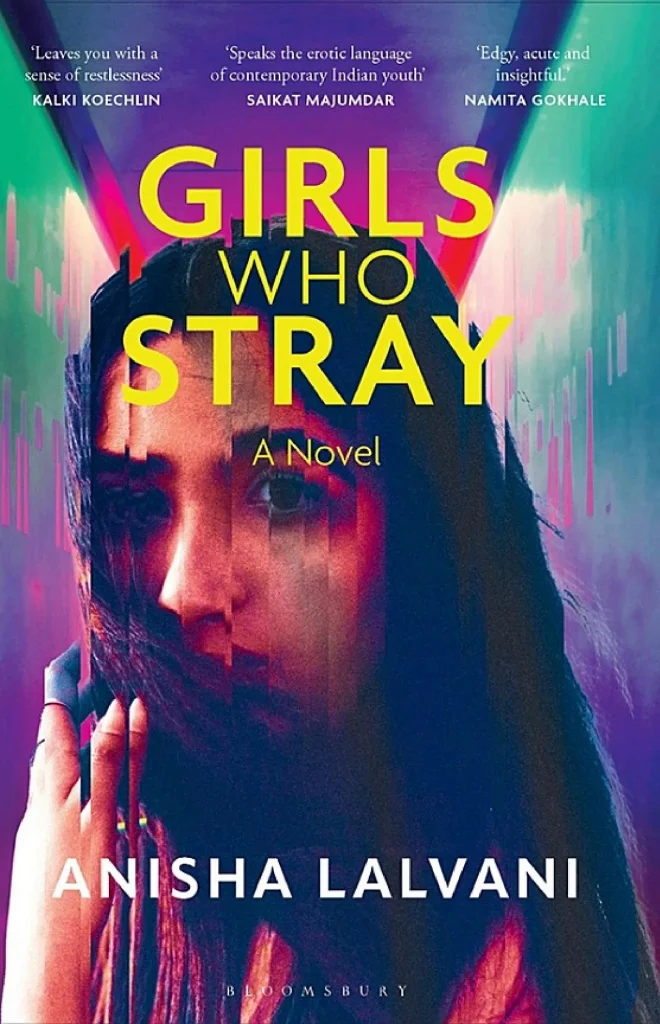
Girls Who Stray

By Anisha Lalvani


A coming-of-age thriller about the foolish choices you knew you shouldn’t have made

Excerpt: Girls Who Stray

Delhi's winter smog smothers. A failed affair echoes in the city's ruins. Walls, tombs, and echoes haunt her lonely, high-heeled, hungry circuits.

And when I stop to consider how it all unravelled, I see it was in these days of December 2012 and the days that followed, when I was so wrapped up in myself post the failed abortion, numbed by the city’s violence.

Numbed and sinking, I didn’t notice how quickly he drifted away, as quietly as he had arrived – a click of a door, a turn of the head, a tap of an app and there he was, sitting on that plush leather chair by the window that first night, watching me with a blank face. And just like that, now he was gone.

He is gone.

The day of the failed abortion, I stepped out of the auto and into the metro station, not looking back, nothing to say to him. And since then, I have messaged him – SMS, WhatsApp, even Facebook Messenger – once, twice, called the mobile number he used only for me, even his landline once, over these months.

Initially he responded, but just hello, how are you, are you looking for a job these days? Just these perfunctory, casual messages once a week, then once in two weeks, less and less as time passed. And when I responded, nothing back, till I messaged again, two days later. I held on to the hope that he would call, message, just something, but as the weeks passed I had to finally admit to myself he wanted nothing more to do with me.

Just like that, he has dropped me from his world, erasing that Friday night – Muniya, Nepali – erasing our affair, erasing the child we could never have, throwing me back into distant orbit all the way home to Greater Noida, where I belonged.

Everything changed after that night, but the less he messages me, the less he responds, the less I see him, the more I miss him. With a hard force. Her too, never known.

I miss them.

And so to mourn for her, to not miss him, I walk these days. In the winter smog, I walk all over this city, non-stop, up-tempo, outpacing the jumbling thoughts in my head.

Take the metro to the central Delhi of my childhood in Jor Bagh, my youth, blossoming into a woman – the faded pink symmetry of low blocks that lead one to the other, a childhood spent scratching out the eyes of politicians with black ballpoint pens, delicate foliage of the overhanging khair trees in endless afternoons of lukka-chuppi, of kabaddi and hopscotch, the stupor of summer holidays. The night guards in cabins, the shrill whistle and lathi-tapping of the watchman on his rounds, the white Mother Dairy packets falling in the mud, mango dollies after school.

Nothing changes here. Nothing ever will.

I walk in central Delhi now, through carbon and fog that settle low in the lungs, make the amorphous dread something real. I walk and walk and reach IHC, IIC, IGSS, Paryavaran Bhawan. I meet a government building with one thousand windows, snaking corridors of paan stains, offices and cabins in cupboards that lead to more such cabins, with paper files wrapped in twine gnawed by rats.

I meet a dead end.

I walk. Roam around the beautiful expanse of Lodhi Gardens, forgetting the metropolis that belongs to this century just outside. In the foreground, Sheesh Gumbad in decay with black doorways that lead to nowhere. Crows perch on the spindling branches of a lone tree that has shed all its leaves to brace itself for winter.

I take a photo of this on my phone.

This city, this wrenching beauty of this city. Breeding dark fantasies. Everyone feels it. Everyone secretly unsettled. A haunted house of a city. History’s necropolis, masquerading as a metropolis. Ten thousand bodies hidden beneath the earth. One small body, on top of all the bodies of history, beside the towering water tank at the edge of the compound in the brigadier’s farmhouse in Noida. The other young body from the toilet, at the other end of the compound? In someone else’s compound? In the forest beyond?

Where? Where?

Where where where?

Night sets in as I turn to leave. This desolation, these silences, those dead before my eyes, what do they say to each other in whispers as I pass by?

I walk further. Stop at a rampart slick with dew that glows gold, the moat that surrounds. I pick up a stone, hurl it against this wall of the city. It hits the wall and falls to the ground.

I pick up and hurl another stone.

I peep through the chinks in the gravel mortar, pick up a twig and scratch at the crevices, pull at the weeds, dig through with my fingernails. The dogs wake up, snap at me, spitting saliva on my ankles. A watchman appears from somewhere, shrills his whistle.

Haanji? Kya Chahiye?

But before he can say anything else, I am already gone.

I walk in the Delhi of my childhood and I met a bastion here, a crumbling wall there, a citadel. I turn and go back and meet another citadel, a fortress, a great and glorious tomb.

I walk along and reach a roundabout that splits out – Janpath Road, Akbar Road, Motilal Nehru Marg. I take any one of the roads. I reach another roundabout. I go round and round the junctions and boulevards of this city, a labyrinth stuck in the mind.

Tick-tock, clip-clop. The next night and I wear my highheeled shoes. I walk over drunk men, poor men, poor drunk men slouched over the street, half expecting an arm to grab the flesh of my calf, pull me down. I walk along the inner circle of Connaught Place, cutting through drunk teenagers falling out of My Bar Headquarters a whirr of men loitering in the shadows, opening their mouths to say something, smacking their stinking booze-addled lips.

Then a nasal voice from behind – side-please-baby-sideside – a hijra in tight jeans and a swishing ponytail makes her way like a hurricane through the Saturday night crowd as the men hoot and snigger. I weave in and out through the inner circle and outer circle, a carousel of red and blue disco, winding into the sleazy heart of the city.

I am hungry for you I say to myself inside my head underneath my breath, hooded beneath my black coat, my stomach a tight knot, palms clammy but ripping out the thin cloth inside the coat pockets as I walk feverishly across these city streets, these city nights.

It rings hollow into the night, my hunger.

But I am so hungry.

Excerpted with permission from Girls Who Stray by Anisha Lalvani published by Bloomsbury, 2024.

Looking for more Books?

Browse the Bookshelf →

Review: Girls Who Stray – Getting Lost in the Urban Wilderness

Lalvani examines the illusion of female agency within a patriarchal Global South, charting the moral complexities of individual desire and identity against pervasive urban alienation.

The word stray means to deviate—from the norm, from a path decided on, from limits imposed—for exploration, rebellion, curiosity, or even a sort of directionless boredom. This straying inevitably leads to a moment, or moments, of reckoning, in whatever form or intensity. But first, the journey, one that might at times meander more than we’d expect.

Anisha Lalvani’s debut, Girls Who Stray, juggles multiple interlaced meanings of the word, including “being a stray” as in lost. Her protagonist, whom we will know only as A, is a twenty-three-year-old recently returned from England after a master’s degree in an obscure field from an obscure university. The return isn’t planned, A has hoped that by moving abroad, she would be able to permanently escape the repercussions of her parents’ divorce. However, no job is forthcoming on graduation and return she must. But not before a chance meeting with a powerful stranger gives her a heady taste of the world of high-level escorting.

Back in her home country, A lives with her divorced father (a retired government official) and her dementia-afflicted paternal grandfather in Noida, in one of those fancy high-rise buildings and gated communities that are now as ubiquitous with India’s urban landscape as the stark and ever-deepening divide between the have, the have-nots, and the want-tos. Her future is uncertain, the student loan looms, she cannot dig her traumas out of her no matter how hard she tries, and what to do about the itchy restlessness invading every part of her body and mind? Increasingly adrift, anxious, and alienated as she navigates her new reality, A will find herself succumbing to her most impulsive and unhinged desires, which leads her to a romantic involvement with a big builder and a double murder (the inspiration for which was the Nithari murders in Delhi from two decades ago).

The blurb states that A’s only saving quality is that she is self-aware. This is a double-edged sword, because as refreshing as it is to own up to her choices, it can be frustrating to watch A barricade herself and her building guilt, anger, discontent, and self-loathing within a vicious cycle. She knows her choices will only make things worse, yet she is unable to wrench herself from the all-encompassing ennui. You can’t help but feel like a part of her actually finds comfort in this endless loop because it’s known—in a roundabout way, here she is in control more than out there, in the wild world. It is also true, however, that another part of her revels in the adrenaline-fuelled nature of her double life; the proximity to power and danger. The author presents these often contradictory impulses within a single individual without overarching judgement, though the narrative itself asks questions about, among other things, the definition of morality and who gets to shape it.

The narration by the author is sharp and energetic from the get go and never lets up in pace or intensity. And because you’re so focused on keeping up with A, her myriad streams of thought, and the everyday minutiae of her existence, you hardly notice the sneaking, ensnaring claustrophobia. By then, you’re already invested and cannot pull away. But after a while you stop feeling so stifled. Instead, there is a deceptive lull as the days, weeks, months blur into a numbing, bone-deep, repetitive weariness. Then, suddenly, unexpectedly, as if even the narrative and A herself are surprised by it, everything slowly but surely starts to clear. A continues to wander the streets of her city at all hours, continues to grieve and mourn and grapple with her life and the realities of the world around her—from the Nirbhaya protests and its aftermath, from A joining an underground activist group, from the reality of a deep personal loss and the fallout of her involvement with the builder and the murder. The final third of the novel has more forward momentum, showcasing a shift towards possibility in multiple small steps that stack on top of each other and allow us and A a peek at the horizon, somewhere in the beyond. The open-ended finale is fitting, though one potential revelation feels a tad too scripted for it to belong in a story that has till then stuck to brash candour and avoided neatly tied threads or pat conclusions.

If you were to ask me what this novel was about, I would say that it was first about ideas. Ideas draped against the structure offered by the crime plot, and aided by Delhi-NCR itself being its own character as a city defined by its fragmented, fractured, layered history. Using an unnamed protagonist within this framework not only helps in making this a story about the condition of modern, urban women as a whole (though the keen interiority of the narration means that we’re intimately aware of A’s emotional and mental landscape), but it also allows the author to use her as the conduit for exploring various themes of concern—gender inequality; social inequality; the complicated nature of desire, free will, and independence; the illusion of choice and agency, especially as an Indian woman in a patriarchal society; a rapidly changing social and economic landscape; the resultant feelings of alienation and loneliness; the murky underbelly of a developing nation, and more.

This is a broad and ambitious canvas to traverse, even without the multiple intersections of genre, and in just 270 pages; not to mention in a debut novel. There are times when all the elements glide into perfect place, others where it falters, and others still which pull you in despite its jagged edges. As I see it, we will all find our own version of an anchor as a lost A journeys in search of purpose and belonging—and I will be keeping an eye out for this promising author’s next.

Looking for more Books?

Browse the Bookshelf →

Anisha Lalvani in Conversation with Kabir Deb

Urban East/SE Asian patriarchal structures profoundly condition women's autonomy, desire, and the pervasive shame and judgment defining their 'straying' from expected societal paths.

KD: Hello Anisha! It’s nice to meet you, finally. Firstly, congratulations on the publication of your beautiful novel. The book perceives modern society from a unique lens. How do you think the same modern society with all its achievements perceives women?

AL: Hi Kabir, lovely to meet you too and thanks so much. Your question about modern society and its perception of women is so, so vast but let me try to be as precise about it as I can. I think modern society in India is conflicted about women and their roles in society. Women in India have made massive strides especially in urban contexts in gaining a sense of autonomy and independence, but the sense of respect is still lacking. People, especially of an older generation feel deeply conflicted about how young women are constantly breaking new ground – and I don’t mean in a conventional sense of taking up jobs that only men once did, but I mean in much more subtle, intimate ways, kind of fighting back from the sphere of the household or family.

Women themselves are conflicted, naturally torn by all these opposing forces, both external and which they have internalised through the ages of their true place in the world, of how they should behave, of how they should or should not love. It’s a very interesting time to try to capture all these inner contradictions and that is what I have tried to do in Girls Who Stray.

KD: The glories of a woman are observed with the thought of patriarchs in mind. Should the wrongdoings of a woman be seen with a similar thought in mind? What do you think about the gender dynamics of India?

AL: I think everything is connected and nothing occurs in isolation. If the glories of a woman are observed with the thought of patriarchs, it is only because we live in a fairly patriarchal world, especially in some societies and so everything is judged, especially the achievements of women in relation with this lens.

If a woman is perceived as being wrong, it is in relation to something and unfortunately this is largely seen in relation to the underlying patriarchal structures – in the case of my book the woman becomes an escort and enjoys it, she gets involved in a double murder of poor children and does nothing about it, and then time and life passes and nothing happens. I think the wrongdoings of my protagonist are not explicitly wrong in terms of her subverting the patriarchy or anything like that, but just wrong on a moral level (in terms of the murder), and I wouldn’t say she is wrong or right in terms of her choosing to become an escort, and then enjoying it for a while.

I think both the glories, and wrongdoings of women should definitely shift out of the patriarchal lens or the ‘male gaze’ in this sense and women’s achievements and sins should be judged from a humanistic lens, but it depends what those achievements and sins are. Generally, and especially the sins and wrongdoings are against masculinity, patriarchy etc. and so are always viewed from that lens, unfortunately.

KD: How important is it to address the desires which are considered as taboo or a matter of closed rooms in contemporary literature? How can a collective community of desire bring a significant change in our society?

AL: I think this is happening a lot because of social media and the internet with a lot of pages openly discussing sex and desire. But the distance between urban attitudes and more rural attitudes is immense in our country, or between the classes. Of course, everything is changing incredibly fast. I definitely think women should be more open about their desire, and also the complexities that come with that desire, as it is an integral part of living, for a lot of people. It is not just one is desiring in vacuum, one desires another human – man or woman or any gender with their own baggage and complexities, as one holds their own baggage and complexities.

Yes, I think addressing the complexities of desire is important in contemporary literature, but we must remember we have a rich tradition of poetry that does just this, so we can draw on that tradition. A collective community can definitely embolden people to speak more freely about their desire, but I do believe on some level we should preserve the intimacy of desire, and this intimacy can be explored in literature.

KD: Working women are portrayed as strong women in films, novels and even in gossip. The homemakers are kept as weak and dependent women even though they are forced into this position. Your book speaks about both sections of women. How can a society create a balance between the both? And how should literature approach the stories of both the sections?

AL: I think the point is we should approach this with a sense of empathy. Homemakers as you said are often not given opportunities to study and then work and while those of us who live in the metros and work and go about our mobile lives would find it hard to believe, still millions and millions of women are forced into these lives. Again, things change but at a slower pace. Oftentimes girls graduate unlike their mothers but then are expected to give up education after they marry or have children. So change is very slow.

I think literature should always approach stories of anyone with a sense of deep empathy – how else can you tell the story of a person whose life is so different from your own? To understand that a person might want perhaps the same things you do, but haven’t been given the opportunities, or the person is at times as lazy, or despairing as you are, hardworking in ways different to you. It’s only empathy that can help us get into the minds of others.

KD: What influenced you to write this book? How different is the society of present India compared to that of the West?

AL: When I first started several years ago, I was very driven to write by a sense of quiet angst I had been cultivating for years. I didn’t know it was fiction or had no clear sense of what I was doing but I was very driven to write about the anxieties that came with living in a very fast-paced world, with the economy moving so fast and young people finding it hard to come to terms with things, and then just anger and rage and love and all these emotions in the context of misogyny, both what I was feeling and what I sensed in my peers and among women around me and society at large.

Your question about society of present India and the west is extremely big- meaning it’s a very, very large question. It’s impossible to compare, of course so many aspects of modernity of the west we have here now – and the world is such a globalized place anyway today, but we hold onto traditional values and customs with equal force, in the face of these rapid changes.

KD: Angry women have been considered as deities whereas in reality an angry woman is marked as arrogant or simply ‘a bitch’. What drove you to expose the inner angst of a woman who knows the consequence of firing the anger in a patriarchal society?

AL: I just wanted to explore the inner life of a woman navigating the modern world in all her, and its complexity and contradictions – internal and external. I didn’t have an agenda or anything like that, in the sense I didn’t want to explore anger or angst particularly, in the latter sections of the book I explore her relation with her mother, her love for her grandfather, the awe she feels while travelling alone across the country, so there are many, many registers and feelings, but yes there is anger, and it is in some ways directed at herself along with society. She is angry she allowed herself to be the subject of misogyny, she is angry at her own passivity, angry she has not revealed anything about the murders to anyone, she feels guilty. So, its several things.

It’s not rage against society, or her family – that would be very one dimensional, it is really anger, and love and pain and fear and awe and wonder at life in general. Although this sounds very vague, it is all this, really.

KD: In an age of crisis, independence is often considered as the only way to reach where women deserve to be. Yet there is an existential crisis where women find longing and belonging as the grammar of liberation. What triggers the shift and how do you think a woman can bring homeostasis between independence and belonging?

AL: Yes, this is a difficult thing. To both be independent and also long to belong. These are very complex questions Kabir! I think it’s a constant dance and balance and negotiation between one’s own aspirations and independence, and then longing to be with another, and find grounds to compromise, or find common grounds to have common aspirations and needs. But the onus has to be on men and women together to negotiate these complexities together.

KD: What is the story behind the title of the book? What does stray mean when it comes to women?

AL: So, stray in the title has several connotations. There’s no straying from a relationship or marriage, or anything like that, although she strays from the run-of-the-mill path and becomes a high-class sex worker for a while and enjoys it very much. So she strays in that sense. She also strays when she walks the streets of Delhi, grieving the end of her relationship and the loss of her child, her parents failed marriage and also grieving with the whole city as it erupts with the protests against Nirbhaya’s rape and murder. She walks at night on the streets where people- especially women don’t, so she loiters and strays in that sense. Later she joins an underground activist group on the lines of Anonymous and hacks government and corporate website, steals from the rich, distributes groceries from high end stories to unsuspecting beggars etc, so she strays from the path of capitalism and consumerism which we in the cities all live.

And of course she involves herself in the double murder of poor children, so she strays from an ethical, moral path. So, straying has several connotations and meanings through the book.

KD: Could you suggest five important books which made you the writer you’re today?

AL: The Bluest Eye by Toni Morrison

The Good Doctor by Damon Galgut

Wide Sargasso Sea by Jean Rhys

Ceremony by Leslie Marmon Silko

A most important, A Bad Character by Deepti Kapoor

All very different from each other, but it is what it is.

KD: What do you think about The Usawa Literary Review?

AL: The Usawa Literary Review is such a great literary magazine. I regularly visit your site for the latest reviews, excerpts of fiction especially, but also non-fiction and poetry. It’s lovely to find new work and names I am familiar with and also discover so many new voices and talent that you give a platform to. Keep up the amazing work!

Looking for more Books?

Browse the Bookshelf →
Back to Issue

Support Our Work

If you enjoy our content, consider supporting us.

Support Us

We are an unfunded, independent feminist publication. We need your support to continue our work.