
KD:Hello, Nilanjana! It’s truly a pleasure to have you with us. I thoroughly enjoyed reading your book. It prompted deep self-reflection, especially as someone who, like many men, already occupies a position of privilege. I’m curious to know what inspired you to write this work. For women, expressing such deeply personal emotions has often been discouraged or dismissed. What motivated you to confront these challenges so boldly and push past long-standing patriarchal boundaries with such clarity and confidence?
NB: People are often surprised to realise that equality, when viewed through women’s lives, is far more layered than they imagine. And this is true of both the small and the big battles of life. Women move through the world in a constant state of negotiation. For them, equality is not only about access to opportunities or an equal share of resources – although those are absolutely essential. The deeper foundation lies in the invisible ways women are taught to shrink themselves, manage expectations, carry emotional and domestic labour quietly, and perform roles designed by patriarchy.
These invisible pressures shape not just our lives, but also how we are able to access and exercise the rights guaranteed to us by the Constitution. That reality needed to be put out there – clearly, unapologetically, in indelible black and white. On the pages of a book. On the pages of a magazine or a newspaper or a blog, and yes, even on social media.
Like many women from middle-class families, I didn’t grow up with the language of feminism. But I saw it in practice at home. My mother was fiercely independent and brought us up to believe that education and financial freedom were non-negotiable, even in the face of possible future societal pressure to prioritise home and family. And she led by example – she never shied away from making uncomfortable choices, to stand up to patriarchal pressures, especially when it came to her daughters and her own financial freedom. But when it came to herself – she often had to stand down and compromise. The power dynamics within my parents’ marriage was skewed in his favour – decision-making, especially when it came to money, largely rested with my father. My mother also absorbed the invisible labour of keeping the household running without complaint.
Journalism eventually gave me the language for what I had been sensing all along. Later, studying and working in the UK exposed me to global feminist thought and to women who occupied space with confidence and authority. Writing about women’s lives came naturally to me – not only because I could relate, but because women carry extraordinary stories within the ordinary details of their lives.
Yet, I was repeatedly told that these stories were not “serious” enough. “Who would want to read about rehabilitated women sex workers on the front page of the morning newspaper?” an editor had asked me once. I had to accept these false diktats of a male-dominated system that decided (and still decides) which woman’s story is worth telling and whose is not. But I didn’t lose the stories. I wrote every story that came to me – and then I archived them – knowing that I would tell them one day on my own terms.
My first book, Lies Our Mothers Told Us came out of that resistance. I didn’t expect it to find the response it did. When readers, especially women, wrote back saying, “You’ve named the problem, now tell us how to live differently,” I realised the conversation could not end there.
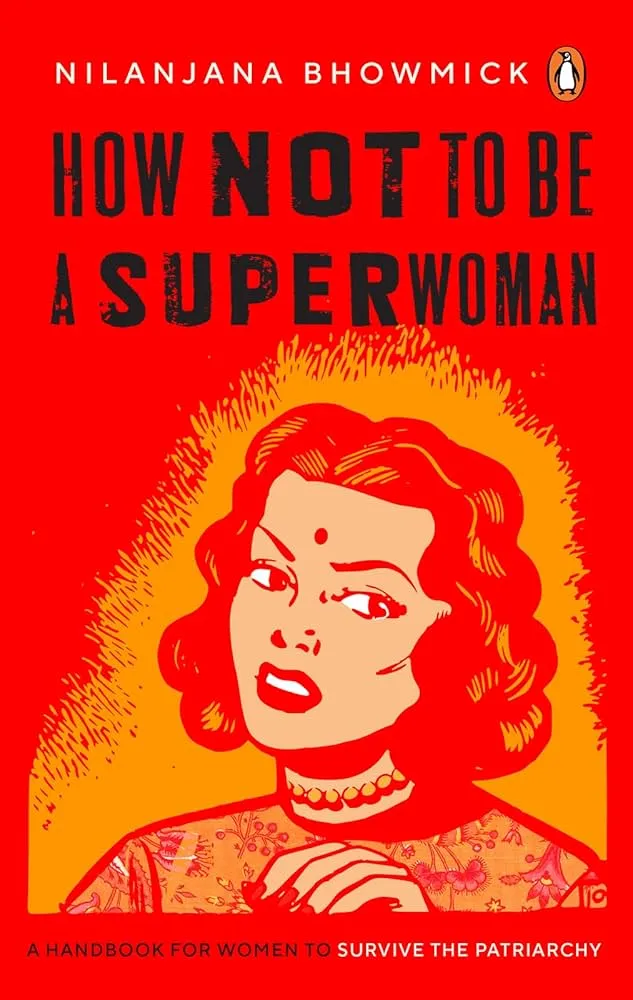
How Not to Be a Superwoman grew from that responsibility. Most self-help literature is written for a world designed around male lives. Women are asked to adapt themselves endlessly to systems that were never built with them in mind. I wanted to question that logic entirely.
Writing these books was never about boldness for its own sake. I don’t think of myself as a bold person at all. I am someone who observes, absorbs, and listens. For a long time, I, too, bent around the system – to accommodate it – because speaking up and making uncomfortable choices is never easy in a society like ours, especially in the time I grew up in. Finding one’s voice is a process. I am still unlearning the many conditionings I was raised with, because those conditionings are not confined to our homes alone. Our deeply patriarchal institutions reinforce them, reward silence, and punish resistance.
But most women reach a point in their lives – often in their forties or later – when they stop performing agreeableness. Why so late? Because it is hard to undo conditioning. When I was a young girl, my mother was in her early forties and was unanimously the “arrogant” and “rude” daughter-in-law of the family. These are labels our society throws at women who refuse to conform to societal expectations of femininity.
I didn’t set out to be bold in my writing. I was simply speaking plainly, describing what I have seen and what I have experienced. If that plain speaking is read as bold, it says less about the writing and more about how unused we are to women centring their own lives – naming what they endure, without apology or softening, and refusing to look away. How Not To Be a Superwomen for me is a letter of solidarity with my readers, a feminist manifesto, and an invitation for everyone to look at the world through women’s eyes.
KD: In your introduction, you explore the fatigue that comes with emotional labour and caregiving. From mothers to romantic partners, patriarchal societies often treat care as an innate female responsibility – something expected rather than acknowledged. This assumption not only diminishes its value but also reinforces patriarchal power structures. How do you personally navigate care in your everyday life when it is constantly expected of you as a woman? Additionally, in what ways does patriarchy intensify the emotional and physical weight of caregiving for women, regardless of their professional roles?
NB: Both my upbringing and my marriage unsettled the assumption that caregiving was automatically my responsibility, giving my work and writing room to take centre stage. But patriarchy is not confined to the home; it is embedded in our wider culture. Even if you manage to escape it within your family, you run into it everywhere else. Much of the conditioning I had to wrestle with came from beyond my front door – from friends, acquaintances, colleagues, neighbours, and even random strangers.
I still carry one of patriarchy’s deepest imprints: the idea that love must be expressed through nurturing. That instinct runs deep. I fight it every day. Some days I succeed, some days I don’t. This is still a journey for me – I don’t have all the answers, and I’m still unlearning.
What patriarchy does, very effectively, is tie unpaid caregiving to a woman’s value. Most women in this country are never taught to see care as labour because it has been so thoroughly fused with ideas of love, duty, and morality. No matter who a woman is or what she achieves, she is still expected to aspire to being the “best homemaker.”
A few weeks back, I came across an interview with a successful Bollywood actor, who is married to a successful female actor. During the interview, he hyped up his wife and her professional accomplishments, and yet felt compelled to add that she was also a “great homemaker.” This constant need to justify women is deeply embedded in our culture. This is why women experience a double shift.
This is why women experience a double shift. This is why unpaid caregiving remains non-negotiable. Even women who try to say no cannot fully opt out – because emotional labour, which is rarely recognised as labour at all, is always waiting in the background.
The larger narrative is still one of permission. Women are allowed to work, to succeed, to dream – but there is always a condition attached. That condition is that they must also remain nurturers. This is the real cost of caregiving under patriarchy, because it quietly determines what women can and cannot become.
At a practical level, the so-called “superwoman” ideal – something patriarchy presents as a compliment – means that women end up working impossible hours, especially if they are professionals. Most women do not have the luxury of choosing one role over another. In trying to do everything, often alone, they end up stretched thin everywhere. At home, work makes them distracted; at work, they have to put in three times the effort to achieve half as much. It’s a vicious cycle, and it leads to exhaustion, guilt, and heartbreak.
KD: In your book, you also highlight how the oppression of women contributes to the decline of a society’s economy, public health, and long-term sustainability. Over time, patriarchy has promoted the narrative that men face higher rates of early death, often attributed to cardiac illness because of the heavy responsibilities they are expected to bear. Why do you think that, in India, both men and women have culturally and socially downplayed or dismissed the responsibilities women shoulder in their personal as well as professional lives? Furthermore, how can we challenge and dismantle the narratives constructed around women’s lives that ultimately serve to silence and suppress their broader voices?
NB: Patriarchy harms men as much as it harms women. The difference is that women, being the oppressed, have been forced to recognise it, while men are often positioned as both beneficiaries and tools of the system. Men, too, are victims. They carry what I call provider anxiety, the loud entitlement that men carry – if you carefully look at it, it often hides a deep inferiority complex. While men are not disadvantaged in terms of resources – they clearly hold the upper hand there – I don’t think the picture of their inner lives is a very pretty one.
To address the second part of your question, I think much of this narrative is shaped by capitalism, which formalised the idea of “productive” and “reproductive” labour after the Industrial Revolution. Men were expected to work in factories, doing back-breaking, machine-driven labour, while women were confined to the home to nurture both the productive workers and the next generation of workers. Capitalism deepened this divide because keeping women at home ensured that those who did need to work would always be available as cheap labour.
Why do you think so many women in the informal sector today work as manual labourers? In factories, they are given the most menial jobs; in agriculture, they do the hardest physical work with the least pay, and so on. The very idea of “feminine jobs” was created to ensure that entire sectors could run on women’s cheap labour. And of course, patriarchy benefits from all of this.
As with any extremist idea – and what else is patriarchy, really?- very few people stop to examine the damage it causes. When you keep women confined to the home, you are effectively preventing almost half the population from contributing fully to the economy, public health, and long-term sustainability – just to satisfy the ego of an archaic belief that women are nurturers and men are providers. Ultimately, this reveals the limitation of human thought itself – human thought that remains, even today, deeply male-dominated.
KD: Family often functions as a small world we build within the larger one, yet it is also within this space that the erasure of a woman’s identity is frequently normalized. Several women in your book speak to this very experience. While society conditions everyone, especially women, to respect the ideals and boundaries imposed by family structures both before and after marriage, these expectations often reinforce a shared, inherited form of oppression. In your view, how can women in India begin to challenge and disrupt these boundaries, even when doing so may result in personal or emotional collateral damage? Also, how does the family continue to reproduce and sustain patriarchy, even when its women members have themselves been victims of the same hierarchical system?
NB: Women are already doing this, and they have been doing it for decades. The change has been slow, yes, but that is also because feminism has remained such an elite concept in India. Patriarchy has also worked very hard to malign feminism, so much so that even highly accomplished women who live feminist lives often hesitate to align with it publicly – not because they are unaware of what they are doing, or because they lack the language to name it, but because they fear that openly claiming feminism will make their lives harder, not easier. That is how successful patriarchy has been in turning feminism into a liability.
This is why I think it’s time we seriously begin to look at women’s lives – not so much at what they say, because that is often where the challenge lies, but precisely because that is also where empowerment and inspiration live. Women often live deeply feminist lives long before they have the language to name them.
A woman’s experience is always valuable, whether she is a farmer in a remote village in Bengal or a call centre worker in Delhi. The contexts may differ, but the structures shaping their lives often do not.
There is a young creator from a village in West Bengal whose content I find absolutely delightful. In one of her recent reels, she spoke about how women work just as hard as men in the fields, yet do not get paid, or have access to the money that is earned. My mind was blown – not because this was new information. We have read about this endlessly, consumed it through reports and articles, and I have written extensively about it myself, including in my books. But when it came from her, rooted so clearly in lived experience, it landed differently. It cuts through abstraction. And her videos get thousands of views – which means they must be resonating with people.
For a long time, we did not centre women’s lived experiences, and I think that is where we went wrong. Now that we have begun to do so, I genuinely believe change will come faster. We are at a very interesting crossroads of what I would call everyday feminism, and this is something we need to consciously hype and nurture. This is where the core of feminist change will lie. Theory and policy cannot operate in isolation – they have to meet lived experience. While we have come a long way, we still have a long way to go in India, especially because our institutions continue to be deeply patriarchal. That remains a serious problem and a real challenge.
KD: Across both professional and personal spaces, women are often conditioned to believe that they cannot – or should not – refuse the responsibilities placed upon them. In this context, consent becomes a crucial factor in shaping women’s psychological and physical well-being. Why do you think saying “no” remains so difficult for women? At the same time, in today’s world, how can women better prioritize their daily responsibilities – both paid and unpaid – to reduce overwhelm and reclaim a sense of balance?
NB: Women are trained to be agreeable – to be people pleasers. It is taught to them as a must-have quality. Value is attached to it. That becomes your value in the family: that you are smiling, pleasing, never saying no to unreasonable demands, excessive work, or even to your own exhaustion.
As I said earlier, these conditionings are very surreptitious. They become part of who we are and are therefore much harder to unlearn. Just the other day, someone told me she thinks she is a “natural smiler.” I asked her whether that was really true, or whether that was something she had been conditioned to believe. I asked myself the same question. I was always smiling, always happy to oblige. Now I find it harder to smile – and while I still do smile a lot, I can see how unnecessary it often is, and how frequently I smile just to soften a situation or cushion something I am about to say.
Reducing overwhelm is also learned behaviour for women, because we are taught to multitask. You often hear it said that women are better at multitasking. That’s not true. There is no credible research that proves multitasking is a gendered skill. There are studies that show men multitask, too, and as effectively as women. It may be a personality trait, but it is definitely not a gendered one. It has been turned into a gendered trait because, honestly, what choice have women had but to multitask between home and work? Over time, that compulsion was reframed as ability – much like nurturing – until women began to carry multitasking as a character trait. Unlearning that is difficult, precisely because it was never a choice to begin with.
There is, however, more awareness around boundaries today, which gives me hope that we will get there. There is no ideal balance and no universal benchmark. Each woman has to decide her own – and permit herself to honour it.
KD: You write that the idea of “having it all” is a standard imposed almost exclusively on women, often presented as a prerequisite for love, marriage, or being labelled the “perfect woman” in society. As a woman, how exhausting do you find this relentless pursuit of perfection? Given that definitions of success and failure shift dramatically based on gender, could you shed light on why accomplishment is still so deeply measured through a gendered lens?
ND: It is very exhausting – the mental load of it, the unwritten-law-like feel to it. But what we don’t talk about enough is where this pressure originates. It comes from the permission culture that women grow up with. It comes from the gratitude culture that women are trained into.
Women need permission even to exist freely. The rights provided to us by the Constitution are not truly available to us unless we are “allowed” to exercise them. And when we are allowed, we are expected to be grateful – because these rights are not treated as something we hold by virtue of citizenship. They have to pass an extra layer of male and societal scrutiny before they are handed to us. And because they are “handed” to us, they can also be taken away.
This is magnified in our country, but it is not unique to it – it is a global truth for women. We only need to look at how abortion laws were rolled back in the United States to see how quickly hard-won rights can be withdrawn when women’s autonomy threatens power.
In that sense, “having it all” becomes a woman’s punishment (disguised as a reward) for daring to dream and aspire like a normal human being, like a full citizen. Perfection is demanded as proof of deservingness – because anything less can be used to justify withdrawal, judgment, or control.
KD: Society continually conditions women to feel guilty whenever they fall short of the expectations set by parents, partners, or peers. You write that “guilt is the bane of a woman’s existence.” Patriarchy often frames this guilt as necessary for personal growth, yet the notion of “people” in this context almost always refers solely to women. While guilt can sometimes provide direction or purpose, do you believe that, within a patriarchal framework, it frequently transforms into an oppressive burden for women? Women are often advised to ignore the sources of their guilt, yet are ultimately compelled to comply in order to avoid disappointment. How, then, should women navigate and reinterpret guilt so they can distinguish between what is internally driven and what is imposed by patriarchal conditioning?
NB: I don’t think there is a difference. The kind of guilt we are talking about here – mother’s guilt, daughter’s guilt, partner guilt, not-doing-enough guilt, not-being-enough guilt – is driven by patriarchal pressures. It keeps women permanently on their toes. The more they second-guess themselves, the more they take on; the more they take on, the more they shrink themselves.
There is no real way to reinterpret this guilt. The only way forward is to untangle what patriarchy has tangled for us. For instance, at a recent talk on How Not To Be A Superwoman, the spouse of a foreign diplomat asked me whether women should let paid caregivers take care of their children. Isn’t it better, she wondered, for a child’s growth and development if the mother brings them up with the “right” values? She was visibly surprised when I told her that women need to start differentiating between care and upbringing. I could see the idea land with her – something she hadn’t really considered before.
Care is a paid job – or at least, it should be. When care is outsourced to a professional caregiver, the responsibility of upbringing still rests with the parents. For that, whatever time one is able to give – so long as it is intentional – is enough.
Until we learn to untangle care from upbringing, and love from sacrifice, guilt will continue to thrive. What patriarchy has done is weave an emotional web around women’s labour. Calling that labour out for what it is, and understanding that it can be outsourced without moral failure, is key to loosening that grip.
KD: Everything patriarchy imposes on women often accumulates into a form of collective trauma – passed down from one generation to the next, or from one woman to another. Over time, this trauma settles like sediment in the mind, resurfacing as exhaustion whenever those memories are revisited. What impact do such seemingly small, everyday traumas, within families or professional spaces, have on women’s mental and emotional well-being? And how does sexism function as a catalyst in sustaining and deepening this condition?
NB: Misogyny-driven traumas run through women’s lives – in personal relationships, professional spaces, and shared public worlds. Taken individually, many of these experiences are dismissed as minor or inconsequential. But their cumulative effect is profound. Over time, they train women to second-guess themselves, to shrink their ambitions, to constantly calculate risk.
The lack of safety in public spaces is a clear example. It is not just a question of crime statistics; it directly affects women’s participation in public life. Public spaces in India are not gender-responsive – there are few usable toilets, poor lighting, unreliable transport, and little institutional acknowledgement of women’s needs. This absence itself is a form of everyday violence.
We often assume that surveillance and policing are what make women feel safe. But safety, for women, is not only infrastructural – it is visceral. It is experienced as a feeling. The unease of a pair of eyes in the rear-view mirror of a cab. The sudden dread of finding oneself alone in an isolated space. The quickened heartbeat at the anticipation of violence. These moments may not always result in harm, but they leave an imprint. They live in the body.
Sexism acts as a catalyst by normalising this constant vigilance. It tells women that fear is irrational, that discomfort is imagined, that adaptation is their responsibility. When women adjust their routes, their clothes, their hours, or their ambitions, it is framed as prudence rather than coercion. But when you are always calculating risk and planning escape routes in your mind, it becomes a mental burden showing up in the body as exhaustion, anxiety, and emotional withdrawal.
It is not individual fragility but collective trauma, produced by a system that repeatedly exposes women to risk while denying that risk exists. Until sexism is recognised as the condition that enables these everyday injuries – and not just their backdrop – the toll on women’s mental and emotional well-being will continue to be minimised and misdiagnosed.
KD: Could you share some of the books that influenced or inspired you while writing this book, or that helped shape your understanding of how women might navigate their lives with greater clarity and agency? Also, do you have any advice you would like to offer our readers, especially women, who are seeking direction, strength, or self-assurance?
NB: I find inspiration from everything I read and consume – books, shows, films, social media – from the very serious to the ones that barely scratch the surface. All of it shapes my thinking in different ways, sometimes by showing me what feels truthful and necessary, and at other times by clarifying what feels hollow or misleading. In that sense, everything I have read or watched has influenced me, whether as guidance or caution. But if you talk about inspiration for my books, including How Not to Be a Superwoman, that comes exclusively from women’s lives. I am inspired by the women around me – I am inspired by their struggles, their resilience, the stories they carry within themselves. The stories they decide to tell. And the ones they don’t.
I’m not really an advice-giving person. Mostly because we are all doing the best we can, in the ways available to us, while navigating collective societal constraints that shape our lives very differently. So, I can only speak about what works for me. I pay close attention to what makes me uncomfortable. I read widely and indiscriminately – even the most “non-serious” work, if written by women, often carries its own quiet revelations; you just have to read between the lines. I question relentlessly, and over the years I’ve built the courage to name what I see. The courage to speak up – to call out doesn’t happen overnight, so I have learned to be kind to myself. Agency does not always arrive as confidence; sometimes it begins as a “no,” or even a “maybe.”
KD: What are your thoughts on the significance and impact of a feminist publication like The Usawa Literary Review in today’s cultural and literary landscape?
NB: It’s a much-needed initiative, especially in the times we are living in, when speaking about caste discrimination, gendered violence, and inequality is increasingly policed. Literary platforms, after all, are also political records – they are a reminder that literature is not merely about imagination, but about witnessing; not just about beauty, but about truth. And telling that truth with conviction and courage. Publications like the Usawa Literary Review refuse to look away – and that’s its most important role.