
I remember one of my first safaris in Karnataka’s jungles. It was a Friday morning. We had just missed a coveted tiger sighting and our guide was speculating about where the animal might have wandered off to. “I think it’s been a while since its last meal”, he said, “It may be on the hunt”. As the jeep drove out of the forest area, we saw a man and three young children waiting at a corner for a school bus. I have never forgotten the sense of peril I felt for them. I hadn’t realised how close they lived.
Urban people like me often think of the forest as a special realm, a place that we must make a long journey to reach. We have long reconciled ourselves to the mess of our cities but the forest holds the promise of wildness. And when we think of wildness, we imagine a place with fewer people as well.
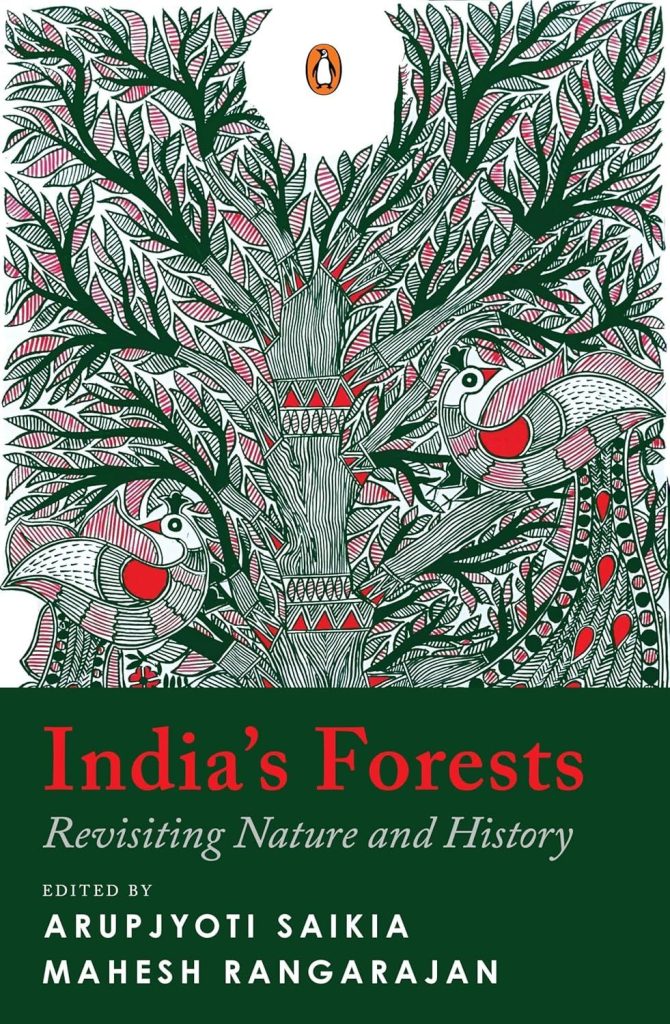
It is this simple, romantic notion of the jungle–the idea that it is unsullied by human presence–that India’s Forests seeks to dismantle.
The book was published in February this year by Vintage Books, a Penguin Books imprint. It is a collection of academic essays edited by environmental historians Mahesh Rangarajan and Arupjyoti Saikia. The book arrives 37 years after Unquiet Woods, a landmark book by Ramachandra Guha about the history and sociology of the Chipko Andolan. The Chipko Andolan was one of our first environmental protests. It was a grassroots movement, a Gandhian movement, a movement led by women. But behind its captivating images of women shielding their trees lay a longer, more complex story. It was this that the book illuminated.
In our current century, the Forest Rights Act (2006) has been another landmark, establishing the legal rights of individuals and communities to forest land. It was a much needed corrective measure for power-imbalances dating back to the colonial-era. To look at the many decades between these dates is to remember the words popularised by Martin Luther King Jr (another Gandhian): “The arc of the moral universe is long, but it bends toward justice”. And make no mistake, we are still not at the point of justice, just heading towards it.
India’s Forests uses Guha’s book as both starting point and internal compass. Each of the ten essays in the book come from scholars with different areas of expertise. The book starts with a look at the Arthashastra, ends with a re-examination of Guha’s book, and stops at different regions of India, covering everything from archaeology to megafauna.
If the forest is inseparable from humans, it is also inseparable from human issues. Gender, religion, caste, class and capitalism all feature in these essays. How exactly did Indians define a forest? Was there always a binary of field versus forest, agrarian versus forest-dweller? These are just some of the questions that come up as one reads the book.
Again and again, the book warns us about the danger of simple stories. Take, for instance, the colonial era and its terrible impact on forests. Behind orderly systems and the concept of “forestry” hid an extractive mindset. Access to the forest was also tightly controlled. Now, to study this period is one thing. But we must also accept that there was never a past where things were, to coin a phrase, nature-perfect.
From that follows the idea that maybe there was no nature-perfect forest dweller either. From our privileged standing, we imagine people who are simultaneously all-knowing about nature, and innocent of the wider world. But essays like the one on the Baiga community or the one about the sacred groves of Jharkhand ask more of us. In examining, say, methods of cultivation or the ecological importance of a grove, they call on us to see people and places as existing in their full complexity. They are not just characters in a story that is convenient to our sentiments. Similarly, social problems and inequalities don’t simply stop at a green border. Indeed, they are sometimes multiplied within them.
India’s Forests is an important work in 2026, in an age when climate-change is a reality for even the most oblivious of us. But then, in India, we are still being drawn into debates of development versus environment–again the kind of simple binaries that the book argues against. The optimist in me hopes that scholarship such as this can inform discussions and decisions. I would also like to see more popular science books and articles that can take off from these essays. Maybe even a children’s book or two?
Without faulting the book’s wide range, there are also more issues to be examined. Just recently, in Karnataka, after a spate of human killings by tigers, safaris were banned for a few months in Nagarhole and Bandipur. It was the contention of local communities that tourist safaris were driving the animals towards the villages. But elsewhere, people have argued that farms growing bigger in size and turning to cash-crops has upset the balance. It is imperative that we understand these issues, not as one-off news flashes, but as developing stories.
Many years after that first safari I took, I met someone from an NGO that works in conservation. The lady told me they worked with children from forest-adjacent areas and even took them on wildlife safaris (an activity usually reserved for tourists). I couldn’t help but wonder about those kids I’d seen that Friday morning. What would it mean for them to see a tiger, not at their bus-stop or village, but deeper inside the forest? And from the safety of a jeep? What questions might they have? More importantly, what perspectives might they bring to the rest of us? And what of the tiger herself?
As Shekhar Pathak, historian and author, writes in the foreword to this book: “This is just the tip of iceberg…I dream of multilingual, multi-eyed and multi-legged social scientists, historians and others who can integrate all kinds of source materials—including archival—with field and folk studies. They will emerge someday.”