
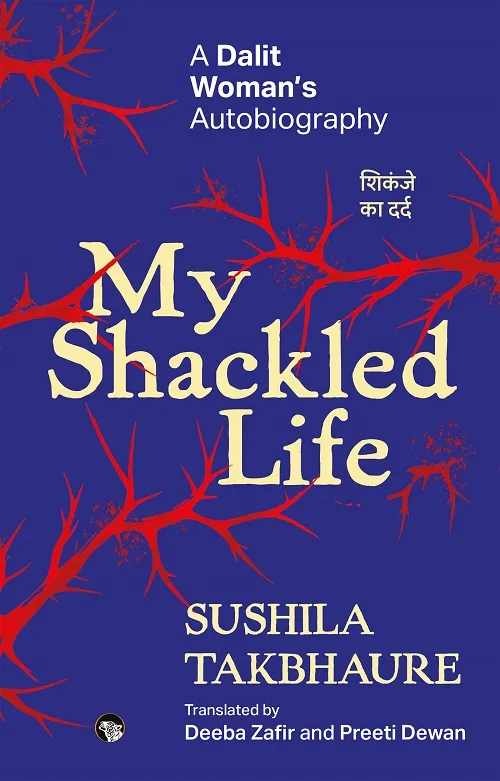
Sushila Takbhaure’s Shikanje ka Dard translated as My Shackled Life is an archive of a deep political awakening. At the start, one is naturally drawn to the English title’s deliberate conflation of dard with life which is not incidental. Pain being the grammar of the narrative, the reader is compelled to pause at this conflation and read from the point of view of a caste that is already authored within it. This conceptual density is well preserved in Deeba Zafir and Preeti Dewan’s translation. This fidelity complements and honours the political stakes of Dalit literature and trusts the reader to sit with unfamiliarity rather than be guided out of it.
Takbhaure’s autobiography refuses to separate Dalit experience from the idea of the nation. Rather than framing Dalit writing as a parallel or oppositional movement to the standard nationalist discourse, the book insists on being read as part of India’s coming-of-age story—a national bildungsroman. Pre-independence, post-independence, elections, wars, famine act as markers of lived time ensconced into domestic hunger, caste labour and women’s bodies. This insistence is already visible in the Translator’s Note where Deeba Zafir and Preeti Dewan, start the Dalit conversation with a didactic and declarative tone. “Writing caste”, therefore, becomes a collective act of refusal. The reader becomes the mouthpiece of Sushila Takbhaure and refuses to soften the historical weight of exclusion. Once the narrative proper begins, Takbhaure’s voice loosens further into memory of her Nani collecting night soil year after year and stating how scavenging becomes a default role of the Dalit community. The scenes from Takbhaure’s life, then, speaks without an explanatory scaffolding. As a result, this effect of empathizing with the Dalits leaves a radical thought with the reader: life, at its bare minimum, demands recognition. And that is the key takeaway from the book.
It is no mystery that Sushila Takbhaure speaks both as subject and witness and this is key to understanding how strongly feminist this book is. To draw a particular reference, the naming practices in the text are especially revealing. Girlhood is frequently identified through patriarchal markers like “Kallu’s Amma”, “Kamal’s Bappa” and this absence is telling as Takbhaure rightfully questions how one never addresses the patriarch by calling them “Sheela’s Bappa” or “Sheela’s Amma”. This asymmetry exposes how women circulate in language as relational beings and how the lineage is always tethered to sons. Takbhaure’s narrative goes on to show how girlhood in the Dalit community is treated as hibernating birds expected to fly away. While this metaphor resonates with Luce Irigaray’s critique of woman as passage rather than presence, the affinity is thematic. Another closer parallel would be B R Ambedkar’s insights on endogamy, where women become the conduits for reproducing caste. The bird, then, is not free but always in transit. This very savarna Hindu ritual understanding of the transience of woman is deeply complicated. This binary of oppression is the mould that Dalit discourses are trying to negate. But through Takbhaure’s narrative, we see how the community continues to remain deeply invested in scripture, gotra-keeping and naming customs. The reader understands how religion is treated as a naïve and vengeful subject for the Dalits and the other communities at large. The Dalits’ claim at practicing Hinduism is their attempt to bridge back into social legitimacy. And this is a hornet’s nest, indeed. Dalits wish to move towards the center, but the center always remains hostile.
The book is also a melting pot that bears the sharpest contradictions around women’s bodies. Takbhaure walks us to show how her Nani functions as a scavenger and certified midwife, entrusted with blood, birth, restoration and yet denied dignity. The image of Sushila’s Nani carrying a razor blade to cut the umbilical cords of women post birthing is unforgettable. Even though Takbhaure mentions this as a mere slice of life, the convenience of such politics has the potential to jettison the reader from the reading experience and pause to understand how deeply troubling this is. With such instances, the reader undergoes a rite of passage only to realise that such a life is deeply Beckettian—there is no respite, and one hopelessly waits for Godot to arrive. This book also forays into exploring the figure of the mother and its particularly fraught position. Motherhood is valorised, but only insofar as it serves patriarchal continuity. This is also the space where we realise how natural and integrated the Dalit community is by seeing how they continue to fight the larger cause along with the microcosmic battles to survive. Takbhaure records how women’s worth is measured through reproductive success, especially the production of sons. The haunting episode of Sushila’s early married life—marked by the absence of a “womb” and the ridicule of her nanad—reveals how deeply womanhood is tied to biological function. Women’s bodies, through Takbhaure’s lens, then become sites of reproduction politics and caste reproduction. This is why Takbhaure’s engagement with Ambedkarite school of thought is legitimate as it refuses to sentimentalise suffering or moralise endurance.
As one moves from page to page, the inevitable punctuation of natural and political catastrophes like floods is hard to ignore. Dalits in Banapura, displaced by floods, are forced to rebuild homes from memory. The land they occupy is not legally theirs anyway and therefore, the floods act as a natural erasure of locus for the Dalit community. They are exiled by nature, by religion and by law and this turbulence is like the last hammer on the nail. Where geography itself becomes a form of policing, we end up questioning what is legitimate after all? My Shackled Life endures because it refuses such narrative closure. There is no redemptive arc here. There is also no simple life-writing. The book acts as a critique of how lives are so differently valued. Perhaps, the most apt way to understand this book is not as a story of aspiration or caste politics, but of judgment. Takbhaure does not write to explore Dalits as a community but daringly records and insists that the nation reckon with the lives it has long kept at arm’s length.
To read Takbhaure is to be reminded that the nation was never experienced evenly. This nation continues to carry the rhetoric of belonging, but not its practice.