
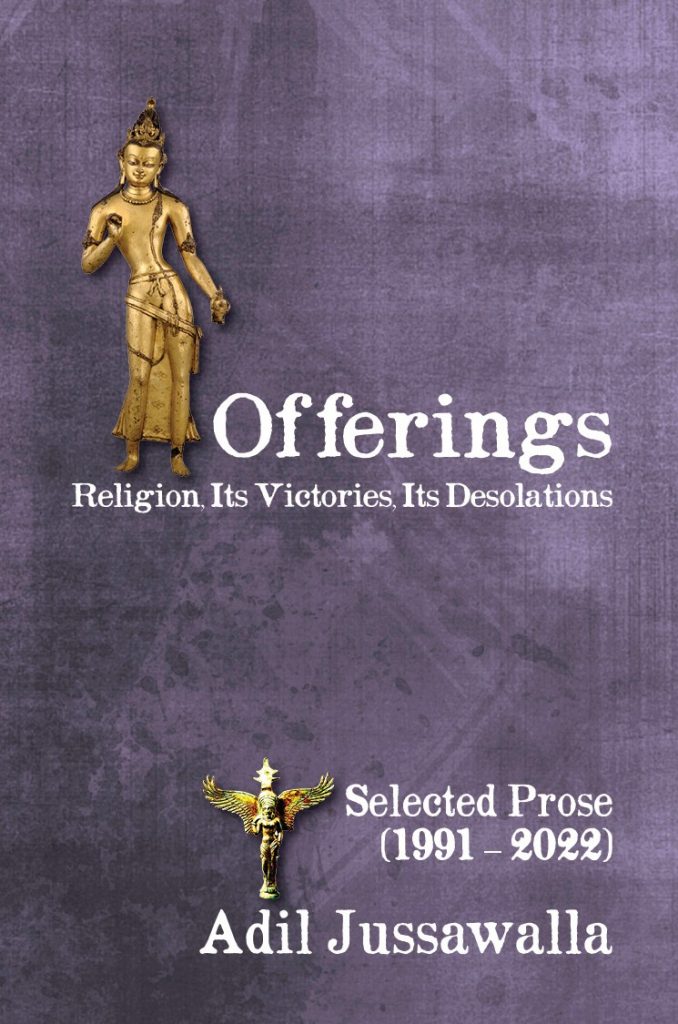
Adil Jussawalla on the collection: “During my childhood or adolescence, when I used to pray or was asked to pray, I must have been a believer. Later, I was an agnostic and, even intellectually, an atheist. I say ‘intellectually’ because, even when in my mind I was an atheist, turbulence, stress and the illnesses of those dear to me made me pray by myself or visit a fire temple or a church to offer my prayers. What follows (in chronological order) is not meant to be about my spiritual development or fall, but rather to indicate a pattern of thought, of constant making and re-making that isn’t complete, that has yet to find an area of rest that allows me to craft it into a pattern.”
At the End of the Day
It was the catch phrase of the year. Instead of saying something like, ‘Finally it boils down to politics,’ people went about saying, ‘At the end of the day, it boils down to politics.’ Of course, it never boils down to politics, at the end or any other time of the day. At the end of the day, at the end of the year, it boils down to something more frightening.
I’m scared. Books lie around the flat, their titles prominent and mocking: Says Tuka, an annotated copy of the Quran which someone sent me, The Teachings of the Magi, The Heart of Religion. I grope for them as I normally do when the mind’s awhirl and the heart pitch black, but they bring me no light. I realise that however well I may be acquainted with their words, they haven’t tamed the killer in me, the murderous thoughts.
The other day I struck a man who was bothering me in the street. I felt justified in doing so since, apart from demanding that I give him a large amount of money, he was aggressive and insulting. But wasn’t there another way, or several other ways? The books tell me there are. Which?
At the end of the day, all of us die. That’s one certain thing that unites us with the people we strike and those we caress. This year I lost some young friends and a close relative. I look out of the flat to get my thoughts in order but it makes things worse. I can’t believe so much will die — the gulmohur trees, the crowds at the fishing dock, the ships at sea, the children in their shacks. That’s the scary part of living, the fact that it contains death at every turn, in every breath we take. Dying itself may just be another art, to stretch Sylvia Plath’s words slightly. Some people do it exceptionally well.
This month there’s been some talk of art in the flat, which isn’t unusual but more than art, religion. A young couple speaks of the religious ecstasy of rave parties, a friend back from Australia after eight years does the same. I often speak of PD Mehta, the author of The Heart of Religion, whose words seem to me to demystify religion and yet to keep its essence alive for us to draw on. A cousin of mine returns from a brief visit to England and tells me that one of her hosts was Robert Mehta, Phiroz Mehta’s son. I was astonished at the coincidence. She was astonished to learn I knew him. We spoke about Phiroz Mehta’s work.
There’s been talk of Osho, Papuji, Sri Ramana Maharshi, Sri Madhava Ashish, all guides to an essential self, all warning us against the false lights of ego.
Yet the darkness continues. At this time of year, it can get pretty intolerable, even if you remind yourself of what you’ve been told, that the first day of January is just another day, that death is just like entering another room. At the end of the year, sometimes, one can only wait and not see.
I don’t come from a particularly religious family, though one of my uncles, Dr Dinshah Mehta, did come to be known as the Reverend Dadaji. My mother was once cured of a severe illness, thought to be cancer, through Christian science, and now, on occasion, almost 40 years later, she and a nurse read some of its old texts together. Otherwise, she has her own form of meditation and prayer. My father doesn’t make much of either publicly but believes in God. My brother has certain questions of a religious nature which he is trying to find an answer to. I occasionally go to a fire temple, though, since I’ve married a non-Zoroastrian, there are people who wouldn’t want to share the temple with me. (Nor, for that matter would they want to share the same lift). The rest is a matter of books, some of which I’ve mentioned, which I like to believe have shown me some kind of light. But the light doesn’t stay on, mainly, I suppose, because I keep putting it off.
Perhaps that’s one way of doing it — to endure a darkness so intense that finally a chink of light, as radiant and hard as a diamond, has to come through. I don’t look forward to a massive power failure at the end of the year but let’s just suppose it happens. Let’s just suppose we have no electricity for 48 hours. Then, even as patched-up old men go up in flames in different parts of the city, even as the unfrozen blood of birds and beasts starts running in our freezers, perhaps our own blood will unfreeze in the darkest of nights and run with love. Because that’s been the trouble all along, hasn’t it? I cannot love as the good books tell me to just because I want to. I await another word.
1995
Excerpted with permission from Offerings: Religion, Its Victories, Its Desolations: Selected Prose (1991 – 2023) by Adil Jussawalla published by Red River 2026