Usawa Literary Review is headquartered in Mumbai, India.
PIN Code: 400050
Interested in working or collaborating with us?
Contact Us

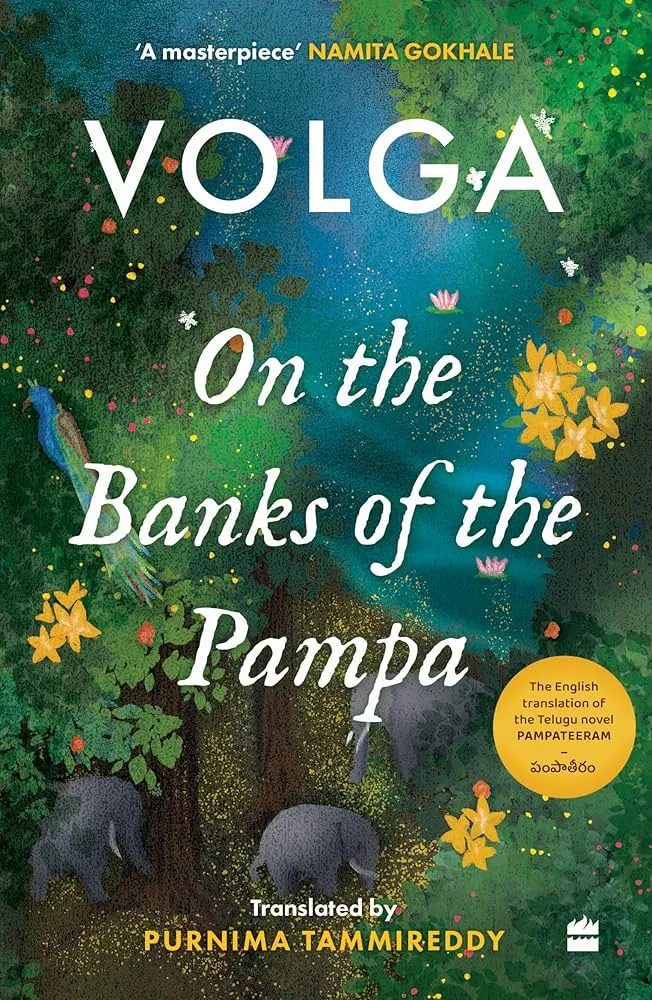
On the Banks of Pampa

By Volga


In On the Banks of the Pampa, award-winning writer Volga returns to a figure the Ramayana barely pauses on — Sabari, the forest-dweller who becomes Rama's devoted follower. Born of aranyavasis, forced into slavery and then free of it, Sabari's journey is one of spiritual awakening and quiet dissent — rooted in the forests along the Pampa river, inseparable from them. The concluding volume in Volga's feminist retelling trilogy, the novel asks hard questions about dharma, conquest, and the exploitation of nature. Powerfully translated by Purnima Tammireddy, this is resistance drawn from a story we thought we knew.

Review: On the Banks of the Pampa

Critiquing power systems, the novella undermines how fear and faith define 'civilization,' exposing the violence inherent in colonial mindsets and the subjugation of the marginalized.

The only way to keep the small folk loyal is to make certain that they fear you more than they do the enemy. Remember that if you ever hope to become a queen.

Game of Thrones, Season 2, Ep. 9

Cersei Lannister, in educating young Sansa Stark on the basics of governance, casts a very realistic glance on how power systems operate in controlling a large mass of people. Volga’s novella On the Banks of the Pampa, translated deftly by Purnima Tamireddy from Telugu, is situated in the milieu of the mythological era of the Ramayana, but is very much a text of the present times. A noted feminist, Volga tries to reimagine the Ramayana universe in taking the character of Sabari, but unlike most feminist retellings of the myths, the text is not stuck merely at giving voice to characters who are either typecast or fall through the cracks of history into oblivion. This slim novella, at a mere 125 pages, packs a lot in it and does so successfully without seeming contrived. Taking the thread of Sabari’s conversation with Ramachandra, the novella goes into the very heart of kingship, kingmaking and leadership, that is a tale of our times.

Faith and fear emerge as the twin pillars of ‘nagarikata’ on which dominion over the common folk is sustained. Sutapa, an Ayodhyavasi and a simple weaver, embodies this subtle dominance which is extended by the state. He is a catalyst of sorts in the narrative. Following Ramachandra’s exile, Sutapa ventures beyond the Sarayu River and heads to the forests of the South where Ramachandra is supposedly headed. But very soon, the journey becomes his own. He is guided by his own wanderlust and quite like the modern urban tourist finds repose in the lap of nature but also fears its unfamiliarity and is self-aware enough to know that the forests, in all their glory, is not for him. In fact, Sutapa has been brought up to fear anything that does not follow the prescriptive, preordained and normative codes, which is reflective of citizenry not only in our country but in most parts of the world.

The exchange between Sutapa and his elder brother Padmapada is one of the most interesting episodes in the novella. Padmapada, being the older, more experienced and worldly individual, slices through Sutapa’s fascination with kingship, power and finery, and presents the point of view of the common people, whose lives continue with major and minor adjustments, irrespective of leadership. He questions the grand narratives that the common folk are fed by kingmakers to keep them in tow.

How does it matter who becomes the king? What difference would it make? If Ramachandra takes over the throne, tell me one good change that would happen in our lives. (emphasis in the original, p.85)

Sutapa’s fear of his brother’s dissent and later of Sabari’s uncanny wisdom and Kabanda’s oneness with nature, represents the quandary of the city-dweller, who in going through the motions of life, actually belongs nowhere in particular. This passage is a mirror to those of us who stay away from dissent, in fear or awe of the leadership. In fact, another episode following the heels of this exchange is the one between Kaikeyi and Vashistha that focusses on Brahmanical patriarchy, power systems and kingmaking. It speaks of the insidious control over people using faith as a medium, with an enigmatic, charismatic leader at the forefront, who appears no less than a coloniser. This exchange absolves Kaikeyi of the historical blame she carries and shows how women are at times forced to be the carriers of patriarchy. It highlights the anthropocentric greed for resources which undermines the sanctity of human and non-human life and comes out of a deep distrust of the other.

Unlike us, they don’t have kingdoms and power structures, and neither do they follow any dharma. They have no idea of what it means to be civilised; they are full of ignorance. But there’s unimaginable wealth present in the forests. Rama must live in these forests to bring them into our fold of dharma and their riches under our control. He has to make them passionate about nagarikata and the Arya dharma. (p.91)

In fact, the anthropocentric city and the eco-centric life of the aranyavasis are juxtaposed in the novella from the very beginning through the terrifying experiences of Matanga Muni, an untouchable, in the city, as he questions the ‘jnanam’ he has received so far and forsakes it to adapt a life of ‘ajnanam’ of the forest-dwellers. His experience and that of Sabari’s at the detention camps of the city reminds one of the bio-political nature of citizenry where enhanced surveillance tactics and codes of conduct are marked on the bodies of its inhabitants. While reading the text, and with what has come to pass all around us in the recent history of our country, one might easily question like Matunga:

What is it about the human nature that breeds such animosity towards another? How can anyone rejoice in inflicting pain upon someone else? Who or what induces such behaviour? (p. 61)

The comprehensive discussions about these two forms of life in the initial half of the text, which at times can read a little preachy, are geared to address this dichotomy and although the text is somewhat partial to the life in the forest with Sabari’s beauty and peaceful wisdom as its manifestation, it doesn’t denigrate life in the cities or its citizens. What it tries to question and subvert is the idea of civilization and knowledge systems peddled by its rulers. The entire text builds up to the meeting of these two forms of life in Ramachandra and Sabari’s discussion and mulling on the idea of a benevolent leader. The central question that this novella posits is if we were ever free of the violence of colonization. Who is the other and who determines who is an outsider?

This work of translation does justice to its original in two primary ways. Purnima Tamireddy’s translation clearly showcases how poetic the original must have been. The text ably aligns to the two forms of life through its clever stylistic use of language, with the descriptions of the life in Sabari’s ashram on the banks of the Pampa rendered in lyrical prose, while those of the city in practical, straightforward phrasing. Moreover, the translation has cleverly retained the philosophical terms like ‘rajyam’, ‘jnanam’, ‘ajnanam’ ‘nagarikata’ and ‘dharma’ in their original complexity instead of their English counterparts, bringing to a wider audience not just Volga’s ecofeminist consciousness but also a book that is very satisfactorily prescient.

VOLGA is a writer, critic, translator and poet, who has been a forerunner in introducing a feminist perspective into the literary-political discourse of the Telugu-speaking states. One of the most significant figures in Telugu literature today, her works opened the floodgates for a host of women writers to articulate the doubts and confusions they experienced as women. Her novel Sveccha (Freedom) marks a watershed in women’s writing in Telugu and is now being published in all Indian languages by the National Book Trust of India. Her other works include the short-story collection Rajakiya Kathalu (Political Stories), that looks at the oppression of and control on a woman’s body; Maaku Godalu Levu (We Have No Walls), the first volume in feminist philosophy in Telugu, which she edited; and an anthology of feminist poems, Neeli Meghalu (Dark Clouds), also one she edited. She co-authored Saramsam, which documents the anti-arrack struggle, and Mahilavaranam (Womanscape), a detailed collective biography of important Telugu women of the twentieth century.

Looking for more Books?

Browse the Bookshelf →

Excerpt: On the Banks of the Pampa

Voices clash: city dwellers promise land, demanding forest's heart. Tribals, rooted, question desires, defending ancient, breathing home—a choice between worlds. Listen closely.

Pages 30 – 31

‘All of you are anagarik. There’s no meaning to your lives. You don’t have houses, backyards or highways. You don’t know how to till land and harvest crops. You aren’t animals, but your lives are hardly different from theirs. If you accept our offer of friendship, we’ll give you land and teach you cultivation. We’ll build your houses for you. Go ahead and cut all the trees in this forest. Flatten the land. We’ll ensure you get your fair share of it. But the decision of how much each one of you will get lies with us. We’ll provide you with food while you work for us. You lot aimlessly roam the woods because you have no work. You aren’t disciplined. You eat whatever you see hanging from a tree. You starve on days when you can’t find any food. We’ll teach you how to preserve and store for your rainy days. We’ll show you what nagarikata in its finest form looks like.

‘To be honest, the food shortage we’re facing isn’t as acute, but it will become worse in the next decade or so. We had anticipated the possibility of such a reality. We aim to extend our city into this forest and convert it into arable land. You don’t know how to preserve anything. You don’t know what wealth is. Nagarikata is nothing but the art of mastering these. If you cooperate with us, we’ll give you special status as our subjects and govern you. Imagine what a great honour and privilege it’d be for folks like you. Should you opt not to support us, it’s no matter.

We wouldn’t hesitate to wipe you off the face of the forest for good. Don’t doubt our claims of possessing countless weapons, nor our clan’s exceptional talent in crafting new ones. We’re trained in numerous combat techniques. Weapons are the sole means to defend a civilization. Yours are laughable—scarcely fit to even hunt down a tiger!’

The tribals found it hard to remain calm and level-headed in the face of these provocative words. Yet, they managed to respond as gently as possible.

‘Why would we hunt tigers? If we don’t hunt, why would we need better weapons? We do possess the skills and tools to defend ourselves. We know how to live without needing yours. We have access to abundant food—Mother Forest bestows upon us all that we need to survive. We’re content with our lives. Why would we want to destroy our forest, our home? Stop trying to convince us with your foolish words and return to where you came from.’

The tribal representatives went back to their homes and had another round of discussions with a larger gathering about the exchange they had had with the nagaravasis. All present were appalled and furious, except Kannudu, who was terrified. He could not disregard the experiences of his father. The old man was well aware of not only the cities but also of the state, or rajyam. Was his life as a slave in the city forgettable by any means?

Pages 66 – 67

As Sabari narrated the incidents to Sutapa, Kabanda lost himself in the story yet again. No matter how often it was told, it was a story that left the listeners wanting more. Sabari snapped out of the past and returned to the present, but Sutapa was reluctant to come out of the incredible story.

‘Amma, have you been living in the forest since then? You seem to embody the very grandeur of the forest inside you! We’re too immersed in city life. You’ve become a part of this forest.’

Sabari smiled gently, like the leaves of the sacred fig tree rustling. She, too, was unwilling to end this conversation.

‘Yes, Sutapa. From that day onwards, our lives became inseparable from the forest. Matanga Muni, too, realized the futility of the desire to undertake penances, pursue jnanam and mingle with nagariks. Under his tutelage, I also pondered deeply about nagarikata, anagarikata,

jnanam and ajnanam. I also came to realize that the very nagarikata which nagaravasis and those hungry for power proclaim as something indispensable for humanity, is, in essence, contemptible. As it was my own experiences that helped me gain this deeper understanding, there was no space for doubt. I could comprehend the multitude of ways in which nagarikata separates mankind from nature. The ways of being uncivilized weren’t hard to grasp either. I learnt about them and chose to be a part of anagarikata. At every given opportunity, I explain my stance on anagarikata to my fellow folks and visitors, but gently, not in the manner of arguments and debates. I am not a preacher either.

‘I advise everyone to befriend nature, hug trees, treat every being as an equal. I recommend a way of life that fosters nothing but love and compassion. Stop this relentless pursuit of the universe’s buried secrets. Instead, learn to listen to its whispers. Our existence will find its true meaning if we develop a keen ear for the subtle murmurs of the universe. Our life’s ambition must be to recognize and revel in its mysteries, without an urge to unravel them. The universe is here to awe us. After a while, once you overcome being awed, you will witness this cosmic play in an impersonal, passionless way, only to become a part

of it. This is the act of intimately fusing with the light of ajnanam. I’m encouraging you to immerse yourself in the sadhana of such ajnanam.

Looking for more Books?

Browse the Bookshelf →

Volga in Conversation with Rituparna Mukherjee

Reinterpreting patriarchal myths critiques state violence and anthropocentric destruction, advocating for ecological coexistence and empowered sisterhood against contemporary oppression and surveillance.

RM: Congratulations, Madam on the publication of the translation of your novel, On the Banks of the Pampa. It’s a slim book that packs quite a punch. Retelling myths from the woman’s perspective is one of the hallmarks of the feminist perspective. Interestingly, although you have dealt with the reclamation of Sabari and Kaikeyi’s narratives in brief, the novella is not just about that. What led you to the conception of this framework for the work?

VG: Thank you. You said it right. The novel is not entirely about Sabari. It dwells on larger questions about State, its oppressive nature, expansionist nature, about aggression, borders, boundaries, and citizenship. In the name of civilisation and scientific knowledge wars are turning into genocides. Nature is destroyed without caring about other living beings. Environmental destruction is going on. People who protect or want to protect nature and environment are looked upon as uncivilised, anti-development and they are targeted as anti-socials. The whole world is roiling in war. War, destruction, nuclear weapons, is it all sane?

I wanted to ask these questions from the viewpoint of a tribal woman or a forest dweller. I found Sabari whom we all love.
Matanga Muni and Sabari are right persons from mythology to ask about the nature of civilisation and the so-called development. So, the concept of the novel is critiquing the contemporary world filled with hatred, violence and war. Emphasizing the importance of the peaceful and loving coexistence between nature and human beings.

The Aranya Kanda of Valmiki Ramayana, Valmiki’s description of forest near Pampa tempted me so much to make Sabari and Matanga Muni the co protagonists along with the forest. Then the whole story fell into place.

RM: What would you say is the power of approaching a predominantly patriarchal text from a feminist lens? How do retelling of myths make them relevant to the present readership, and through translation, to a wider audience? What have you tried to achieve in this particular work because it is very focused?

VG: Feminism always analyses patriarchy and patriarchal texts. It tries to subvert the theme and characters. Patriarchy always tries to hide or throw into insignificance the agency of oppressed people. Feminist retellings try to throw light upon those characters and through them subvert the patriarchy. By doing this, feminist narratives give strength to people of contemporary society to raise their voices.

I believe that the purpose of literature is giving strength to the weak, courage to helpless, and the power to change their lives.
Mythology or epics are influencing people’s lives in many ways. People love, hate, and often make those characters as their ideals. They easily relate to those characters. By retelling and subverting we can make people think and understand those characters differently from entirely new perspectives which are contemporary.

RM: In the epilogue, you mention about the power of sisterhood. Women are often the carriers of patriarchy, willingly or unwittingly, which is also shown in the text. How does one adhere to the strengths of sisterhood, especially in the age of digital media?

VG: Sisterhood is never projected as important as brotherhood. Patriarchy always glorifies brotherhood. Every relationship between women is embedded with some kind of enmity. I want to change it. Women in every society help other women but in a different way. Patriarchy never allows women to be directly involved with any agency. So, women find their own ways and it is important to highlight those actions. In contemporary society sisterhood is a powerful tool to struggle with patriarchy.

RM: You mention that aside from the Valmiki Ramayana there are several other readings and interpretations of the Ramayana that exist in the cultural milieu through the oral tradition. How important do you think orality is in upholding alternative spaces for wisdom and solidarity? Have you referred to any such source in the writing of this novella?

VG: Oral literature or Moukhika Sahityam is very important in understanding women from the past centuries. Then women are not literate enough to write or society didn’t allow them to write. But the imaginative power and creativity made women create oral literature. Songs, dwipadas, stories which have travelled through time. A lot of preservation efforts and research is going on in the case of oral literature.

In contemporary society also, the percentage of literate women is not high in many communities. They still practice the tradition of oral literature.
For this particular novel I didn’t get any oral sources. This is purely my imagination.

RM: In this novel you delve into the anthropocentric greed for power and how that is constructed and condoned by the state mechanisms. At the same time, you have situated your narrative in the mythological era, the very text that is being vastly used to project a singular and monolithic form of leadership. Why did you choose this particular setting for your novel?

VG: You talk about a singular and monolithic form of leadership. That is very destructive. People, institutions, environment- everything will be in danger. Dissenting that power structure is needed. Sabari raised that concern.

RM: You also dwell very lucidly on the system of ‘nagarikata’ or citizenry and its highly evocative of the times we live in. How important do you think is literature at present especially in times of increased surveillance of academic and literary spaces?

VG: I believe we have to assert those academic and literary spaces and make them our own.

RM: You have utilized space very efficiently in the novel and half of that narrative space is devoted to the description of the restorative power of nature on the banks of the Pampa and the happiness of the ‘aranyavaasis’. Is that a realization of your feminist vision of moving away from an anthropocentric world to a more eco-centric world?

VG: Yes. In one of my dance ballets titled “Lakshmana Rekha” I wrote a song that will perhaps answer your question.

“Woman as Nature
Man as the patriarch
And the destruction
Of Nature as Civilisation
The power studded
slavery is going on.
Realise how
Gruhapatni changed as Pativratha
How women defeated and
Lost their mother right forever.”

It goes on like this.

Patriarchy always talks about Prakrithi and Purush, that is, nature and man in unequal, hierarchical terms. Women want to change it and establish peaceful coexistence.

RM: In the dichotomy between the city and the forest, you have approached both the spaces from the point of view of power structures and flow. Most of your readers live in structured urban spaces or rural spaces which operate under specific power systems. Can nature spaces, in this age of over-tourism, ever be free of systems of control?

VG: Unless people struggle to free themselves and nature from authoritarian control, earth will be in trouble. Everyone knows it but few people really care. That number should increase. May be literature will help.

RM: Which specific feminist vision would you like to realize in your next work? When can we look forward to it?

VG: I am deeply worried about the growing violence, insanity (Unmaad) within the society and people’s psyche. I am planning a theme for a novel around this issue.

Looking for more Books?

Browse the Bookshelf →

Purnima Tamireddy on her translation “On the Banks of the Pampa” – in Conversation with Rituparna Mukherjee

The discussion probes how translation navigates linguistic and cultural disjunctions, asserting the translator’s intellectual role within an evolving, often polarized, publishing landscape.

RM: Congratulations Purnima on the publication of your translation On the Banks of the Pampa. At the very outset I would like to ask you, how do you choose your texts for translation? What made you choose this one?

PT: Thank you. My usual answer to how I choose texts for translation is that I select some stories, and some stories select me. At the heart of it, though, it’s always about how deeply I connect with a work and how relevant it feels to our times and our lives.

On the Banks of the Pampa, like all great literature, holds many layers. When I first read it in the original, it struck me as an ecological reimagining of myth. In this age overshadowed by climate change, I felt a quiet urgency to translate it. The text challenges our human-centred ways of thinking, our definitions of knowledge and dharma, and instead, gently invites us to listen, to belong, and to see ourselves as part of the living world.

RM: I was quite taken with the conversation you and the author have at the end of the book as a postscript. It is not something that is usually found in a work of translation. What did you hope to achieve by its addition?

PT: The credit for including our conversation at the end of the book goes entirely to the editorial team at HarperCollins. They’ve been doing this for several of their translation projects, and I think it’s a lovely practice.

You’re right—most translated books typically include a translator’s note or a foreword discussing the work, but a conversation between the writer and the translator is still quite rare. I thought it made for a beautiful addition.

There were a couple of things that pleasantly surprised me about how that conversation took shape. First, the usual hierarchy between writer and translator felt blurred—we shared the space equally, as collaborators. Second, we were able to go beyond just this particular book and speak about the larger practice of translation: the process, the challenges, and what it means to bring stories across languages.

I hope it offers readers not just a glimpse into our decisions and dilemmas, but also a sense of the mutual respect and deep love for literature that both Volga garu and I bring to our work.

RM: In the postscript, you interestingly mention how we are becoming parts of ‘echo chambers’ that hinder productive dialogue. How much do writers and translators in the present publication landscape need to deal with this phenomenon and yet retain an identity in showcasing their work?

PT: When I referred to ‘echo chambers’ in the postscript, I was thinking about the increasing polarisation we see today—especially how people often remain confined to specific ideological or linguistic spaces, limiting meaningful exchange. This applies just as much to the literary and publishing landscape.

One echo chamber I notice quite often—as a writer and publisher working in an Indian language—is the dominance of English in the discourse around translations. While it’s encouraging that more attention is being given to Indian language writing, the conversations are still largely happening in English, and often among English-language translators alone. Very rarely do we see events or platforms that bring Indian language translators into conversation with one another, or with those working into English. That lack of cross-dialogue can be limiting.

Another issue that comes to mind is the persistent idea that translation is simply a labour of love. While passion is undoubtedly part of the process, without fair compensation and meaningful recognition, it’s difficult for many translators—especially those working from marginalised languages or regions—to sustain this work. If we don’t challenge these assumptions, the field risks becoming accessible only to those who already have resources or privilege.

As for retaining one’s identity while navigating such a space, I think it’s about staying rooted in the stories we believe in, and being in community with others who share that commitment. For me, translating is not just about the words. It’s about bridging gaps, holding space for nuance, and listening across differences. That, I believe, is how we resist echo chambers: by continuing to engage, even when it’s difficult, and by insisting on multiplicity—in languages, in viewpoints, and in voices.

RM: From the very first chapter, the description of the forest reveals that the original text must have been very musical. How challenging was it for you to transfer some of that lyricism in English which is a very stress-timed language?

PT: Yes, absolutely. Right from the first chapter, the forest in On the Banks of the Pampa feels like a living presence—humming with rhythm, breath, and a quiet charm. The original Telugu carries a gentle, almost meditative lyricism. It’s richly textured, and the language flows in a way that feels deeply rooted in the landscape it describes.

Bringing that kind of musicality into English—which works very differently as a stress-timed language with its own cadences—was definitely a challenge. But one of the distinctive qualities of Volga garu’s prose is that it isn’t ornamental or overly Sanskritised, as many myth-based narratives tend to be. Her writing is simple, accessible, and powerfully visual—almost cinematographic in places. That clarity actually made my work a little easier, because I could focus more on conveying the imagery, rather than wrestling with dense prose.

Of course, the innate musicality and cadence of her Telugu is a special gift for Telugu readers. English readers may only get an echo of that in translation—but I hope even that echo carries something of the mood and spirit of the original.

RM: Indeed. You have retained certain regional words, especially those which have a philosophical underpinning. What drove you to choose and retain some of the words while leaving out others? How do you build the text around those words for lucid comprehension?

PT: In my first draft, I had translated almost all the philosophical terms into English—except for something like dharma and jaati, which is already widely familiar. My reasoning was simple: since the book is short and intense, I didn’t want to interrupt the reader’s experience with footnotes. Also, a word like nagarikata, although present in many Indian languages, carries different connotations in each. I didn’t want to risk misleading readers by leaving it open.

But when I submitted the draft, Volga garu suggested that we retain some key Telugu words, as the crux of the novel lies in those words. The editorial team was open to the idea, and I then had to go back and rework the manuscript to bring those words back in.

Of course, reverting doesn’t just mean replacing one word with another. Literary translation is rarely that straightforward. I had to revise the surrounding sentences to ensure these Telugu words felt organic to the flow and rhythm of the English narrative. One particular challenge was when such a word appeared first in a line of dialogue. In the narrative, you can gently gloss a word, but in dialogue that would sound unnatural. So I had to find ways to carry the meaning—not just in the word itself, but also in how the sentences build up to it, letting the weight of the idea come through gradually.

My editor, Rinita Banerjee, was wonderfully generous during this stage of revision. She helped me shape those moments with care and balance.

Since this is a novella, and the reader has limited space and time to absorb everything, we decided not to retain every culturally rooted word. For example, a word like sadgati wasn’t carried over. Instead, we chose to retain only those Telugu terms that were central to the novel’s key arguments and philosophical depth.

RM: You mention in the postscript that translating a text set in the ancient mythological age is a challenge because one has to move away from contemporary linguistic influences. How have you navigated this challenge? Can we really escape language in the age of digital media?

PT: Yes, it’s a real challenge. When you’re translating a work set in a mythological time, you can’t lean on everyday, contemporary idioms. The tone has to evoke a world that feels older, more elemental, without sounding artificially “ancient.” In On the Banks of the Pampa, the original Telugu naturally carries that sense because of its cultural and linguistic roots. My task was to choose English that could suggest that atmosphere without slipping into a stiff, archaic language.

Of course, we live in a time when our language is shaped every day by social media, memes, and fast-moving digital exchanges. I don’t think it’s possible — or even necessary — to fully escape that influence. What matters is to be conscious of it. In this translation, I kept my sentences tighter, with a more deliberate rhythm, and avoided words or turns of phrase that felt too modern or casual. It’s not about shutting out the present-day language, but about letting the world of the text decide the register and tone.

RM: You are a writer as well as a translator. How has your own writing and experience with publication influenced your translation? How much of one’s own writerly self can a translator bring to the table?

PT: Being a writer has certainly helped in how I translate. When you’ve lived inside your own sentences, you develop a sensitivity to rhythm, pacing, and the emotional weight of every single word. That instinct naturally carries over into translation — you’re not just matching meaning, you’re listening for the breath of the text.

At the same time, I’m careful not to let my own style overshadow the author’s. A translator’s “writerly self” can’t take centre stage, but it’s always present — in the choices of cadence, in how you untangle a tricky sentence, in the decision of what to retain from the source language. It’s a balance: you bring your sensibility, but always in service to the original voice.

Wearing my publisher’s hat adds another layer. I think not only about fidelity to the text, but also about accessibility — how to present the work so it meets the reader halfway. Translators are often asked why they chose a particular word or phrase, and the assumption is that it must be the most beautiful or inventive option. But often the real challenge lies in finding the word that is faithful both to the spirit of the original and to the reader’s world.

RM: Since you translate from and to Telugu, I am curious, how far is retention of Indian words while translating between Indian languages possible? What can you tell us about this from your experience of translating Manto and Amrita Pritam in Telugu? Does your translating experience change with the change of the linguistic medium?

PT: As I’ve said in the interview at the end of the book, English does pose a different set of challenges than our Indian languages—but translation into any language is no cakewalk. Even when we share cultural context as Indians, and even when certain words share the same Sanskrit root, their connotations can differ sharply.

Take the word nagarikata. In Telugu and Kannada, it primarily means ‘civilization’ or ‘cultured-ness’. In Hindi and Bangla, however, it carries the meaning of ‘citizenship’. In a novel like Pampa’s, where the term is central to the ideas being discussed, such shifts matter. Anyone translating it into Indian languages will have much to deliberate on.

Another example: in Manto’s Khol Do, there’s mention of razakars—volunteers rescuing abducted women during Partition. For Telugus, especially Telanganites, the word is deeply loaded, recalling the violence unleashed by the Nizam’s razakars. As a translator, do I use the word because it exists in my target language, or avoid it because of this charged history? In the end, I chose to retain it, trusting that a discerning reader would understand its import in Manto’s context.

My own experience has been quite different when translating into Telugu versus English. Between Hindustani and Telugu, I could often keep my ‘unit of translation’—the chunk of text I work with—at the sentence level. What the writer says in Hindustani is usually enough, because in our languages, you can say a lot by saying very little. In English, however, the unit often stretches beyond the sentence. What is implied in Telugu, I’ve had to make explicit in English.

Much also depends on the text itself. Both Manto and Amrita Pritam were writing when the wounds of the partition were still raw—their works are trauma-heavy, but linguistically accessible. The two books I’ve translated into English, though, are different: Pampa’s novel, steeped in philosophical terms and set in mythical antiquity, and Mallu Swarajyam’s memoir, rooted in a hyper-local people’s movement with its own vocabulary. Comparing my experience of translating into Telugu and into English, then, is really like comparing apples to oranges.

RM: Translation seems to be having its moment under the sun. Yet there still exists a wide gap between the writer and translator and how these two writing positions are viewed in the publishing industry. What are your views on this matter?

PT: I’m thankful that translation into English is having its moment in the sun. While I’ve said earlier that the limelight on English translations alone can limit the greater good, I must admit I have benefitted immensely from it as someone with access to English. I owe much to accomplished translators like Arshia Sattar, Rakshanda Jalil, Vanamala Vishwanath, J Devika, Kalyan Ram, and Arunava Sinha, who have generously shared their knowledge in public forums, especially outside academic spaces. During the pandemic, many translation sessions on Zoom were made public, and their recordings became a treasure trove. These not only deepened my understanding of literary translation but also offered practical insights on navigating publishing as a translator.

Over the past decade, I believe the gap between writers and translators has begun to close. Personally, as a reader, J Devika is as much a hero to me as KR Meera. Within India, awards like the JCB Literary Prize—which places translations from Indian languages on an equal footing—have been game changers. And with Geetanjali Shree–Daisy Rockwell and Banu Mushtaq–Deepa Basti winning the International Booker Prize, the critical role of translators in bringing our stories to global readers is being recognized as never before.

We must acknowledge the persistent efforts of translators who brought us to this stage. Much more sustained work will be needed to further close the gap between writers and translators. But at the end of the day, we are in the business of making and selling books. If we can build readership for translated works and make writers from any Indian language household names across the country, that gap will continue to collapse is my hope.

RM: You have worked with Volga Garu ji who is herself a translator. How has your experience been working with her? Also, how collaborative does a work of translation need to be?

PT: I’ve worked with Volga garu in two different capacities — first, as a translator of her work into English, and second, as an editor and publisher of two of her translations into Telugu (from English) through Elami Publications. Because she is herself a translator, with a deep understanding of both the workings of English and the challenges translations can pose, working with her has been both a joy and a rich learning experience.

For the Pampa book, our collaboration was especially close. We brainstormed translation strategies together, navigating one of the novel’s central challenges — its brevity. In Telugu, so much is implied without being stated. My task was to carry that subtlety into English while still making the text accessible. Volga garu’s inputs on when to make something explicit and when to refrain from explanation or self-glossing were invaluable. Our many discussions on the very ideas the text proposes were themselves a kind of education.

This book was also special to me because I had never before translated a text in consultation with its author. With Manto, Amrita Pritam, and Mallu Swarajyam, I was working with the words of our ancestors — I could only hope and pray they would bless me and the translation from above.

How collaborative a translation needs to be depends entirely on the text and context. For instance, I recently translated a short story by Volga, set in contemporary times, and it was relatively straightforward — hardly any debate or extended discussion or revisiting was needed.

RM: What are the works that you have recently read that have stayed with you? What can we look forward to from you in the near future?

PT: Ever since I started Elami, I’ve had very little time to read purely for pleasure. Most of my reading now revolves around texts I’m translating or selecting for publication. That said, Samantha Harvey’s Orbital, which I managed to read early this year, struck me with its meditative prose. And Frederik Backman’s Anxious People has been an absolute delight—both are rare exceptions in recent times.

My translation of Mallu Swarajyam’s memoir is forthcoming from SouthSide Books and Zubaan. Another work slated for release this year is my Telugu translation of Vadivasal, the graphic novel by Perumal Murugan and Appupen. And then there’s the nearly 600 pages of Manto’s short stories and essays that I’ve translated—sitting with me, waiting to be published under Elami. I keep hoping (and praying) that I’ll manage to bring it out by next year.

Looking for more Books?

Browse the Bookshelf →
Back to Issue

Support Our Work

If you enjoy our content, consider supporting us.

Support Us

We are an unfunded, independent feminist publication. We need your support to continue our work.