
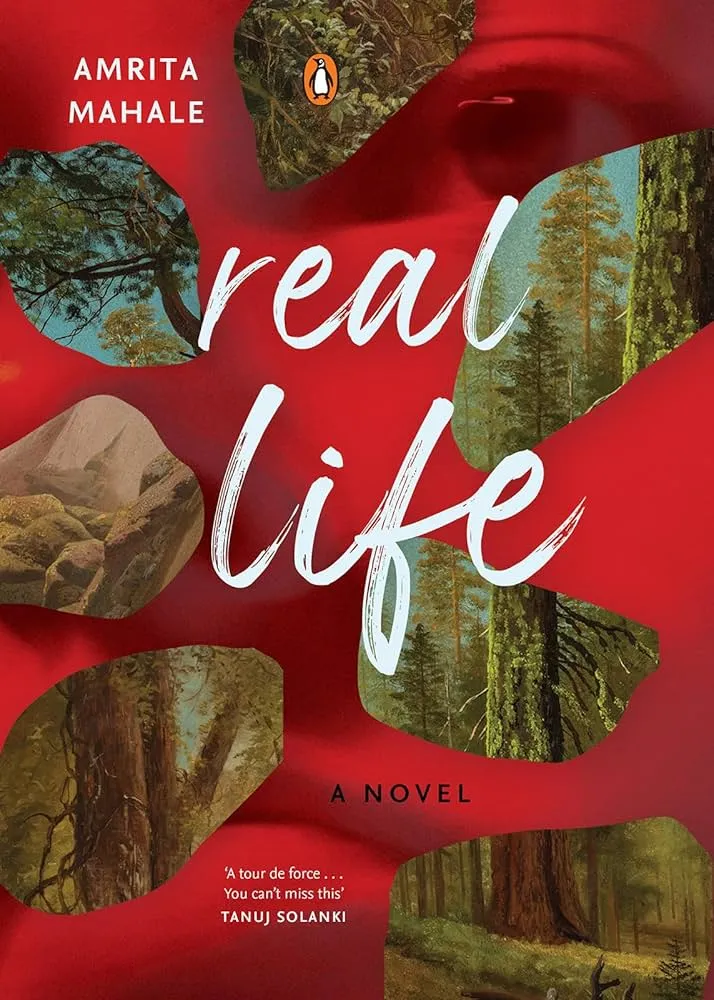
RM: Congratulations Amrita on a truly remarkable second book and thank you for talking to us. Real Life is a timely and important read. In your author’s note you mention of your work in artificial intelligence, especially its social and ethical dimension. What prompted you to write this book and what is your own personal conception of responsible AI?
AM: Thank you so much, Rituparna!
One of the central questions of the novel is what it means (and what it takes) for a woman to pursue a life that feels real–that feels authentic to her–in a society that constantly tries to control and reshape women. AI has now started to complicate the question of what is real (and what is seen as valuable).
As you have pointed out, apart from my writing, I also have a career in the development sector, more specifically in tech and AI for maternal and child health. Some of the ideas around technology and AI that I explore in the novel had been on my mind for a long time: techno-solutionism, the issue of representation and bias in AI models, the ethics of using personal or copyrighted data to train language models. I have seen how easily women can get left out of the teams and datasets that shape AI. Real Life is also a novel about the ways in which women disappear from the world. The AI subplot gave me a chance to reflect on how women can disappear in an unexpected way: when they are rendered invisible in the technologies and decision-making systems that now increasingly govern our lives.
In the AI systems that I help build and deploy, we try to follow the principles of safety, fairness, transparency, privacy and inclusivity. But for me, responsible AI starts with humility, knowing when to use AI and also knowing what technology should not attempt to replicate or replace.
RM: In this novel, nature and technology stand as almost diametrically opposite poles, and if I have read it correctly, as diametrically opposing lifestyle choices as well. Mansi and Bhaskar, both engineers mediate their experiences through technology, albeit in very different ways, while Tara, an ethologist, lives out her days amidst nature and considers the possibility of a more organic, natural existence. Have you conceived of these two positions as mutually exclusive in your work?
AM: That’s an interesting question. While I don’t see the two as strict opposites, they do represent different ways of organising attention, effort and value. Both Mansi and Bhaskar are dissatisfied with their lives before they come to Jora, but for different reasons. Bhaskar is aware that modernity has contributed to his loneliness and alienation, but he doesn’t see his own role as a technologist in making the world the way it is. For Mansi, being in the mountains is a way to step out of her previous life of performance and surveillance, both of which are exacerbated by technology. Tara, in many ways, has a much healthier relationship with technology, where she doesn’t let it control her or shape her inner life. I don’t see Tara’s immersion in nature as a rejection of the modern world, but as a way of recalibrating her relationship to it. Perhaps that is the case for all three characters: each of them is looking for a way to find balance between technology and modernity and the slowness, true connection and presence essential for authentic living.
RM: How did you arrive at ethological research as a point of view in your novel? You have explored the dichotomy between craving solitude and the need to return to humanity very well through Tara. What has this representation meant to you personally, especially in terms of the value of solitude for women?
AM: There are two novels I read in college that I fell in love with, both of which feature women ethologists: Amitav Ghosh’s The Hungry Tide and William Boyd’s Brazzaville Beach. I suppose what drew me to these novels was that their protagonists spent long stretches of time on their own in nature and their work gave them the license for solitude. Solitude for women is often seen as selfish or dangerous, and I wanted the novel to push back against that assumption. Solitude is essential for intellectual, creative and spiritual survival–I think I realised this acutely only after I became a mother and my time was no longer my own. It took me a few years after my son was born to start to carve out pockets of solitude for my writing.
Also, in some ways, a novelist’s work is not unlike an ethologist’s; the reason I write fiction is because I love observing and understanding people. Ethology offered a way to think about humans as animals shaped by their environment, their social structures, and their instinct for survival.
RM: One of the biggest takeaways for me while reading this novel was the realistic and nuanced way in which you portray female friendships, the patriarchal codes that seep into that friendship, the subtle cruelties and the absolute honesty, above all, the love and bond that is stronger than perhaps most other relationships. Tara and Mansi, both feel a kind of rage, and while it’s more visceral for Mansi, Tara’s anger is more intellectual. Why is it important for you as a writer to highlight and talk about women’s labour and emotional exhaustion, especially in the present socio-cultural context?
AM: I am deeply interested in the lives and minds of women, and was very deliberate about using the friendship between two women as the lens to examine ideas of agency, authenticity, and female and male rage.
For my work in maternal & child health, I look into how women exercise agency, access information, and make decisions around their health and well-being. For a large number of women in our country, marriage shrinks their social circle outside the family. A woman who holds on to her friends is one who is likely to be empowered in other ways too; female friends offer support and solidarity, they can show you how to take up space, how to bargain with and challenge patriarchy. Female friendships hold intimacy, joy and deep loyalty, they are a place for women to be themselves. It felt like a very important topic to write about (and also, so interesting and fun–an absolute goldmine for a writer!)
RM: Also, in talking about women’s work and the degree of independence that a woman can carve out for herself, I find Tara’s portrayal very realistic. You show how feminism is achievable and completely doable through Tara’s mother, who not only strongly advocates for her own liberty, but also brings up Tara in a way that makes her seek her own path on her own terms. I love how towards the end of the novel, Tara, aware of her difference from other women of her age, tries to define radicalism not only as a feminist supposition but simply as a mode of life that seeks a certain richness from living. What did you want to achieve through Tara’s portrayal?
AM: Tara was my favourite character to write. She is free-spirited, not afraid to live on her own terms. She is sure of herself but also curious about the world and open to its possibilities. She is also a bit unknowable, even to those closest to her (including me, her creator).
I am so glad you brought up Tara’s mother. She appears in only one scene, but through that scene I hoped to convey how she has modeled freedom and agency for Tara all her life. It’s not surprising that Tara is the way she is, someone who is comfortable choosing richness of experience over safety or society’s approval.
Through Tara’s portrayal, I wanted to explore the concept of agency. I think a lot about agency: as an individual, as a woman in a patriarchal society, and as a public health professional who works in the field of women’s health. Agency is an individual’s capacity to act and shape their own life, and this intrinsically includes the capacity (and freedom) to make mistakes–this is central to the idea of independent action and self-determination. Some of Tara’s decisions have serious consequences, but I see her as someone for whom the right to be wrong is a way to assert her full personhood.
RM: The men in the novel represent varying degrees of patriarchy that are often coded on the woman’s body, from the older generation in Sid’s father and Bhaskar’s uncle, to the refined, entitled and more dangerous patriarchy of Sid and Bhaskar themselves. Bhaskar’s interaction with the software is a particularly chilling episode and you have demonstrated beautifully the dangers of unbridled AI that can reinforce the existing discriminations based on the abundant linguistic data it is fed. How important do you think research in this emergent social problem is and what role can fiction writing play in this mix?
AM: AI systems absorb the biases of human society through data and language that represents our world as it is, and can easily reinforce and amplify these biases. This is a very important social concern and research and proper policy-making are crucial. Fiction can be a way to explore the consequences of poor systems before they fully materialise in the real world. We humans are natural storytellers and have used stories to entertain, provoke and change minds for thousands of years. Fiction allows the writer to ask moral “what ifs” and engage the imagination and empathy of readers, and not just the intellect.
RM: Another particularly appealing aspect of reading this novel was its linguistic depth and flow. The novel flows beautifully from Mansi’s introspective, poetic language to Bhaskar’s straight, edgy and often paranoiac telling to Tara’s lyrical voice infused with philosophical grandeur. The characters in their inner world and in their interactions with the outer world, talk about a variety of problems such as western capitalism, or the industrialization of academic endeavors, but it is done with a restraint so as to not overburden or take away from the novel’s central intrigue. Why did you choose the format of an intrigue to talk about a serious social issue and what have your literary influences been?
AM: I remember reading an interview of Elena Ferrante, one of my literary heroes and influences, where she said that she aims to hook the reader’s attention from the first page, that she is not above using any trick available to get the reader to keep turning the pages. But once she has the reader’s attention, she will engage with it on her own terms and not pander to the reader. I was attempting something similar. Intrigue creates momentum and invites readers to get absorbed into the story. The first section of the novel is very soap operatic in its emotional register. Every chapter ends with a little cliffhanger. I wanted readers to get fully invested in the story before slowing down and bringing in ethical, moral and social questions.
RM: While the characters in this novel search for their ‘real lives’ in their own ways, what does a ‘real life’ mean to you? Also, what project can we look forward to reading from you next?
AM: For me, a ‘real life’ involves choosing meaning over chasing accolades. It is a life that is not fully optimised or explained, but one that has room for serendipity, wonder and contradictions.
I am planning to start working on a third novel soon, but I have a short story out in the new anthology of Bombay stories titled The Only City (edited by Anindita Ghose). While it’s nothing like Real Life, it is also about women and technology and follows a young data annotator who works at an AI company. All I can say about the third novel is that there will be no AI in it, I have had enough of the topic for now 🙂