
A dear friend and tireless worker in the field of peacekeeping, Ezabir talks about the personal challenges in her life and how she has used these experiences to support half widows in remote districts of Kashmir.
〜
WHEN I THINK of Azadi, I envision birds soaring freely in the open sky-uninhibited and boundless. This freedom, so natural for them, became my life’s most profound struggle. My journey from a carefree childhood to reclaiming my Azadi in the face of societal and personal challenges has shaped not just my life but my work with women who are silenced by conflict.
So that is what Azadi is to me: to be able to do what you want, without any obligation or restriction or inhibition. My life is very clearly divided into two parts: the personal and the professional. Having said this, I will also say that the work I do has been possible because of the way my personal life has been: one has led to the other. In that sense, they have been entwined. Let me attempt to explain how.
As I reflect on my personal sphere, I find myself feeling numb. I am a person who has intentionally blocked all my memories, choosing to erase old files from my mind as a defence mechanism. This has been my way of coping with a past filled with uncomfortable moments.
It is as if my heart whispers, ‘If only I could let go of these memories and find peace from their lingering pain?
As such, the idea of revisiting and reflecting on past memories feels overwhelming and deeply unsettling.
I was born and brought up in a free-spirited environment. My childhood was filled with love, comfort and the liberty to dream. I never questioned what it meant to be ‘free’ because I always felt Azad-free to explore, express myself and grow without constraints. It was only later, when my freedom was curtailed, that I understood the privilege of this unencumbered liberty.
My father was deputed by the Government of India to East Africa as an advisor to the Ministry of Finance and Planning. It was a family posting, so my brothers and I went to Kenya with our parents.
My childhood, split between the vibrant openness of Kenya and the more conservative norms of Kashmir, gave me a unique perspective on freedom. While Kenya offered co-educational systems and casual gender interactions, Kashmir’s societal fabric was tightly woven with tradition and restraint.
My parents ensured we stayed rooted in our culture, even as we embraced the liberties of a modern environment. This was in the early 1980s, and I remember my mother telling me, We have come to Kenya now and we will be here for a few years. But, eventually, we will go back to our home country, back to our roots. So, even while we are living here, do not change yourself to adapt to this place so much, that when we go back to Kashmir, you have difficulty settling back there. Let it not make you drift away from your roots. This was a standard guideline for my brothers as well.
The basic guideline given, I understood it clearly: you are given absolute freedom and liberty, but how you use it, how much of it you use, and in what spheres of life you use it, is entirely up to your discretion, because nobody has bound you in chains. You have your culture, your roots, your ethics and your traditions that shepherd you through your life, and provide you with perspective, along with appropriate limits, but you are neither bound nor chained.
It was this understanding that made me feel very Azad-free to study alongside boys, interact with them and openly discuss various topics without hesitation. It was a warm, friendly environment and we never felt anything to be unhealthy or out of place.
If there had been something wrong with the way I was allowed the freedom to express myself and simply be, I would have sensed it. I would have felt restricted, as though chained. But that never hap-pened. Instead, I felt absolutely free.
Later, once I was back in Kashmir, I entered college with a mix of excitement and uncertainty. I was not used to this kind of a life. My cousins were much older, and they warned me, ‘When you go to col-lege, you will find boys waiting to tease girls. So, be mindful, because they will be looking out for new prey. I had lived in an environment where I could freely engage with others, but now I was being conditioned to behave differently.
I asked them what I was supposed to do. They advised me to keep my eyes on the ground when leaving college for the bus stop. ‘Don’t look up, they said. ‘Sink your gaze into the earth, and walk quietly. If you don’t look at anyone, no one will tease you’
I can’t believe it now, but for many months, I did exactly this. I avoided eye contact, walking with my gaze fixed on the ground as my cousin had advised. This self-imposed invisibility felt very disempowering.
The Women’s College uniform was white, and girls were often ridiculed and teased as white hens, a taunt that highlighted pervasive sexism. I escaped such teasing only because I was strictly and religiously following my cousins’ advice, though it came at the cost of my confidence.
Eventually, I realised the absurdity of this behaviour and began to reclaim my confidence, lifting my gaze and laughing at the fear I had allowed to control me.
Though this moment was small, it was a significant step towards reclaiming my Azadi in a society that often sought to curtail it.
This experience taught me how deeply the societal norms could dictate a woman’s behaviour even in mundane situations. This was my first step towards questioning and defying such forced restrictions and to feel Azad. Freedom no longer seemed as simple as doing whatever I wanted; it now involved navigating societal expectations, judgements, and even restrictions placed on my behavior. While I had once felt liberated—whether in Kenya or in Kashmir as a child-this new phase was fraught with confusion. It was the first time that I felt controlled, bound by unspoken rules about how I should present myself, especially in public spaces.
However, it wasn’t until I got married that the concept of Azadi took on a different meaning. Because that is when I experienced the true loss of freedom. The very liberties I had taken for granted were slowly stripped away. In my marriage, my choices became limited. I was confined to the four walls of the home, isolated from my family and friends, and controlled in ways I had never imagined.
This new lifestyle was very uncomfortable, because my ex-husband simply did not let me do anything. I was completely suppressed, dominated and bullied by him. He used all kinds of pressure tactics to suppress me entirely. And I kept getting suppressed further.
I would not share anything with my parents, because I did not have the space or opportunity to do so. He neither let me go to them nor encouraged their visiting me. So, emotionally, psychologically, mentally and physically, I was not free; I was bound in chains. In the cage of his control, my wings were clipped. The vibrant freedom I had known became a distant memory as my choices were stripped away.
This oppression deepened my understanding of Azadi-not just as a personal right but as a necessity for survival.
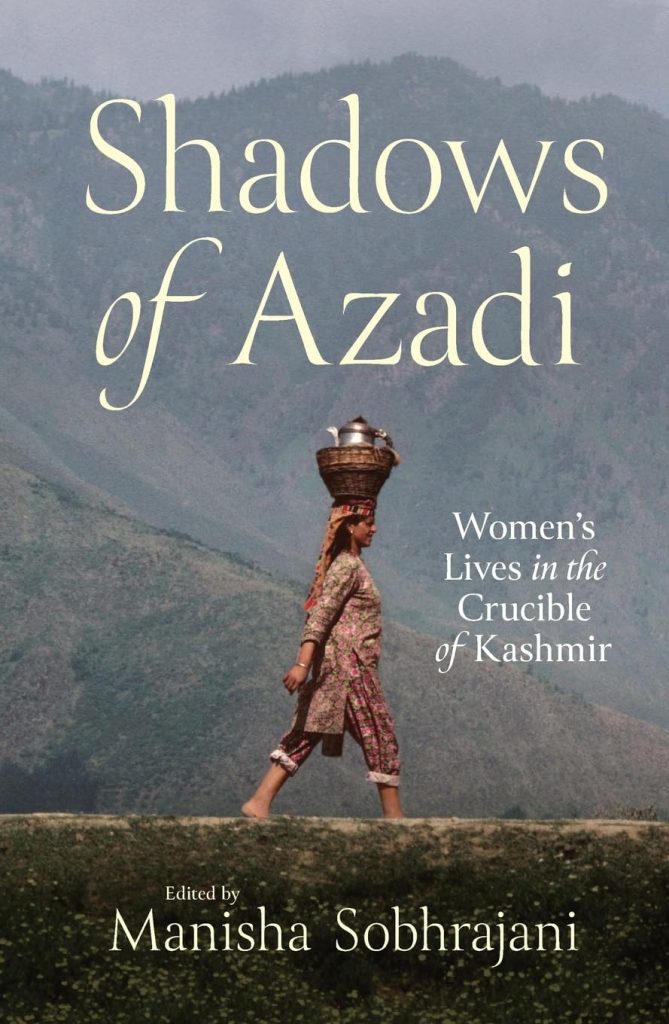
Excerpted with permission from Shadows of Azadi: Women’s Lives in the Crucible of Kashmir edited by Manisha Sobhrajani published by Yoda Press 2025