Usawa Literary Review is headquartered in Mumbai, India.
PIN Code: 400050
Interested in working or collaborating with us?
Contact Us

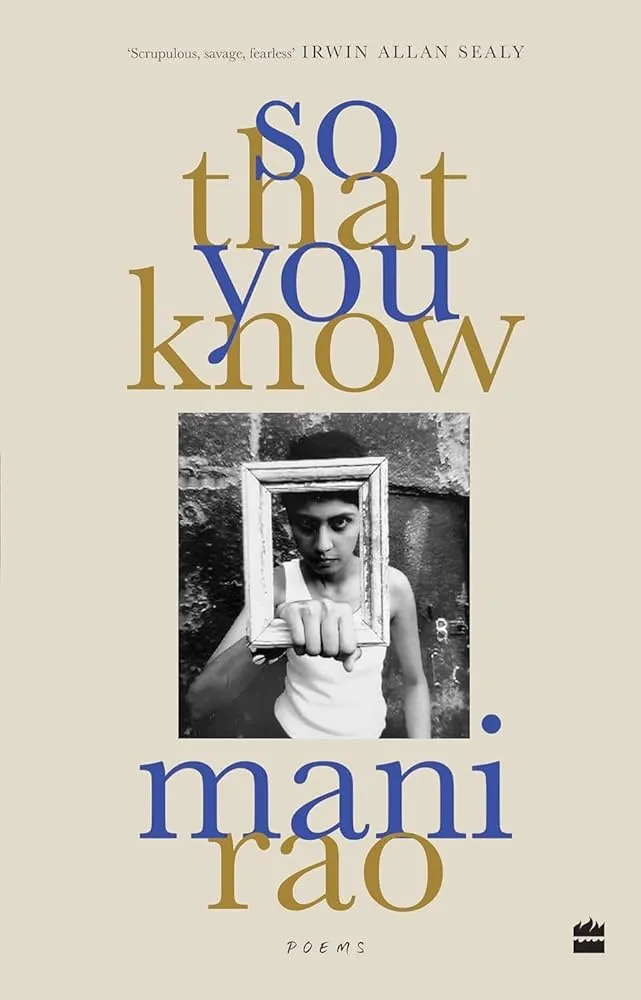
So That You Know

By Mani Rao


Mani Rao's work has, over the years, acquired a reputation for battering against the doors of poetic convention, experimenting with form and language, and untethering images so they run fast and thick. Part visual, part text, So That You Know stands testimony to the mischief and anarchy of her poetry.

Excerpt: So That You Know

A weighted coat, a marriage. Poems sift through loss and quiet piety, an Indian mountain's dreaming silhouette, walking barefoot into echoing replies.

THIS MARRIAGE

It’s not too cold, I know,

but I had nowhere else

to keep this overcoat

All my suitcases were full

And my closet overcrowded

So I just let it sit

upon my shoulders

SOME OF WHAT I LEARNED FROM BOOKS

Give books away before they gather mold.

Will I be lucky or live to be old?

So you were fooled by the cover.

You’re the fool and it’s also over.

Not all great poets find renown.

Oh the snoring when they sleep on their own.

STORY MOON

Pair of lovers coupled

with a full moon—

Formula for romance.

Silhouetted faces cradled

in a generous moon curve—

Pregnancy.

The same pair walking on a beach, skies overcast,

moon skidding on footprints—

Death, or death

rescued by separation.

If there is no moon, oh no moon, there is no

moon at all, where is the moon, there is no

moon, honey, there is no moon, no

moon, and saying it again conjures no

moon what’s a poet to do

without moon

IF IT’S ANY CONSOLATION

To you who loved and could not speak of it,

lost something no one knew you had.

To you who find yourself abruptly weeping

in public with no legitimate explanation.

To you who told a friend who said ‘this too will pass’.

This did not. This carved a hole within your chest.

There this lives and owns your face.

To you who denied yourself and have no one else to blame

Surrendered to bondage thinking it your place

You went by the book, did not know better,

that piety was false, it was too late,

Two-minute silence.

TIRUVANNAMALAI

After I spat out sweet-n-sour stories

under the tamarind tree

Old photographs at Ramana’s cave

looked at me infinitely

Agape I walked on barefoot

rocks rumbling replies

Arunachala, red mountain,

your silhouette lines my dreams

Every morning, humanity snakes

around you, churning

Excerpted with permission from So That You Know by Mani Rao published by Harper Collins Publishers India, 2025.

Looking for more Books?

Browse the Bookshelf →

Mani Rao in Conversation with Ankush Banerjee

The conversation examines poetry’s role in navigating the fuzzy art-life relationship; internal contradictions, formal integrity, and embodied places redefine its contemporary stakes.

AB: Hello, Mani! Thank you for doing this with us. At the outset, tell us a little more about So That You Know? Does the book have clear-cut thematic focuses, sustained engagement with specifics, or is it more sprawling, and diverse in terms of its themes and preoccupations?

MR: Readers could probably answer this question better, but I can attempt an answer. I think many of the poems are about minutiae and a moment – about being here now – they size up, acknowledge, realise what is. (I guess I mean that they rarely speculate, pretend or go lofty). Many of the poems are meditations on specific discoveries – candid emotions – in relationships with a love(r). Overall, the delight of being t/here, and of the micro-grain of experience.

On the face of it, the book is sprawling, especially if you consider the selections from previous poetry books. In fact the first section has some poems written over 20 years ago, and that were never published.

AB: You begin your Preface by raising an interesting, though long-standing argument – about how the relation between life and art, rather than being apart, is deeply intertwined with each other. Given the age we are living in, wherein both, the boundaries between real and reel life, and how art is produced and consumed, have become so fuzzy, how does such fuzziness configure the the life/experience – art relationship? In short, where does the art and life equation stand today?

MR: Projection of the self has become much more important today. What to say on social media – and the craving and the pressure to be liked. If it has not been seen and liked, it is deleted. Is there a face buried under the mask? But our reality has not changed. We still live with our illnesses, with the consequences of our actions, and experience this world directly. Art depends on our experience of living.

AB: I notice many the poems, such as ‘If it’s any consolation’, ‘Story Moon’, and ‘Just Looking’, have woven within them, either thematically or formally, a self-contradiction; what I mean is, they seem to turn upon themselves. What do you think is the role of interweaving contradictions in poems, and how does this technical strategy affect these poems or poems in general?

MR: When you run a finger along a möbius strip or loop, you proceed smoothly on the same plane, but then abruptly discover that it has landed you on the flip-side. Same co-ordinates, but the other side. Many of these poems were like that. They began in one place and ended up as their opposites. I mean, the poems wrote themselves to their own opposite possibilities. Or perhaps every idea holds its opposite deep within itself and you only have to plumb it to get there. So it is a kind of wholeness, rather than a contradiction.

AB: Reading some of your ‘about love’ poems, I was reminded of Louis Gluck’s observation about Emily Dickenson, about how the dignity and restraint of her phrasing didn’t necessarily obscure the source of her poetry; on the contrary, Dickenson’s poems inherently assume that other people would also have similar life experiences, and this is what makes them so incredible. Can you tell us a little about the ‘about love’ poems in the book, such as, ‘This Marriage’, ‘How I Knew’, ‘Statutory Warning’, ‘Happily M’? Where do these ‘come’ from? And more importantly, where do you assume the reader in these poems to be, i.e. is he/she voyeur, ally, or objective observer, among other positions?

MR: The specific poems you refer to come from reflecting over the practice of marriage. At best, it is a sustained mirror for the self. Mostly it is a mixed bag, with its realities and facades, hopes and hopelessness. At worst, it is a travesty of the spirit. Why do human beings prolong the transitory? Are we incapable of loyalty unless under duress? There is no knowledge to be gained for the self via marriage beyond the (limited) warranty of the formula. Yet, it creates an undergirding – a nest – for others.

And where is the reader in this theme? All of the options you outline are possible. That’s not for me to speculate or know. The poems are not addressing an external reader and making any case or argument. The readers are all within me. Just as the writer splits into writer and reader during the process, the reader will be in the skin of the writer during the poem.

AB: There are quite a few poems in which you use rhyme. Do you think it is a formal risk a poet takes while using rhyme in this day and age? Tell us your thought process behind the decision to use rhyme.

MR: Poor rhyme is when you act like you’re in jail before it’s time. The anticipation of rhyming constrains the scope. Even before you explore the next thought and line, you’ve already decided the end-rhyme and then make do with the thought that fits the rhyme. But when the rhyme is successful, there has been ample scope for thought, the reader focuses on the delights of the meaning, and then marvels at how the rhyme added the power and sound-value to the poem. There is no risk when the rhyming is successful.

AB: I was spellbound by your poem-essay, ‘I, Lorine Niedecker’, not only because I am a huge admirer of Niedecker’s work, but also because you have managed to interweave surprise, playfulness, and a lot of dense historical information in that poem. Can you tell us a little more about the poem-essay, your engagement with Niedecker and her work, and how it has influenced your own poetics, if at all?

MR: I’m so glad you liked that one! I really related to her writing and her approach when I encountered her work for the first time. I was to write an essay about her work, and decided to use her own words. How do you express admiration for someone except by voicing it, and re-reading, repeating, their words? Much like a musician playing a master’s composition. And then if I really embraced her poetics, of “the condensary”, I too would apply it back upon the original. So I retold her life and poetics through my poem-essay. There was one page for flora and fauna, one page about the mother goose poems and the villagers who inspired those poems, and so on.

AB: Some of the most striking poems in the book are about places – Kashi, Vrindavan, New Zealand (Half Moon Bay), Tiruvannamalai, and Waiheke. These poems are dense with remarkable details, and movement. I must say, one almost feels one is watching the ghats of Manikarnika, or the pristine coastline of Waiheke. One could surmise that these poems become spaces which reproduce these places, shaped by your poetic imagination. Gaston Bachelard, in this regard, has written in his book, The Poetics of Space, that, “space that has been seized upon by the imagination cannot remain indifferent to the measures and estimates of the surveyor. It has been lived in, not in its positivity, but with all the partiality of imagination”. How is the speaker positioned in these ‘place poems’, and how do these places affect the speaker? Can you explain in reference to any of these poems?

MR: Each of those poems comes from being there. The Kashi poem was originally written for the Divining Dante anthology edited by Priya Sarukkai Chabria – it had to be in three parts, and involve a journey. Dante describes the journey of the soul after death. I was in Kashi that January, wandering, walking the ghats, ten days away from my deadline and had not written anything yet! SoI put pen to paper and thought I would describe the journey of the body/corpse after death. What was around me just jumped into the poem.

Divorce Blooms is sparked by a 2005 phenomena in Waiheke Island, New Zealand. The water surrounding Waiheke had become red in colour due to the algae blooms. This turned into blood and wine in my mind (pathetic fallacy?)

The mountain is the temple, the sacred space of Tiruvannamalai – embodied Shiva – which everyone circumambulates. I conflated this with the Mt. Mandara that was churned with serpent Vasuki by the devas and asuras to obtain the nectar of immortality. And when we circumambulate (snake around), there’s another nectar within ourselves that is churned, and rises.

These places became a part of my body.

AB: What are you currently working on?

MR: In writing, nothing right now.

AB: Any advice to younger poets (apart from reading more poetry)?

MR: Let it steep. Work at it.

AB: What are you currently reading?

MR: Adil Jussawalla’s Soliloquies (Thayil Editions, 4th Estate, HarperCollins)

AB: Is there a message you’d want to convey to the readers of Usawa?

MR: Thank you for supporting the values that Usawa stands for.

AB: Thank you so much for your time and for the wonderful insights, Mani.

Looking for more Books?

Browse the Bookshelf →

Review: So That You Know

Examining the body and psyche's subjugation to patriarchal strictures, the collection exposes the profound individual cost of institutionalized suppression and unseen societal pressures.

Art is not personal. It also is not a projection of our inner ‘self’. Rather, what we think and create is a truth that holds an illusion of manifestation. Artists are bound to be the people who are seen and they represent whatever they come across with or without pretension. Some may refer to them as subjects of voyeurism. Others know that if they are not seen or heard, they will write something that is going to remain distant. Thus, when Jorge Luis Borges says, I am not sure that I exist, actually. I am all the writers that I have read, all the people that I have met, all the women that I have loved; all the cities I have visited, he is actually telling us that he has engulfed everything and everyone he met. Mani Rao, in her recent collection of original poems so that you know, establishes something similar where she allows us to see who she is through her associations with people, relationships, dreams and complexities, without putting any filter. Here, poetry is exhibited, to endorse the unseen territories.

Society is habituated of developing certain customs and rules around its institutions. Marriage being one of them, finds less room to any catharsis. Mani Rao’s poem This Marriage, is a naked revelation of how most marriages work when surrounded by invisible statutes. These statutes get larger with time and then the society leaves nothing but a force that compels one to stay within its periphery. The locked, peeking eyes work as surveillance bodies, which further effects the people living under the institution. In the poem, the overcoat can be imagined as a clever metaphor of both a human being’s body or something that can be coined as a burden. The line all my closet overcrowded, magnifies the noise and claustrophobia that crowds around individual freedom. The poet, in the last stanza, speaks the voice of most women who simply leave thinking about these issues to live in a bit of peace. Through this short poem, Mani draws the nucleus of most marriages.

All my suitcases were full

And my closet overcrowded

So, I just let it sit

upon my shoulders.

In the poem Island, the poet writes about the necessity of distancing oneself from the crowd. Being alone is a primary component most of us do not explore. In that space, we manifest and speculate some world which is different from the one we live in. To be more practical, the poet also writes that if we want a person in that situation, we can simply manifest one to arrive. With this particular thought, the poet balances both the needs of a human being. During the moments of solitude, we assemble a world which may or may not exist, but its presence in our head counts for a greater realization. The latter half of the poem is where the dust settles and then Mani gives us an idea of how by experiencing solitude (sometimes loneliness), we develop an idea of how companionship works. A person in solitude opens more to provide space to those who have the affinity of an association. In the last verse, the poet knows that in loneliness we mostly forget our habits, but she is ready to make their traces stay within us; to make us not forget what we usually do – and who we truly are.

The waiting is now clean

Body leans toward the door

Door foreshadows

Who lifts the mist why is the steed on a hillock

Figure tapering over it black and grey

Speechless as though the last breath can be saved

The floor is a mess.

The time we are living in is desperate and harsh. It takes us to our saturation point and then breaks us by using its tricks. In the poem A Little Secret, Mani Rao addresses the dichotomy of who we used to be and how we have become with time. Institutionalized religion figures out its own ways to reach us and tell us to measure the supreme being with money, relevancy and virality. In the first two stanzas, the poet is rooted to the rituals which have been passed on to us by our ancestors. She is more focused on the inner peace that the customs of worship provide. The build-up of a community in places of worship have nothing to do with rituals, but is more about the energy that has a serene synergy. To find devotion in a pebble is not blindness. It is a method through which we convince our psyche to live in contentment. At present, the vastness and reach of the supreme is based on the physical size of idols and the ability of most godmen to leave no question unanswered.

Now look, the deities are out like clock towers.

Adiyogi competes with the mountain’s profile.

He is everybody’s backdrop and buddy.

Beneath a Prussian blue sky

to all the shooting stars we reply with selfies.

In the section Sing to Me, the poet explores historical figures, their lifestyle and essentialities through a series of poems. The poem Peace Treaty, speaks about Helen of Troy who is left alone by her partner because in the realm of masculinity, men seek freshness and leaves the other as unwanted. There’s no affection left and hence, the absence of love becomes cruel. Cadmus is History, on the other hand, describes the world in its wildest form where he witnesses everything that grows and falls. Jove’s Collar is an intense poem where powerholding is demonstrated by keeping gender and relationship in mind. To consider a wife a sister is a sinister process where the man wants both pleasure and protection without any condition attached. In the Shower, Thinking of Actaeon broadens the history for us which was never about restricting desire and suppressing what makes us human.

What Ovid does not offer

What Slavitt does not explain

It has the water I say

It has the water she

Squirted when you gawked

that masked your trail

(from the poem In the Shower, Thinking of Actaeon)

Poetry is never about the language we speak. It is always about the language we do not speak and yet something we want to spill out. A desperation is in operation in that particular space and poets are driven by this emotion. The poem Haul, is about giving a physical smell, visual and touch to the craft of poetry. Here the poet finds another poet in the moonstone hanging by a thread and ink is the footprint she gets to see in the cradle of beach. In this poem, the poet is aware of who she is, but then to not be overexposed, she clings to the metaphors. For a poet, audience is found in the dark and damp corners; under the rugs of a pillow; in the food that is being prepared. In sleep, dreams bring with them the elements which mostly stay out of notice and the supernatural becomes quite natural. Poetry drools because of greed and desire. It accumulates only in the presence of freedom.

I let the airline flow

Give myself some slack for a slow graze in the deep

Drooling all over the pin bloodshot

And reel it in.

Mani Rao explodes and explores in this collection of her original poems. She experiments with form, words and thoughts but we find her voice trickling down our throat to the places which have never been experienced before. These are creations which are going to work only when seeking would become our primary objective. so that you know is an important addition in Indian poetry that can either give readers a pleasant day or can make them leave the room to breathe some more. Either way, the poems are going to haunt readers with their impact.

Looking for more Books?

Browse the Bookshelf →
Back to Issue

Support Our Work

If you enjoy our content, consider supporting us.

Support Us

We are an unfunded, independent feminist publication. We need your support to continue our work.