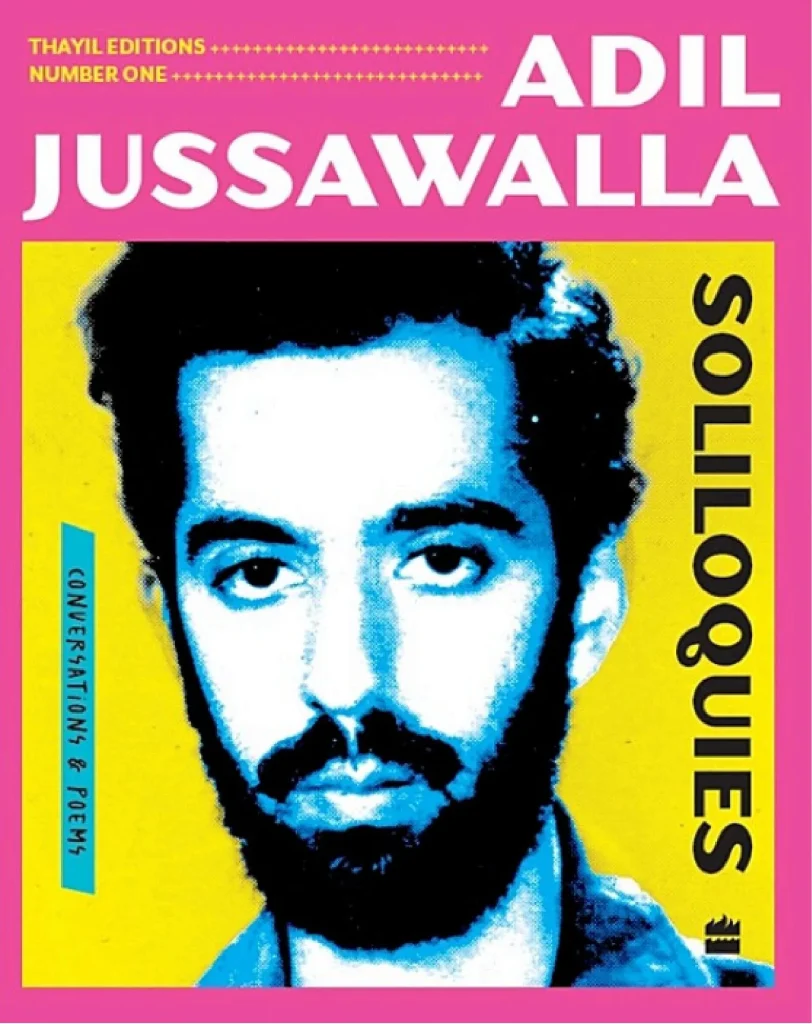
Some books shout but others whisper then can change everything. Adil Jussawala’s Soliloquies whispers instead of declaring, circles instead of arriving, and stays with the reader long after reading.
Jussawalla starts now to circle all around his past: “I was either seventeen or eighteen. Jian was my first full-length play.” That unsureness of his is disarming. It does not perform certainty. It simply exists — and that quality runs through the entire book.
That unsureness of his pops up at times when he says, “I don’t think you can dismiss mysticism as obfuscation.” If you try to force mysticism into a box of logic, you kill it. He knows that. He does not try.
Critchley now says something quite interesting concerning either Julian of Norwich or Meister Eckhart: the Word actually was not the beginning. Silence was. And from that silence Jussawala writes. From the Bible, what he has from memory: “In the beginning” — and what he does with that fragment, that half-remembered line, is the whole shape of this book.
He is confused even when discussing community: “I don’t know if there was a feeling of community, at least that’s not what I got” — and that honesty, that refusal to romanticise belonging, is part of what makes these soliloquies real.
He talks of the missing person as if like a puzzle: “Does he want to be found, or does he want to be invisible, or on the other side?” The question hangs. No answer comes. That is the point.
Disagreements along with tension and distance yet also sticking it out with love is there. He is honest, as this is clear when he says of Nissim and himself: “Our friendship remained intact till the end.” That is not a small thing in Soliloquies — it is perhaps the only certainty the book allows itself.
The poems come next. These are poems themselves. Where should a person have to even begin from? One must start somewhere, so start with the father.
“My Father?
This bastard father intrudes as always
Nothing’s been gained but
Pain and fear and illusion,
Dissolution, darkness, despair—
These things affect me still—growing
Around me stronger than before—
And strangling.”
Focus with intent on that which is of most importance. No fancy words. A grown up kid still choking in the past, just paying attention to this bastard father. The poem’s title is Daddy, but the word “father” appears and it is heavier for it.
Then in an instant it mainly then turns.
“Knowledge which began a vast
Cycle at my birth is closing
On itself now.”
Because knowledge itself goes around in circles, you are in a trap. That your life is now stuck within the patterns, and T. S. Eliot’s “In my beginning is my end” echoes behind it — but the circumstances are different. At that point, a little spark of hope appears.
“Sun will rise again.
Fires will Warm, but till then why must I be
Left unsatisfied,
Asking and doubting the nature of
What I am, and what around
Me must be?”
Now the unsure hope feels no big deal. The sun will rise up indeed, yet this speaker is sad chewing her uncertainty. That is the kind of faith Jussawala deals in — not triumph, not despair, but the trembling space between them.
Such lines exist. Prayers are also lines. These lines do now ache, almost as if begging now.
“Heal this pain of division, Lord,
This parting of ways.
Cannot those I love receive You
Through me, that I must
Leave them to illusion, and know
Truth myself?”
Love has a power to unite even God with all people beyond just salvation — so that voice has desires for connection for each person, not only for itself. That is the theological weight of the book: not personal salvation but communal belonging.
“There is one, calling far from
Home and hope, in a lonely
Land—eating spit, drinking
Tears where no one calls a name”
Tears existed since then, and no names were called. Tears could be seen to be present, but names stayed still unsaid. No one called out. And then:
“Or asks me where I go,
Where even the earth and all”
That image hits hard in a nameless place: eating spit, drinking tears, without name. The wandering poet, Job, the refugee — all collapse into one figure. That remains a shaky faith moment.
“If then I love you still, God,
Myself shall be absolved, as all
My conscious will shall be, and your Presence shall stay with me forever.”
It is not easy faith. It is perhaps because a “still” goes with it as if it is like a question that its quality is touching. It does not declare. It asks. Even the grammar is tentative.
Poems focus on peace, on new observations, on eternal childhood.
“There is within us all though not a dream
A peace which despite unprevailing
Laws prevails for you you
and you that
you may have fulfilment”
and
“Ever be a child awakening
as one that forever opens
its eyes and awakes
Imagine its eternal moment
of revelation”
However they also give up since they circle in despair. Again just a circle tries then. It tries at closing.
“But at this gap between
Beginning and end I stopped,
Turned away from
Love In defiance
And dropped.”
and finally:
“I renounce this home,
This family and the shelter
It has given me from the
Chaos outside it.”
That hooks me, and there the book misses one mood. It varies among anger, worship, despair and hope. It circles back. It refuses to resolve.
Duino Elegies by Rilke keep coming to mind; angels vanish then appear. The speaker then shifts in a rapid way from terror to tenderness. The comparison is not forced — both books circle the question of what it means to be human and uncertain and still reaching for something.
It is unsettling that Jussawala makes an allowance for visible cracks. Even though all of the words are not always so perfect, the poems work, because the imperfection is alive. The crack is where the light enters, as the other Leonard observed.
Thus the book lacks a tidy ending. It pauses, then questions do arise, and then it circles around. It is persistence that matters — not resolution.
Ultimately Soliloquies offers to us no happy ending, no rulebook. It leaves us with an echo from a voice that persists. And that echo lives in the gap between Beginning and end — which is where all of us live, whether we admit it or not.