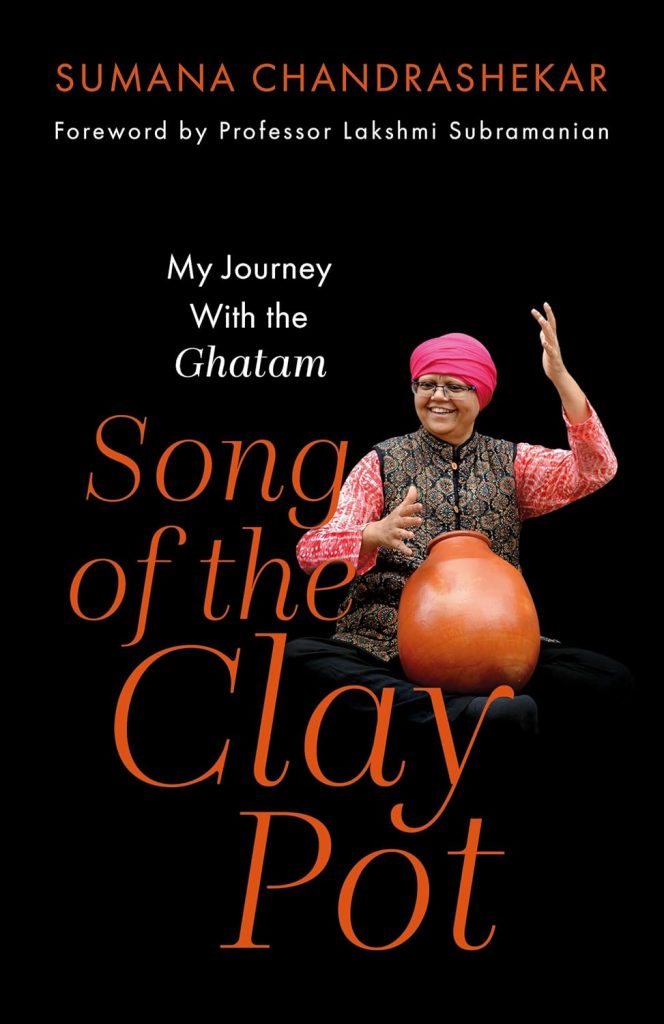
Rituparna: Congratulations Sumana on this wonderful memoir. I had a really great time reading through it and as someone who is fond of music, but not classically trained, this book in many ways has been an eye-opener about the world of percussion music. You have ingeniously structured this book in many ways like the making of a ghatam itself, the amalgamation of elements that heralds the formation of the ghatam till it finds its own space. In the introduction, you speak about finding your own space, and sitting inside your body to view the world taking shape. Do you think this body-mind dichotomy reflects in the making of music?
Sumana Chandrashekar: Thank you, Rituparna, for your warm words about the book. I am so glad that it resonates with you. And yes, the book itself is structured in a way that it enacts the making and the journey of the ghatam. You have insightfully made this observation. Thank you.
With regard to the ‘body-mind’, in reality, there is no dichotomy between the two. It is not body and mind. Like you very rightly put it, it is a hyphenated ‘body-mind’. To view them as binaries and as dichotomous would be a mistake. Unfortunately, this is what our education system has made us believe today. Therefore, as a society we are becoming more and more ‘disembodied’.
Music learning / teaching too tends to reflect this. From what I have been observing, classical music in general is being taught, learnt and performed these days not by centering the body, but more as an intellectual pursuit. Of course, nothing wrong with that. But the problem is that in this endeavour, we seem to ignore or even erase the wisdom on the body. The body, its sensations, its sensorial knowledge, all of this is not something we engage with or even acknowledge. The body is made to order the commands of the mind. And by doing so, we are depriving ourselves and the art form of the rich wisdom that the body can offer to us. And, let’s remember that music, as much as dance and theatre, is a performing art form that takes place in the site of the body. So how can we ignore it?
What I am trying to do in the book (as well as in my own practice) is to foreground the body and the wisdom that is holds within it. We need this paradigm shift. Rather than foregrounding the mind and treating the body as its attendant, I foreground the body, invite the mind to absolve itself of all preconceived notions and sit within the ‘present-ness’ and the everyday experiences of the body. This for me, is body-mind. With this our whole perspective changes. And the insights that then feed the practice can be quite radical.
RM: You have spoken very vividly about being struck by the rhythms you have encountered during your travels, especially the folk traditions of Rajasthan. Because as you say Ghatam has no specific school of music, it is open to experimentation and is propelled a lot by the creative impulse of the artist, how have your travels influenced you to create new patterns in music?
SC: I cannot imagine myself as a musician if I wasn’t a traveller too. When I say traveller, for me the destination does not matter at all. It is about what you find on the way, just like the discoveries one makes in the process of making music. Any outer journey I have taken has invariably fuelled my inner journey and my thinking about and practice of music. Now, as a pot player, I have a bigger advantage because the pot as a musical instrument is something one finds across India. There is no region in India that doesn’t have a musical pot. Therefore, my travels have opened me to the vast world of musical pots across India. Not just the many ways of playing it, but also the socio-cultural ecologies, the philosophies, the stories, histories that exist around these musical pots. They have fascinated me to no end. Although my training is essentially in Carnatic rhythms and the Carnatic grammar, my travels have offered me opportunities to expand my thinking even while I am rooted in my practice. It is not only about creating new patterns in music. Musicians are constantly doing that anyway. But for me, to travel is to see an expanse. To see an infinite ocean. And then to be in the presence of that ocean even when one is practicing in one’s private space. That definitely changes the colour and experience of my practice.
RM: You have been trained as a vocalist, before venturing out to follow your calling for the ghatam. What differences have you noticed in the two forms of training and the two schools of music?
SC: My training as a vocalist has been in Carnatic music and my training in the ghatam is also within the grammar of Carnatic percussion. In that sense, they are not different. In both these, I have been steeped in the Carnatic system. However, there is one important difference that I have experienced. As a student of vocal music, I was hardly aware of my body. Of course, one is aware of breathing, the vocal chords and so on; but beyond that my body-awareness was quite limited. In fact, in a broader sense, women, in general are also expected to ‘visibilise’ just the voice, while keeping the body sort of ‘invisible – as if the voice is some ethereal, disembodied entity. However, when I started training in the ghatam, the first thing I noticed was the manner in which my entire body from heel to head was participating in the playing. That for me was a fascinating discovery – to be able to feel and experience the joy of movement in my whole body. It is quite liberating.
Anyway, this is not to say that vocal music training does not engage the entire body. Of course it does. But in our pedagogy and in performance, we seem to not forefront this at all. With percussion playing however, the body’s engagement thankfully is more conspicuous. Therefore, moving from vocal to percussion also marked my passage into the incredible beauty and power of the Corporeal, of being embodied.
RM: One of the main reasons why this memoir has been such an endearing read is because it is replete with stories of our folk traditions. You draw an interesting parallel between documented history and oral traditions, folk lores and stories that are transferred across generations, stories that are alive with the pulse of the people, where history can sometimes be linear and sterile. How have these stories personally carried forward your musical journey and which stories would you yourself like to preserve for successive generations?
SC: As you can see from the book, I love stories – whether they are stories documented in history or stories that live in oral traditions. Of these two, my greater love is for folklore, legends and mythological stories that exist in the realm of orality. In my view, history writing is just another way of story-telling. It depends on who is writing the history, whose history is being written about and what is the vantage point from which the historian is writing the story. Indeed, there is great value to this; but the weight of a written word tends to often suppress or silence other narratives; it tends to create an ‘authentic’ single story. However, diverse oral traditions always flourish parallelly, offering diverse viewpoints.
I think we need both – documented history and oral narratives. However, excessive reliance only on documented history can kill our imagination and trap us in what to me is a ‘single-story syndrome’. However, the multiplicity and diversity that oral traditions offer can be immensely empowering.
In my own journey, I would not have been able to embark on my research path if I had uncritically accepted documented history. For instance, let’s look at the stories of the ghatam or the stories of women artists – most of which lie outside of formal history. In order to find these stories, one must leave the high road of history and meander along the alleys of orality. That’s what I had to do. And that’s where I found the treasures. My own musical journey, the way it has taken shape, would not have been possible without these stories.
For successive generations – I would say let’s keep the diversity of stories alive. Its not this or that; it is this and that. Especially we must find a way to retell stories that have been silenced (and as we know, there is always a politics to what stories get silenced). It is from this diversity of stories that each of us will find our own purpose, courage, wisdom and inspiration.
RM: You talk of gender in interesting and varied ways in this book, the way it innocuously permeates the mundane, even the musical instruments themselves and that has definitely been its most fascinating aspect for me. Coming from an unconventional upbringing yourself, how important has your upbringing been in instilling in you a need for gender equality in life and in music? I especially find it fascinating because you yourself have stood against the patriarchal code of conduct in music, in terms of your appearance, your subversion of the expected standards of beauty, the choice of the percussion instrument you play. How far would you credit your parents and your gurus for your strength and outlook in your musical journeys?
SC: Without doubt, I would credit my parents for creating the safe and liberal space that home always was. Like I have said in the book – at home we could discuss anything. Nothing was taboo or sacred beyond questioning. And there was never any pressure to conform. My parents themselves were not the kind who readily conformed to societal authority. The accent was always on ‘do what your heart says’. Growing up in this kind of atmosphere shaped my entire worldview I would say. I didn’t feel the need to comply with society’s ideas of success; there was no need, no pressure to fit in. Therefore, whether in terms of my appearance or in terms of the instrument I chose, it is not intended one bit as subversion. This is just who I am. Looking back I feel that being true to who/ what we are requires a certain rootedness and fearlessness. This for sure is a gift from my parents. In fact, it is this ‘unconventional upbringing’ as you say, that made me instantly perceive that the real world outside of home was very different.
Subsequently, I was fortunate to have gurus who have all been fearless in the paths they have chosen. They have stood by my life and musical choices and have always had my back. For me, the book is also my tribute to all these incredible people who have gifted me that spirit.
RM: What I also found interesting in the account of your musical growth is how you develop an intimate and visceral connection with the village of Manamadurai, where the ghatams are made, following the tradition of your teacher Sukanya Ji. In your relationship with the potters, especially with Meenakshi Amma, you describe an episode where the women are giving the hardest job in the making of a ghatam—hitting the soft plaint earth, fresh from a potter’s wheel, till it takes the shape of ghatams with varying pitches and tonality. This physically straining work, that goes against the societal gaze of women not being fit enough for arduous labour, is not discussed enough, rather it is erased. You bring that affective labour to the forefront. What has this connection to the village meant for you as a woman, as a musician? You also mention how real estate projects and government-corporate alignments around Bangalore, and I’m sure other parts of this country, are engulfing entire ecosystems of craftsmanship and ways of living. You have already made efforts at conserving these traditional knowledge systems by initiating the guru-shishya Parampara. What are your plans to further your attempts in this regard?
SC: When I started playing the ghatam, I was looking for my ancestry – for other women who have walked this path before me. Of course, my guru, as a woman who has been undaunted on this path, has been my biggest strength. But the larger narrative about percussion was and is still about it being a male space. At this juncture, my connection with the makers, especially in Manamadurai where I built a deep bond with Meenakshi amma, completed the circle for me. As a woman myself, to have a woman guru and to see a woman making my ghatams, was liberating. It immediately upturned the larger narrative of percussion being a male space. It put the woman at the centre of my practice, my music. This changed everything for me.
The three of us burst into a loud, hearty laughter, like we understood a common code. Paati continued, ‘Early these patrikai (media) people would interview my husband. Now they interview my son. It’s okay. After all, they are my people,’ she said with a mother’s magnanimity. Sitting within the four walls of her workshop, in one sentence, Meenakshi, in her own compassionate manner, had mocked at the ignorance of the world outside; a world that had hardly acknowledged women’s role in the making of the ghatam; and a world that kept reinforcing the narrative that percussion is a male preserve. (pg. 101)
The relationship between development and conservation / preservation is always fraught. Development is mercenary. Most models of development are built on the idea that land, resources, communities are there to satisfy our needs; our political or commercial interests. Within these frameworks, all conservation/ preservation attempts tend to at best, among other things, ‘museumise’, the crafts or ways of living. I think it is time we take this conversation to a more mature understanding and create new bridges between developmental projects and craft traditions, in a way that one does not sabotage the other. Can we find ways in which development frameworks can embrace culture. Can they nurture crafts, craft traditions and communities that are involved in these? This is where I wish to take my work.
RM: In discussing the politics behind the hierarchies of the Carnatic musical performances about who gets the limelight in a stage performance, you unravel the various layers of patriarchal codes that inform the performative space, that becomes manifold especially in case of a woman percussionist in terms of performance opportunities and pay disparities. You highlight the importance of language in this context. What has been the role of language as a medium in sustaining this patriarchal mode of performance and what is the present crop of artists doing to subvert this?
SC: Like all other domains, music also has a language that is largely internal and is used and understood by stakeholders within this system. This is something we all take for granted as a common code for communication and we often don’t pay much attention to it. However, if we were to tune in a little more into how this language is employed, we see patriarchal, hierarchical or even gender codes entrenched into words and phrases that are routinely used. Like I also mentioned in my book, metaphors of war, hunting, the larger beast out on a preying spree, are so commonly used among musicians, percussionists especially. Or for instance, reference to a percussion player would invariably bring to mind the image of a male artist and not a woman. Some misogynistic expressions even include statements such as ‘men’s music is to be heard and women’s music is to be seen’. Such language creates an imagery that becomes part of our consciousness. Therefore, I feel we must pay close attention to the usage of language and we must make a conscious effort to change this. Many present-day artists are of course becoming more and more aware of this, which is a good thing.
RM: There has been a deliberate historical erasure of women percussionists in recent documented history due to a drive towards constructing a classical and sanitized Carnatic music identity. How important do you think the representational space for women artists on stage is, that when a woman artist gains fame, how far do you think she’s also responsible to influence, represent and uplift other women artists? And in this representational framework, do you also think that this expectation can lead to undue pressure on women that is not there on say, their male counterparts? What are your thoughts on this?
SC: Representational space of women on stage is absolutely important. But one has to walk into this mindfully. At times, even well-meaning attempts to create this space, tend to take on other tones – of tokenism or exoticizing women – both of which is problematic. This is something I am very critical of. Nonetheless, at least it is a starting point. And once women find that space, I think they have a hugely responsible role. It is crucial that they guard themselves against functioning within patriarchal frameworks or performing for the patriarchal gaze. It needs tremendous courage for women to stand tall within such overbearing frameworks. Sometimes it can be tiring too. But I believe that women will always find the strength for it if they want to.
Essentialising of the woman’s body in Carnatic music, therefore, has a long history that is complex and layered. Almost everything about the woman is codified – how she must dress, how she must move, how she must think, speak or act. Women who sing or play melodic instruments such as the veena or violin, often ‘perform’ (also, are expected to perform) this ‘image of the quintessential woman. However, when it comes to percussion-playing, the woman’s body is slightly a misfit in that it does not fully comply with prescribed conventions. (Page 120-121)
RM: Coming onto your own, being comfortable in your own skin, finding peace in your own body—whatever shape or form it may be—and resisting the traditional idea of beauty, is a journey that millions of women make every day. I am sure many would be inspired by your journey, by the comfort and oneness you feel with the ghatam, as well as in your own self. What about the ghatam do you identify with the most? How can women in your opinion combat casual misogyny and come fully into their own beings especially at a time when they are being pushed to greater regressive controls and widespread silencing?
SC: I have used the term ‘naked’ at several places in the book to connote honesty and sincerity. This to me is the greatest teaching of the ghatam – something that I deeply identify with. There are no frills; no decorations. What you see is what it is. This quality is something that moves me. In a society that is constantly pushing us to become something, how can we just ‘be’? To be honest with oneself and with the world. This is something that my ghatam teaches me every day.
When it comes to women, or any person for that matter, who questions or challenges dominant social order, will always be subject to regressive controls and silencing. So, what we are seeing now is not an exception. We have seen this all along history. And we must keep combating it. For that one needs to practice honesty, fearlessness and the courage to speak truth to power. I call it practice because it takes time and effort. It is a form of riyaaz too. This honesty to me is a hugely powerful force. It brings grace, dignity and the courage to walk your own path. Once we connect with our innermost selves and genuinely express ourselves, the pulls and pushes of society have no power to sway us.