
“Humour—satire in particular—can drive home your concerns without the need for verbal violence.”
– Ankit Raj Ojha
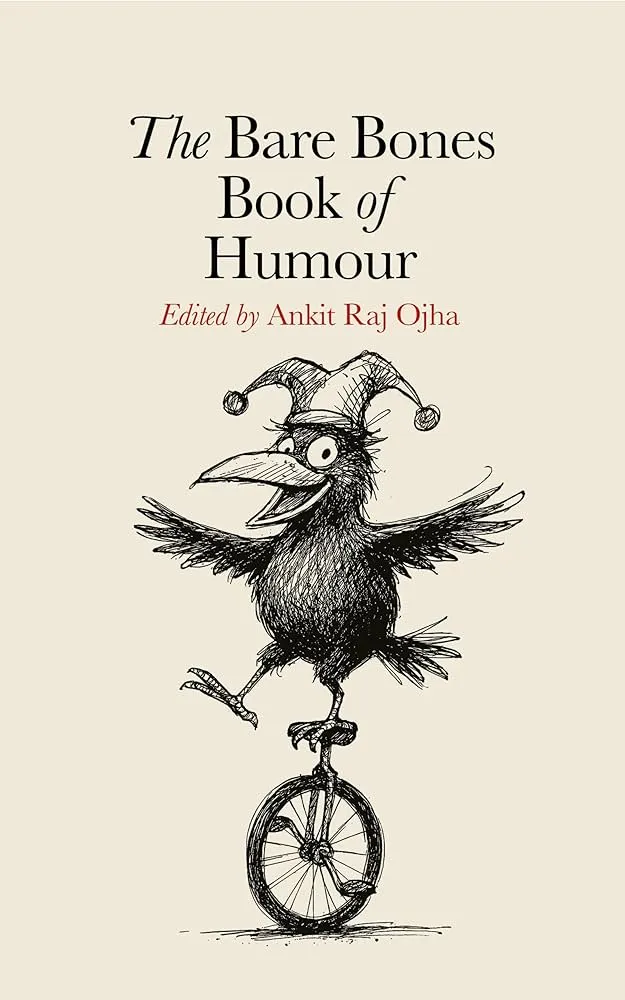
We congratulate Ankit Raj Ojha, an academician, writer, and editor of the wonderful, ‘The Hooghly Review’, for his latest edited anthology of short fiction, ‘The Bare Book Bones of Humour’, published recently by Bare Bones Publishing. One of our editors, Ankush Banerjee, speaks to Ankit about the book, his process of selecting the stories, and the place of humour in today’s world, where emotions run high!
AB: Thank you for consenting to do this interview with us. Our compliments on the recent publication of your edited anthology of short fiction, The Bare Bones Book of Humour. While you broadly mention the reasons for coming up with such a book in your introduction, can you tell us a little more about the ‘un-serious reasons’ for conceptualising this anthology?
ARO: Thank you for this interview and your good wishes. I really appreciate you and Usawa for everything.
About the ‘un-serious reasons’ behind The Bare Bones Book of Humour, I’ll say here what I may have left out in my introduction, and my conversation with my publisher, Sahana Ahmed (both can be read on the Bare Bones website).
Lately, I have found myself unable to commit to novels and see them through the way I could when I was younger. And I see many readers today—barring exceptions, of course—are in the same boat, with their long working hours, short breaks, and even shorter attention spans. But we still need our regular dose of literature. That leaves us with shorter forms. So, what better than humour in bite-sized doses to paint the world a little ‘un-serious’?
AB: Do you think the Indian English novel has treated literary humour with the seriousness it deserves? Ironically, the Stand-up comedy scene, much of which relies on situational, political, and social satire, has been thriving in recent years. Do you think a similar potential for literary humour exists in the IE novel scene?
ARO: Yes and no to the first question. I cannot claim to know the Indian English novel in its entirety, but I really love how R.K. Narayan, Ruskin Bond, Salman Rushdie, Upamanyu Chatterjee, Irwin Allan Sealy, G.V. Desani, Tabish Khair, Manu Joseph, and such masters have given literary humour its due.
It’s good that you mention the stand-up comedy scene in India. Unfortunately, there is no humour ‘scene’ as such in Indian English writing, not to my knowledge at least. Hilarious one-offs happen, but they don’t take the Wodehousian turn—no extended universe, I mean. Often, Indian English writers with an exceptional sense of humour do not have the ‘humour’ tag attached with their books; their hilarity has to rely on reinforcements like ‘social fiction’, ‘political fiction’, ‘climate fiction’, etc. This is unlike the West where writers like P.G. Wodehouse, Stephen Leacock, Joseph Heller, Kurt Vonnegut, David Foster Wallace, Tom Robbins, and Christopher Moore created full oeuvres flaunting ‘humour’ as their unabashed, primary genre.
I do believe the IE novel could be richer with dedicated humorists in the pantheon, their writings identified primarily for their ‘humour’, with other, ‘greater’ genres taking a respectful back seat for a change.
AB: How did you go about selecting the pieces for this book? Was there a specific type or form of humour you had in mind, or were you looking for?
ARO: I just wanted to have a good time, and for the reader to have the same. Kurt Vonnegut says, “Use the time of a total stranger in such a way that he or she will not feel the time was wasted.” That was my mantra. Also, I wanted to serve many flavours of humour and I think I have managed to do that.
Curating a print anthology comes with page constraints, though. It was extremely difficult to narrow it down to the final picks, given the sheer number and quality of stories I received. Some of the stories that I loved but couldn’t include in the book (humour is highly subjective and I’m no expert), I went on to publish online in The Hooghly Review. There’s one story in particular, one I didn’t include in The Bare Bones Book of Humour, that will haunt me forever. Although it is now published in THR (I did what I could to atone for my sins), I will always curse myself for failing to see its genius while making the final picks for the book.
AB: What role do you think humour, specifically literary humour, can play in the sort of angry, agitated world we are living in today?
ARO: I love this question. Everyone is so touchy-touchy these days. Before the internet, we could make jokes about almost everything. Now you have to tread carefully, weigh your words twice lest they should offend someone you didn’t even mean to attack.
Humour—satire in particular—can drive home your concerns without the need for verbal violence. It is also more potent than anger and comes with health benefits, too. So, unless you can effect change with your anger, I guess it’s humour over haemorrhage any day.
AB: One piece of advice for young writers who aspire to write humour?
ARO: I believe humour is part-inherent, part-acquired, and not something that can be ‘taught’. But one should read, watch, and listen to a lot of things. Take in everything around you very seriously. Everyone is a character, everything a plot detail. Your surroundings and what you consume provide material, shaping your sense of humour. And most importantly, disregard any rule or advice, such as mine, if it doesn’t work for you.
AB: What are you currently reading?
ARO: Many things. (I’ve been struggling with time and my attention span lately.) Vinod Kumar Shukla, Juan Rulfo, Gabriel García Márquez, Mario Vargas Llosa, Roberto Bolaño, Fyodor Dostoevsky, Kazuo Ishiguro, Tom Robbins, Ashok Pande, Beryl Bainbridge, Michael Chabon, and Shehan Karunatilaka, to name a few.
AB: Should we expect to see a follow-up book to this, i.e. something like a Book of Political Humour – I am sure there’d be a lot on offer there? Your thoughts.
ARO: Now that’s treacherous terrain. It does sound fantastic though. But it requires great wit and subtlety. When great writers take political digs, they hit the target and the target cannot even prove it. Sometimes the target doesn’t even know they’ve been pierced. I admire Shrilal Shukla, Harishankar Parsai, Jonathan Swift, Mikhail Bulgakov, George Orwell, Joseph Heller, Kurt Vonnegut, Manu Joseph, etc. for their political humour.
Yes, I’d love to try a Book of Political Humour if fate wills it. But as you said earlier, it’s an “angry, agitated world we are living in today”, and every ideology, ‘wing’, and ‘-ism’ is as easily offended, although all of them claim to be the sole stalwarts of ‘tolerance’ and ‘critical thinking’. (Take Orwell’s 1984, for instance. It’s cute how both the Left and the Right cite the same book to attack each other.)
So my note to self if I’m to do political humour would be the Pink Floyd song title: ‘Careful With That Axe, Eugene’.
The Bare Bones Book of Humour (ed. Ankit Raj Ojha) can be ordered here.