
Speculative fiction has, over the past fifty years, undergone a surprising shift in its literary standing. Where once considered peripheral—interesting, but not quite a genre that could be taken seriously compared to realism in literature—it has now become one of the major topics in literary criticism, and there is a solid reason. Currently, we need fresh perspectives to comprehend a reality that experiences climate change, rapid technological development, political instability, and doubts in terms of true and false.
Modern authors apply imaginary worlds not as a tool for escape from reality but as a way to explore it. In such worlds, philosophers find room to question their theories, and ethicists discuss different problems and situations from a perspective that is not restricted by the limits of the realistic approach. Such stories are like conceptual laboratories where one can experiment and reconsider everything. Darko Suvin’s point about “cognitive estrangement”—that odd feeling of seeing your own world with fresh eyes—nails why these stories leave a mark. Speculative fiction doesn’t run away from reality; if anything, it rolls up its sleeves and digs deeper into it.
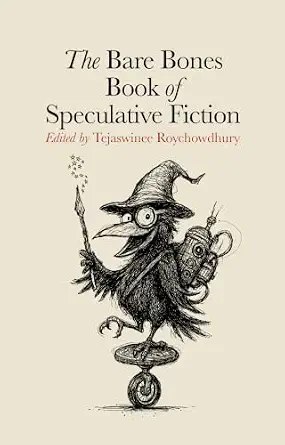
The Bare Bones Book of Speculative Fiction gets that. This collection isn’t just a grab-bag of wild ideas. The editor, Tejaswinee Roychowdhury, pulls together science fiction, myths, fantasy, alternate history, eco-stories, satire, philosophical tales, and magical realism, pushing all these strands into real conversation. Instead of splitting hairs over what counts as “real” science fiction or where myth belongs, the book treats speculative fiction as a big, open-minded field—less a checklist of genres and more a way of thinking. That broad approach lets the stories speak to each other. Even though they sound different, coming in all kinds of moods and styles, they circle the same big questions: who we are, what we know, where we live, what we remember, what’s “other,” and how we dream.
Roychowdhury’s introduction, “Notes on Exiting Reality,” provides an apt entry point into the anthology’s imaginative terrain. Her assertion that speculative fiction is “fiction that helps you question your reality—or make sense of it” captures the book’s underlying philosophy with refreshing clarity. Her playful declaration, “We’ve reached escape velocity,” followed by the invitation to “Step through the door. Reality can wait,” establishes the collection as an imaginative departure that is nevertheless deeply engaged with the world it leaves behind.
Take Amelia Weissman’s “Just a World Away.” The narrative begins with the traditional science-fiction topic of a “strange blue box” that indicates alien life. Yet Weissman does not take the story in the direction one might expect. Whereas adults meet the new with suspicion and fear, Keira perceives it with curiosity and excitement. This changes the mood of the entire story. When the narrator writes, “This box wasn’t dangerous. It was beautiful,” the core theme of the whole narrative comes across: that of wonder versus fear. This is not traditional science fiction since the unknown here is appreciated rather than feared.
The book’s focus on myth showcases this vision. Critics usually treat myth and science fiction as distant relatives—one fixated on the ancient past, the other on high-tech futures. But The Bare Bones Book of Speculative Fiction quietly erases that line. Shobhita Narayan’s “The Moon as Old as Time” makes a case for myth as one of the earliest human strategies for speculation. Long before science explained the cosmos, myths gave the stars, sun, and moon emotional and moral life. Narayan does not merely recycle existing stories, but transforms them in order to make them speak again. She makes such elementary concepts as fire, water, dawn, and dusk symbolise love, pain, cruelty, and forgiveness.
Take Neethu Krishnan’s “The Yakshi’s Barter.” The role of the yakshi in this story does not involve mere gothic decoration or even a typical supernatural figure. It is employed as a medium through which the character has to face those emotions that are impossible to put into words. The supernatural factor sneaks into the plot finely and almost invisibly, dissolving the borderline between psychological experience and mythology. The exact thing being discussed here is no typical deal for riches or wishes but the struggle with debts of feelings accumulated through years. By the time liberation occurs, it turns out to be impossible without suffering losses. Freedom is experienced as an ambiguous feeling because of such ethical complexity.
In Shih-Li Kow’s “Pak Hassan’s Story,” the inclusion of speculative elements is not done to excess, but rather, the writer uses the very act of storytelling to create meaning. The protagonist is a keeper of cultural memory through the integration of gossip, history, myths, and miracles until boundaries blur. Through this technique, Kow illustrates oral traditions as one of humanity’s oldest examples of the speculative; an eternal way of keeping stories alive even after facts and reality have passed into oblivion. While “Pak Hassan’s Story” could be read as a magical realist text in comparison to García Márquez, Kow’s style is much more subdued and restrained in tone and execution.
And all of this ends in the most remarkable change in the anthology, which is its use of comedy and satire in order to critique different elements. In “War of the Needles,” by Claudia Nicholson, the initial idea seems to be absolutely ridiculous: a split society between sewing and knitting. However, as the story progresses, the nonsense starts to appear as something all too real. We constitute divisions out of nowhere and try our best to justify them through ever more complicated arguments. The mock-epic form makes the story funnier, but at the same time provokes profound thoughts.
There is similarly an element of satire present in “The Immortal Bureaucrat,” by Jayadev Calamur, within which the bureaucratic system continues even after one’s death. The bureaucrat will have to fill out certain forms and follow rules even when he is immortal in eternity. The satirical humour in the story is clear, although there is equally an interesting undertone in what Calamur is trying to convey here. It seems as though Calamur is wondering if bureaucracy is mankind’s attempt at bringing order to chaos. The divine world in the story is very much like any other normal place, with the goddess appearing like a librarian instead of a deity. Eternity appears like a worn-out office.
None better illustrates this point than “Water Buckets” by Meera Rajagopalan. On first impression, it could appear to be a quiet story; a tale about water and memories that is not concerned with dramatic collapse or apocalyptic destruction. But the water in the story has an impressive presence. It is more than a mere natural resource; it has witnessed, absorbed, and bears the memories of numerous generations. Water here gains some sort of sentience, being an archive of the human experience. Environmental degradation in this case is equated with forgetting; through degrading or contaminating water, people destroy not merely the environment itself but also the histories, relations, and meanings associated with it.
From here, the book moves seamlessly into the other pressing issue: life as a commodity. “Terms and Conditions” by Carmel Miranda disturbs as it sounds so familiar. There is no tyrannical state, nor any rebellion, merely clinics, agreements, and everyday choices. Reproductive technologies have injected themselves into our lives to the extent that they no longer trigger any doubt. It is that very lack of disturbance that is disruptive. The terror does not rest in a certain dystopian scenario, but in convenience.
Matthew Gordon’s “Hope Springs Infernal” and Joshua Ginsberg’s “Retirement Party” explore theological themes in speculative fiction, but not in the way one expects. Gordon’s interpretation of Hell is more existential than punishing, while Ginsberg begins the final story of the book from a funny assumption that Death shall retire and then illustrates how extensive it actually is. If one of the only constants in literature, mortality, could somehow be substituted, these stories indicate something more about the structure of reality.
It is right from the start that the anthology jumps straight into the existing discussion on the essence of speculative fiction, although it chooses not to limit itself to one particular definition. Contrary to that, it adopts the philosophy that speculative fiction should be defined through its capability to break barriers and blend forms. The “fuzzy set” concept applied by Brian Attebery to describe fantasy is quite fitting for such a literary theory. Indeed, a number of the short narratives presented in the anthology mix science fiction, fantasy, magic realism, myth, horror, and alternate history. It is not uncommon for a narrative to borrow from more than one tradition; it could combine science with mythology, folklore with ecology, and humour with philosophy.
The factor that truly sets The Bare Bones Book of Speculative Fiction apart is the extent to which it is both emotionally and intellectually resonant. Whereas few contemporary anthologies seek to be innovative at the expense of substance, such an anthology takes an approach quite the opposite. The fantastical realms it investigates are never mere gimmicks, but are extensively rooted in the psychology and ethicality of being human. They do not depend upon their own strangeness for their effect; rather, they explore by way of unfamiliar environments a world that we recognise all too well. And it is this resonance that gives the work its power.
The Bare Bones Book of Speculative Fiction (ed. Tejaswinee Roychowdhury) can be ordered here.