Usawa Literary Review is headquartered in Mumbai, India.
PIN Code: 400050
Interested in working or collaborating with us?
Contact Us

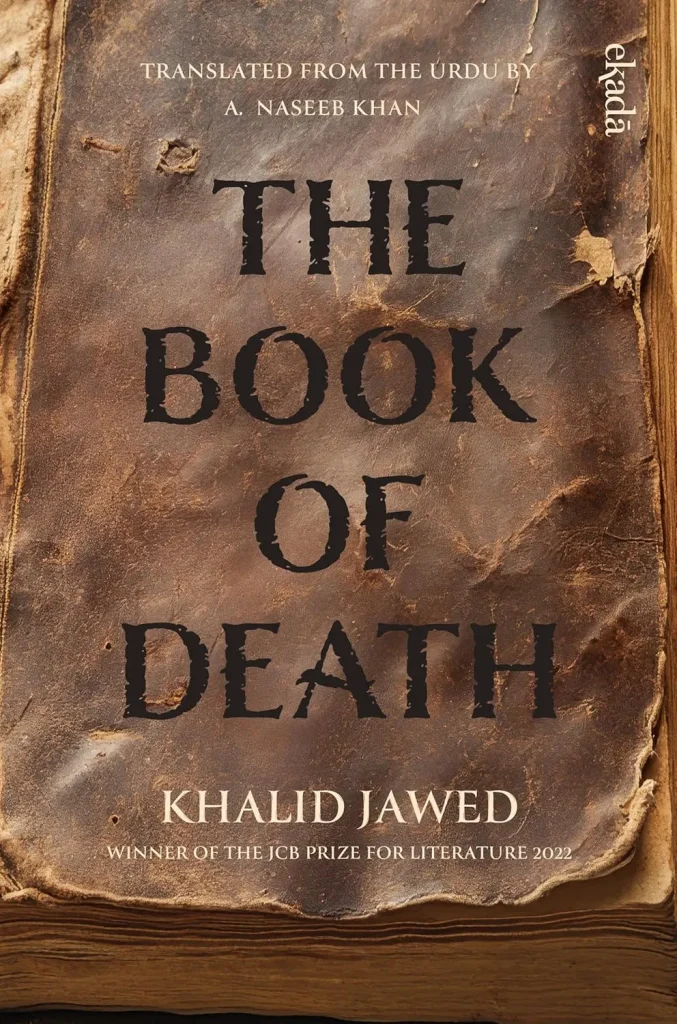
The Book of Death

By Khalid Jawed


A narrator travels to the ruins of Gilgita Til Mas — a small city deliberately submerged for a hydroelectric dam, now resurfaced with its debris — and finds a manuscript. It belongs to a man who suffered a head injury in the womb, at the hands of a violent father, and was committed to the asylum that once stood there. What follows is Khalid Jawed's extraordinary story within a story: the madman's diary, unspooling across an abusive childhood, two women, a constant companionship with self-harm, and a terrifying metaphysical void. This Masterpiece moves between the banal and the cosmic without flinching — a novel about damaged inheritance, lost cities, and the manuscripts that survive them.

Review: The Book of Death – The Intimate Affair Of Mortality And Disgust

Khalid Jawed's work interrogates mortality, portraying death as an intimate, disturbing reality intertwined with life's suffering, thus challenging societal discomfort with the grotesque.

George R.R. Martin puts a very important quote in Petyr Baelish’s mouth when he says, death is so terribly final, while life is full of possibilities. While both the phrases hold true to their objectives, but when it comes to people, they will either choose the former one or commit their lives to defend the latter one. Death has its own charisma and Khalid Jawed’s book The Book of Death, translated from Urdu by A. Naseeb Khan, observes death, self-harm and suicide from the perspective of a man who is flawed, helpless and wants to give a body to his own mortality. The book is a compass to identify what the end is all about, and how the process towards death isn’t vacant. Rather, only by keeping death in the forefront, one can determine if death is a beautiful occurrence or just a way to stop this life. While the latter seems to be an easy instance but the writer in this book explores its many intricacies one seldom desires to explore because of its disturbing conditioning.

The story develops in a town named Girgita Til Mas where a scientist comes across the diary of a mentally disturbed man in the ruins of a mental asylum. In the climatic turmoil of the town, the diary projects a voice which testifies against the moral compass of this real, developing world where the personal lives of people are stiffened and cuffed whereas everyone expects them to have something to say. The protagonist knows the reality and hence, makes his statements from the pages of the diary, in which everything lies on the silver lining between life and death; morality and immorality; respect and disrespect; ideals and fallen thoughts. The book might appear as a ride to a depressing territory, but the writer maintains a narrative where death is a cot to meditate. The only difference lies in how he restricts everyone from taking a route to death by making it appear a replica of life. The philosophy of Tao also believes that death is just an inverted rendition of life.

In this book, contentment is achieved by ‘not being content with anything’. It is a mathematical process where any kind of equation, if achieves no positive result, should be given a negative unit to then add a positive integer and find its positive value. In physics as well, when electricity cannot be controlled by a switch then the power of the battery should be altered on a continuous basis by adding more switches. The ‘absence of power’ in the firsthand is nullified by the ‘presence of sufficient power’, without being an integral part of the process, that can overrule the emptiness by inducing a possibility in the powerless space. Here, the protagonist is depressed of everything yet is seduced by the beauty of both hopelessness and grotesque elements. Khalid Jawed has the skill to make the rotten appear fresh. He doesn’t make you puke. Rather, by describing the ugly, he urges us to imagine what we usually ignore because they can trigger our invisible, dormant senses.

The personification of suicide as a luscious and sultry companion of the the protagonist is a clever way to observe this phenomenon as something physical. In the story, it comes whenever the protagonist wishes for a friend, a listener or simply, a presence. It never interrupts his thoughts on his own sufferings, an exploited childhood and a marriage that he considers a responsibility, and sometimes, an unbearable burden. There are expectations and his vulnerable condition cannot complement his desires. Most of us, in our own lives, stay muddled with our sufferings and when an additional element gets added, we sometimes lose ourselves. To think of that element as redundant is not abnormal. Rather, to endure its negative presence can lead us to a void, and like the protagonist, most of us think of our bodies as voids in which everything goes to not come out.

In the Sanjay Leela Bhansali film Guzaarish, we get to observe the process that makes a crippled man take a decision to end his life on his own terms with proper consent from the law. Its main fault lies in the glorification of what life can be like, only to balance the gloominess of suffering. It was needed to keep the audience happy, but even then, it was a disaster in the box office. Khalid Jawed, on the other hand, does not glorify life. He assures us that life is full of misery and its grandeur lies under the dark shadows of its dementors which arrive to put a mess before us. If we get to see life within this mess, then we are aware of our own lives. If we choose to keep it aside, then we are here to simply survive and die an ‘unbeing dead’. The book measures its readers and so, while reading it, one can feel claustrophobic, depressed and exhausted. But the writer knows that unless he makes the reader experience these effects, death will remain a mere fantasy element.

Naseeb Khan’s translation of The Book of Death flows well and does not keep the readers distant from the text. It does not read like an original text because Jawed’s Maut ki Kitaab had the voice of a mad being which the translator is able to retain in most parts but then, the language and its stylization sometimes keep the voice a little sane and devoid of disturbance. But then, this is where a translation becomes different from the original text – to unite and deviate the source and the consequence. The Book of Death portrays death with intimacy, sensitivity and sufficient disgust. Yet the last bit does not demonize the former two. A slim book of merely over a hundred page explores death by losing all bindings and tethering it to the reality of mortality and the Earth’s fragile reality.

Looking for more Books?

Browse the Bookshelf →

Excerpt: The Book of Death

Autumnal air hangs as a mother vanishes beyond graves. A child clutches a knife, shadow-bound. Laughter twists tragedy, a play where darkness

When I woke up the sun had already climbed high. My mother was not on the floor. She was not in the house either. She had gone somewhere. Her drum lay silent in one corner. My father had been dashing around with other people from the neighbourhood, searching for her. She couldn’t be found. I rushed out of the house. It was the autumn season. Dry leaves and twigs were being trampled under my feet. And from them came the sound of my mother’s dry laughter. I ran and ran and perhaps reached the city’s border where there is a desolate mound of soil. I saw my mother on the mound in the distance. But she disappeared, then resurfaced, and vanished again. My mother then shrank to a dot, moving further and further away until she disappeared completely behind the mound where the graves of war prisoners lay. After that, she never hove into my sight. It was after then that I began to keep a knife hidden in my knickers. I wave the knife, drawing lines in the space. I want to kill my father, and smear his blood on my face. What is all this? Is it a comedy or tragedy? Perhaps both? But who is the protagonist of this drama? Certainly not me. Even though I have written the script of this drama, I am unable to appear on this stage even as a villain. I am but a gloomy and dismal shadow. Quaking in the limelight on the stage is neither the shadow of a human nor any object. This is not a shadow meant to be visible in light. It is the shadow of a filthy abuse suspended in the air. It is the shadow of a shamefaced wind sitting in the darkness with its head burrowed into his arms and shins. Therefore, the scream of tragedy can never be heard on stage. The feeble, discomfited scream, tumbling amidst kicks, never aligns with the songs written for a tragedy. It had no rhythm, no melody and no harmony. It is only the muffled, unrecognizable voice of a stomach worm. It is the scream that turns this tragedy into a comedy. So the grand, moral stage of the tragedy kicks it away with contempt, ordering its departure. The curtain falls, then rises again. But the shadow remains seated, bowing in darkness. The theatre continues. The despairing scream is unable to even garner a single applause. The scream whimpers, bursts into laughter and then goes mad. It begins to crawl towards the mad, dirty wind from which it was born. There in the darkness it remains slumped, and here the theatre goes on.

Looking for more Books?

Browse the Bookshelf →

Khalid Jawed on “The Book of Death” in Conversation with Rituparna Mukherjee

Jawed re-frames death, suicide, and disgust as integral to life, asserting literature's ethical imperative to explore unsettling interiorities and societal decay through language's liminal capacities.

RM: Congratulations Khalid Sahab on the release of your novel The Book of Death. I had a really great time going through it. For a slim novel, the book is quite a heavy read. How did you conceive of the thematic and structural layout of the book, seeing that the novel itself is a tale within a tale?

KJ: Thank you for your kind wishes, your generous reading of the novel, and thoughtful observations. Before the novel, I wrote long stories. Over time, I felt drawn to minimalism, to implication, and to how large, complex emotions can inhabit small spaces. The Book of Death began unpremeditated, organic and intuitive, without a conscious design. I begin writing at noon when the world feels suspended and everything seems briefly balanced between motion and stillness, in what Nietzsche calls the noon-tide, the lucid hour of decision and affirmation. For me, it’s the pristine hour for creation. I began it one noon and completed the novel in a single forty-day stretch. Its slimness was an artistic choice rather than a constraint, so that the raw emotional truth could speak plainly, without ornament.

The structure wasn’t forced. It grew as the theme developed, allowing the prose to carry what is hard and uncomfortable to face. The tale within a tale felt less a device than a necessity. We all live with two stories, the one we display and the one we guard. The outer narrative, the stable, visible world, becomes a steady, lived frame, while the inner story works as a quiet confession beneath it. As the voices move together, each alters the other, the narrator shaping the tale, the tale reshaping the narrator.

RM: Keeping the final chapter a complete blank, seems like an interesting narrative strategy refusing, as life often does, to give a closure. What did you have in mind while conceiving of this format?

KJ: It was a deliberate choice to leave the final chapter blank in order to mirror life’s inherent uncertainty. While we crave the consolation of a tidy ending yet life rarely grants us a neat closure. An open ending allows the readers to step into the silence, to question, feel the weight of the unresolved, and finish the story within their own imagination. But the blank space isn’t absence. It’s a living pause where meaning continues to unfold beyond the confines of the page, as also a resistance to the comforting illusion of finality, suggesting that every ending is a nascent beginning. Like most of us, I believe that life doesn’t conclude in punctuation and full stop but in enduring continuation.

RM: As the title itself suggests, the book is a philosophical rumination on death as a life event. I was especially intrigued by your conception of suicide in this text, as a constant companion, a shadow, a being with a visceral presence, but never viewed with animus as moral texts often condition us to do. What are your thoughts on death and our agency over it?

KJ: What a perceptive reading! To me, death, and indeed suicide, are not crude intrusions into life, but presences that coexist alongside it. Death is not life’s opposite, rather it’s woven into the its fabric. There is a profound irony in how we live our life: we live pretending that death is elsewhere, all the while, it walks silently beside us. In approaching the suicide within the novel, my intention was neither to moralise nor to romanticise. I intended to acknowledge its visceral reality and treat it with the gravity it demands.

I believe our true agency in the face of mortality lies not in seeking its embrace, but in recognising it as the fundamental boundary that gives shape and meaning to life itself. To look upon death without reflexive fear and hatred is to see life itself more truthfully. This awareness can make us more alert to existence, and crucially, more compassionate in the face of despair. So, suicide and death in my novel aren’t a full stop. They are silent companions, reminding us that to live fully is to live in conversation with our own ending. Frankly, I believe birth already contains the predicate of suicide. To be born is to enter a trajectory that ends in death; knowing this, coming into being is a self-willed step toward one’s own vanishing.

RM: I might run the risk of reading too much into it, but I was quite taken with your use of the name “Girgita Til Mas” for the fictitious setting of the novel. Is the use of ‘Girgit’, a chameleon, your way of highlighting the human tendency for masking in social life? Have you directed this novel to address the culture that breeds and conditions us? And that only a person who knows himself as well as the protagonist does, and is repelled by that knowledge, can dispense with the formalities of this masquerade? I would love to hear your thoughts about this matter.

KJ: The name Girgita Til Mas is, as you perceive, deeply deliberate. ‘Girgit’, the chameleon, embodies the human instinct to adapt, conceal and perform. The town itself became a kind of mirror, a place where inhabitants reflexively assume the hue the moment demands, where truth is not absent so much as perpetually in disguise. In that sense, the novel speaks to a culture that cultivates and breeds performance, training us from our childhood compliance and conformity. As a result, we grow up mastering the art of blending in, until authenticity itself feels perilous. To know oneself too clearly is to become estranged from the world’s masquerade. My protagonist’s revolt is not loud. It’s internal, almost spiritual, the quiet rebellion of someone who has seen through the painted surface and cannot unsee it. Thus, Girgita Til Mas is as much a psychological state as a physical place, a landscape of masks. But my intention is less to condemn the society than to articulate the particular ache of consciousness within it.

RM: Although the novel is an intensely personal take on the violence of living and tries to separate death from its moral and societal entrapments, I also found it deeply symbolic of the reflexive human tendencies for self-destruction that is prefaced in the outer shell of this text. Why was it so important for you to ingeniously introduce the self-wrought ecological disaster we are inevitably pushing ourselves towards?

KJ: The ecological ruin and desolation in the novel is far more than setting; it is an extension of the human psyche, a manifestation of the same impulses that drive the individual self-destruction. I have long held that the violence we inflict upon nature is a precise mirror of the violence we harbour within. To exhaust the earth is to externalise our own decay, to project our inner turmoil onto the very landscape. This self-wrought collapse served to dissolve the boundary between personal and collective extinction. The protagonist’s crisis is not isolated; it is symptomatic of a species profoundly out of harmony with existence. His despair, defiance and attraction to the void and death, all of these echo a broader human condition in which progress is often a guise for ruin. My aim is not to moralise, but to allow the environmental decay to emerge organically from the same spiritual exhaustion that afflicts the characters and that govern human life in the novel.

As the individual corrodes from within, so too does the planet wither from our collective blindness. The ecological imagery, therefore, stands as a metaphor for our shared mortality, a silent testament that all acts of self-destruction, personal or planetary, spring from the same estrangement: our failure to live gently with ourselves, with one another, and with the world that cradles and sustains us.

RM: There is a very interesting progression of disgust in this book, from dehumanizing oneself by constant animalization, the rotting external circumstances that converge to intense self-disgust by the time the novel ends. How have you managed to write so lyrically about disgust, especially in Urdu, a language that is vastly associated with poetry, romance and beauty? What is your personal take on disgust and its necessity in literature especially while you are dealing truthfully about love, life and relationships?

KJ: Your question touches the very core of my aspirations and endeavours. True, Urdu is often celebrated as a language of romance, refinement and beauty, yet I find its true strength in a latent tension – its capacity to hold the unbearable, such as decay, shame and disgust, within its graceful contours. I sought to test this elasticity to see if the language could encompass the grotesque without forsaking its inherent music and rhythm. For me, disgust is not a negation of life but its raw undercurrent, the point where beauty falters and a starker truth appears.

The dystopian and the apocalyptic compel me because they sharpen vision. Through them I read suffering and melancholy with greater honesty. In classical Sanskrit aesthetics, this is the realm of Vibhatsa rasa – disgust and revulsion not as spectacle, but as a disciplined seeing that clarifies and illuminates. Held rightly, Vibhatsa becomes a razor that clips illusion, leaving the core of experience bare. To write truthfully of love or tenderness is to inevitably encounter disgust, for profound intimacy demands that we confront all that repels – the body’s decay, the limits of the flesh, the corruption of pure desire. Disgust strips our ideals bare, compelling us to regard the self without ornament. To treat it lyrically was an attempt to restore a certain dignity to that what is considered abject.

In Urdu, I discovered that disgust need not be coarse; it can be rendered through rhythm and imagery that simultaneously attracts and repulses the reader to turn a wound into a mirror, reflecting both pain and a terrible beauty. Thus, disgust holds a moral and aesthetic necessity; it is the acid that cleanses illusion and demands honesty. Any portrait of love or life that avoids it may be polished, but it remains, fundamentally, a lie. The lyricism, then, was not an act of mitigation, but of revelation to show that within decay itself resides a strange, tremulous beauty, the final proof of a responsive life.

RM: Writing about violence, even its intense suffocation, is not something new, what is new, however, is the very visceral and honest way you present it, such that it occupies an entire narrative—a text of progressive mental violence that proceeds from physical and cultural violence. The relentless and disillusioning nature of it in the book especially reminded me of the writings of Samuel Beckett and Tom Stoppard. Who do you consider your literary mentors?

KJ: First of all, my deepest gratitude to the quiet Muse who guided this novel. It may sound odd to say, but I’ve never had a strong predilection for drama; Beckett and Tom Stoppard, for all their brilliance, have simply not spoken to me as powerfully as others. The writers from whom I drew my sustenance for my fiction are Fyodor Dostoevsky, Franz Kafka, Tarjei Vesaas, Pär Lagerkvis, Juan Rulpho, Gao Xingjian, Roberto Bolano, Jon Fosse, and several other Scandinavian and Swedish writers; from our part of the world, O. V. Vijayan, Nirmal Verma, Udayan Vajpeyi and Abdullah Husain. They taught me that violence need not scream: it can live in silence, in repetition, in the exhaustion of language.

Their books showed me how despair can be stripped of drama and faced as a simple condition of being; they also opened my eyes to the playfulness of intellect, to how philosophy and absurdity can share the same breath. My favourite writers, then, are those who look unflinchingly at the human condition and dare to speak of hunger, death—even filth and refuse. Each, in a different way, explores the fracture between morality and survival, the ache of consciousness, and the strange beauty of brokenness. From them I learned that the deepest violence is often inward—lodged in memory, silence, and the failure to connect. Beyond names, my true favourite writers are those who taught me the art of gazing into the human abyss: that literature’s task is not to soothe but to wound truthfully—to touch where it hurts and, within that pain, offer a fleeting clarity.

RM: All writing is political. What would you say is your own politics of writing? What are you working on at present that we can look forward to reading in future?

KJ: All writing is political, not in partisan slogans or ideology, but in the choices of what we see and what we name. Every word is an ethical decision – revelation, omission and confrontation. My work begins with a politics of honesty, a commitment to look at the world and the self without disguise. I believe I am drawn to a politics of interiority – to the unseen terrains of shame, memory, violence, tenderness, and the silences that shape a life. My works, I think, consciously refuse sentimentality and dogma. The aim is not to instruct but to unsettle and disturb comfortable assumptions. If my writing has a stance, it lies in it that truth is complex, empathy is radical, ambiguity is moral, and language must resist the simplifying narratives of our time. Formally, I work in fragments rather than linear plots—spaces where memory, confession, and myth intersect. The translation of my latest Urdu novel Arsalan aur Bahzad is forthcoming…

Looking for more Books?

Browse the Bookshelf →

A. Naseeb Khan on “The Book of Death” in Conversation with Rituparna Mukherjee

Translation is an ethical reanimation of memory against ecological erasure, where conveying consciousness demands navigating profound psychological and aesthetic tensions through language.

RM: Hello Naseeb Ji! Thank you for talking to Usawa about your latest translation of Khalid Jawed’s The Book of Death. Interestingly, the main text that is the diary of the protagonist appears as a translated text itself in the novel. What does that mean for you as a translator?

ANK: Hello Rituparna Sahaba! Thank you so much. Deep gratitude to Usawa. Yes, the ‘original’ text, as the author himself tells, presents itself as a translation within the story. The author immerses us in a world where language itself is a site of meditation and distance. By presenting his text as the translation, he proposes that pure voice is perhaps impossible to hear, thus what reaches us is refracted through another consciousness. This deliberate blurring of original and translation creates a resonant space where voice is in perpetual transit. But the pre-existing condition of the text does not diminish the translator’s role. It redefines it from a mere transcriber to an essential co-creator of meaning. As a translator, I entered this linguistic space, reclaiming a voice that has been journeying through loss, mediation and time. My task, as a translator, was reanimation, to give breath to a voice that had already crossed one threshold of silence, and must now cross another.

RM: The preface of this novel hints at the erasure of an entire civilization due to an ecological crisis. In a world that is already reeling under one ecological crisis after another, how important do you think translating literary works is for the sustenance of civilization?

ANK: The novel’s foundational vision of a world undone by ecological crisis, and the looming erasure of entire civilisation, imparts the translator’s task a profound and urgent dimension. In this light, the translation ceases to be a mere technical exercise, it becomes an act of ethical preservation. As landscapes are erased, species disappear, languages fall silent and a civilisation’s memory frays, stories endure as the last seeds of a vanishing world’s consciousness. To translate, then, is to become a gardener of memory, planting these seeds in the new soil of another language. This act cultivates remembrance, fosters exchange across the ruin of loss and inspires empathy necessary to sustain the ecology of the human spirit. Thus, every translation is a defiance of oblivion, a pact with the lost, ensuring that that their dreams and warnings are not buried with them. The translator becomes a keeper of the dialogue between existence and memory, a medium ensuring that voices from beneath the rubble still murmur, then speak clearly and finally resonate across time and borders.

RM: The novel is slim, but very heavy reading. How did you manage to manage to retain the atmosphere of paranoia and chronic depression that the protagonist constantly negotiates?

ANK: Yes, that’s precisely the central challenge. The novel’s substance lies not in length but in its intangible mood and atmosphere – a pervasive dread and a deep, lingering melancholy. My approach was therefore less about translating words than translating a psychological state, a climate of paranoia and a chronic, low-frequency despair. I considered the text as a fragile artefact, not of events, but of a consciousness in disintegration. Fidelity required resisting the instinct to explain ambiguities and complexities.

The author’s dedication of the novel to the Sanskrit vowel ऋ is no ornament. Its inward-turning, pressure-bearing curves become the novel’s method, currents that falter and resume, strands that knot and hold. Structure, feeling and thought bind together, the formal tension shadowing emotional knots and existential entanglement. The plot is not linear, it is labyrinthine, like the letter ऋ itself. To be truthful, I read the text aloud to internalise its unsettling cadence, the halting rhythm and precarious shifts between observation and delirium so that I could echo that disorientation and emotional vibration in English. I wished to transport the protagonist’s very being, to preserve in English the palpable weight of the story’s silences and the suffocating pressure of its air, so that a new reader not only reads about but feels the inner world.

RM: Urdu as we know is a language with a cadence and a beauty of its own. How did you manage to convey the beauty of the several aphorisms in this novel or most importantly, the recurring images of existential disgust and rot that the author uses liberally?

ANK: That’s a very perceptive question. Urdu, with its intrinsic musicality and layered imagery, can hold elegance and corrosion within a single phrase. The novel works through this duality, its aphorisms gleam like polished fragments of wisdom, yet they are unearthed from a world in active decomposition. My task as a translator was to let this contradiction breathe in English. I resisted the urge to domesticate the text, allowing an echo of Urdu’s cadence, its inward melancholy and ironic grace, to permeate the sentences.

The aphorisms, especially, required restraint, too literal, and their resonance flattens, too embellished, and their stark truth recedes. As for the recurring imagery of rot and existential disgust, I considered it not as ugliness to be softened but as essential texture, the very fabric of a civilisation’s body breaking down. The beauty here is not separate from the decay; it arises from it. Thus, the translation became an effort to preserve both the wound and the strange, haunting fragrance that rises from it.

RM: How many iterations did your translation go in working on this specific text. What has been the most challenging aspect of this translation? What makes this book different from other works that you have translated? Take us through your approach and process of translation.

ANK: This translation went through several iterations, perhaps three or four drafts. Each stage wasn’t about correcting language as much as deepening my understanding of tone, texture and silence. The novel resists smoothness. It demands to be read and translated in fragments, pauses, and echoes. So, I kept returning to it, letting the English find its own rhythm without erasing the Urdu’s haunted music, as far as I could do. The most challenging aspect was to hold on to the tension between beauty and decay. The prose often veers between the lyrical and the grotesque, and it’s easy for one to overpower the other in translation. Preserving that balance, where disgust carries grace, and silence holds meaning was perhaps the toughest part.

What makes this book different from other works I’ve translated is its atmosphere of delirium. It’s less a story and more an experience of consciousness collapsing under its own weight. My process therefore involved a kind of surrender – reading aloud, listening to cadences, allowing the English to sound slightly foreign because the text itself is foreign to sanity. Translation, in this case, became less about fidelity and more about resonance, about carrying across not just words, but a condition of being.

RM: How important it is to read to translate? What kind of reading has helped your own translation?

ANK: Reading is the very soul of translation. One cannot translate without first being an attentive, empathetic and restlessly curious reader. To translate well is to read on multiple levels at once not only the words on the pages but the silences that frame them, and the world from which the text emerged – its history, culture and unspoken traumas, and the world it yearns to address. This deep, multidimensional reading cultivates an ear for the intangible, the cadence of a thought, the shadow of irony and the breath of a sentence. These are the qualities that defy technical manuals and must be intuitively felt. Consequently, reading provided me with the essential instrument – an inner ear. By listening deeply, we learn to hear the voice we’re meant to carry across, and translation becomes the art of inhabiting another consciousness and letting our own language tremble in authentic response.

RM: How do you select the works that you want to translate? What future projects do you have in your pipeline?

ANK: To me, this vocation is not a matter of choice so much as being chosen. I don’t so much select works to translate as feel selected by them. Khalid Jawed gave me this novel, its title and story began to haunt me. The world and its voice lingered in my mind, the silences echoed through my days. And that persistent resonance felt like a summons. So, I undertook the translation. I was drawn to it because it unsettles our comforts and maps the fractures that run through history, memory and the self. Its language offered a deliberate resistance; only through that friction does translation become a meaningful, transformative struggle.

I’m inclined towards texts with moral and aesthetic complexity, speaking of decay and disgust, existential longing and a quiet endurance amid collective collapse. To translate such a work is an act of recovery: rescuing a vital consciousness from the brink of oblivion and giving it the chance of another life. My forthcoming works include my English translation of S. M. Ashraf’s Aakhri Sawariyaan as The Last Rides and my Urdu translation of Cyrus Mistry’s Chronicle of a Corpse Bearer as Ek Murda Dhoney Waley Ki Kahani.

Looking for more Books?

Browse the Bookshelf →
Back to Issue

Support Our Work

If you enjoy our content, consider supporting us.

Support Us

We are an unfunded, independent feminist publication. We need your support to continue our work.