
“Can people ever love each other equally? Perhaps we love an image of ourselves in the other — we never really know him or her. I think we invent the other as a version of ourselves, our desires, or the part of ourselves we lack.”
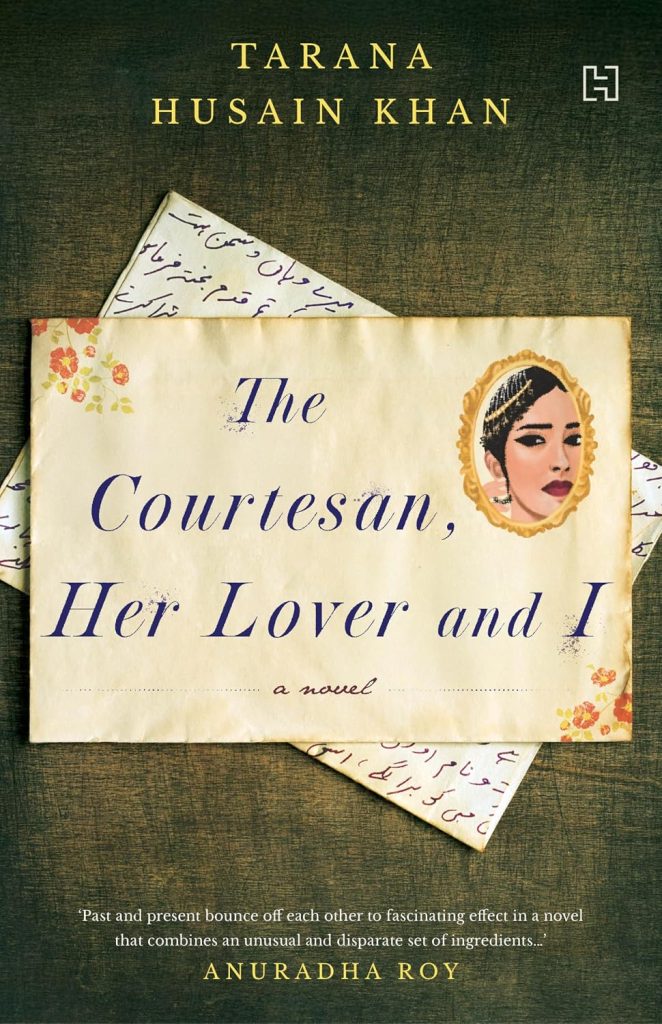
When Daniyal, from The Courtesan, Her Lover and I, says this, it is difficult to decipher where he speaks from: his own understanding of feelings, or as a man who has spent years guarding the history of others. Love is supposed to be simple, and yet something so instinctive is both complicated to believe and even harder to live with. Tarana Husain Khan’s novel is a tale of two women, one’s life reduced to her love and the other’s life currently being defined by hers. Written in a dual timeline, the book moves between Hijab, a nineteenth century courtesan the world remembers because of her passionate, overshadowing affair with the poet Dagh Dehlvi, and Rukmini, a present-day Hindu woman married to the self-acclaimed unorthodox Muslim Faraz. Rukmini, an aspiring writer, uncovers Munni’s story while uncovering her own complex marriage and private desires. On the surface this is a love story, part historical fiction but, underneath it is a book about what it costs a woman to love and just as insistently, about what it costs a woman to love.
Dagh Dehlvi was one of the most celebrated poets of the nineteenth century, and he fell in love with Hijab during a visit to Calcutta. He loved her the way nineteenth century men loved obsessively, extravagantly and in writing. He composed 838 lines of masnavi for her within two days of returning, and wrote hundreds of letters after, to her, to her sister, to anyone who had any longing with Hijab. Across decades he produced a detailed portrait of a woman in nineteenth century Urdu literature – and yet it is entirely his portrait. We know Hijab through his desire: her quicksilver temper, her beauty, the mole on her chin he writes couplets about. The very few lines that survive in her own voice, preserved in scattered tazkiras, give us someone else entirely, sharp, impatient, unimpressed with men who mistake their adoration for a gift rather than a burden.
Hazrat- e- naseh na bak-bak kar phirayen sar mera
Your constant chatter makes my head spin, learned one, enough of your advice.
This shows Hijab talking back, this shows a woman talking back, not a woman in love. And, perhaps she is both; the novel has the wisdom to hold these possibilities simultaneously, and Khan’s use of second person for Hijab brings us closer to her than a courtesan narrative usually allows.
What Dagh’s love ultimately did to Hijab is the novel’s central tragedy. He immortalised her name, but he also ensured she would be remembered only as his beloved which means she could never be quite herself. The novel is unsparing about the distance between the devotion he put on paper and what he was ever willing to risk for it in life. This tells you a lot about what men thought a beloved’s function was – to be wanted and not wed. Dagh’s love preserved what he needed of her; the rest of her, the poet, the teacher, the woman writing in secret is gone.
But who was Hijab before Dagh? A girl of fifteen, inducted into the kotha the way girls in her position were, with none of the choice the word “courtesan” tends to imply from the outside. Khan does not sugarcoat what that induction cost her, or how little protection her Apa was able to offer against it. What the novel exposes, instead, is what passes between women in the kotha in place of protection, a hard, practical inheritance of how to survive.
This is Khan’s most careful achievement, the mother who is not a villain, however much she first appears one. Apa’s entire doctrine is organised around a single line: “Listen, my innocent doll, men never come back, or why would we be sitting here?” When Hijab insists Dagh will return to Calcutta as promised, Apa says this with a deeply embedded exhaustion, a woman speaking from Khala’s example, the kotha woman who once thought marriage would be her liberation and learned otherwise. Apa’s instruction is clear: do not make yourself available to a pain that will hollow you out. And she is right, but she cannot protect Hijab from the thing she most fears, because the thing she most fears, is already inside Hijab herself. Apa’s love is a fortress built from other women’s ruin, and it still is not enough – presence, even fierce and knowing presence, cannot out argue a fifteen- year- old girl’s need to believe she is the exception.
Rukmini’s mother never gets that scene. She is not in the room when Rukmini needs to be told anything, and this is the point her instruction arrives, if at all, as absence. Where Apa’s doctrine is spoken and repeated and lived out loud in front of Hijab, Rukmini’s mother’s doctrine is inferred, resisted, run from. Rukmini spends her adult life organising herself around not becoming her mother, the same reflex Hijab has toward Apa, except Hijab’s reflex is argued with a living woman across a room and Rukmini’s is argued with a memory. What Khan sets up, without naming it, is a study in two kinds of maternal inheritance: one that smothers by being too present, to knowing, too insistent on its own hard-earned truth; and one that haunts by being insufficiently there to fight with, so that the daughter never gets to test her rebellion against an actual person, only against a version she has built. Rukmini cannot talk back to her mother the way Hijab talks back to Apa in poetry, in temper, in the tazkiras of her own sharp lines – because there was no daily proximity to talk back to. She is left, instead, writing Hijab.
Rukmini tells herself she is writing Hijab’s story to recover her, to give back a history a woman chose to forget. But the novel is more honest than that. Rukmini is also writing Hijab because Hijab is the version of herself she cannot be in Rampur – fiery, unbeholden, writing poetry at night in defiance of a husband who would rather she didn’t. When Daniyal warns her, “Hijab is not you; she should never sound or behave like you,” it is understood that the recovered woman is always, in part, a projection. And it is here that the novel’s two mothers meet, though the book never puts them in the same room. Rukmini reaches for Hijab the way she cannot reach for her own mother – as an image to love, rather than a person to argue with. Apa, meanwhile, is the mother Hijab has and still cannot fully hear. Between them, presence and absence produce the same wound by different roads: a daughter who inherits her mother’s fear without her mother’s earned wisdom to go with it.
In the present day, Rukmini is married to Faraz, who considers himself a modern man. He is liberal by the standards of Rampur’s conservative Muslim milieu which is to say, liberal in a way calibrated to his own comfort rather than her freedom. Rukmini, now Rukhsar, learns in small, accumulating ways what that milieu actually asks for her, and what it quietly erases in the process. Faraz never sees this. He dismisses her desire to write as shauq – a hobby. This is the portrait Khan draws of the progressive man in a conservative town: just different enough from the world around him that his wife feels she ought to be grateful, but not different enough to share any cost of her liberation.
The novel is strongest in its historical section, even if the second-person address is disorienting at first. Khan is wholly in command here, the textures of kotha life carry the authority of a historian who has lived among the archives for years. In the present day, the limitations show more; Rukmini’s struggles against her conservative household are real and resonant, but her journey toward understanding Hijab feels, at times, rushed. For a story in which one side of the archive is barely available to the public eye, the novel does not always make the difficulty of that research felt as a lived weight. Hijab’s story comes together more easily than centuries of silence should allow. And yet the novel leaves you with something profound in spite of this. The elaborate food descriptions yakhni pulao sealed for dum, qorma with its secret pudiya, khichda and the search for history in the Raza Library and the decaying corridors of Colootola, the back and forth between Hijab’s world and Rukmini’s all of it keeps the reader tethered, even when the pace tires.
What captured me most, though, were the women beneath the women, the chain of mothers and mother figures that runs under the main plot and rarely announces itself as the point. Hijab’s life does not stay contained within her own choices; her entanglement with Dagh reverberates outward into Apa’s household, into the kotha, where Apa has no escape from its consequences either. Both Hijab and Rukmini try hard to run from their mothers and keep coming back to them, in memory if not in person. What they fail to realise is that this very fear is itself a sign they have already become their mothers and that this is not the defeat it feels like. Their mothers, too, were victims of situations just as they are now.
What does it mean to love someone, then a lover, or a mother, or a woman a century daed whose voice survives in a handful of tazkiras? The novel does not say outright. But it suggests that love, at its most honest, is the willingness to keep reaching toward a person who exceeds your image of them, Dagh never manages this with Hijab, and it costs her everything; Rukmini, by the novel’s close, is only beginning to. Khan does not let this arrive as resolution so much as a permission for a slow, difficult expansion of a woman’s capacity to understand lives other than the one she has been handed.
It is the historical half of the book that earns this argument. Hijab’s world is built with the patience and specificity of someone who has actually sat with the archive, and it is there that the novel’s real intelligence lives, in Apa’s doctrine, in the tazkiras’ scraps of Hijab’s own voice, in a portrait that keeps admitting its own incompleteness rather than smoothing it over. Rukmini’s half is where I found myself wanting more time than Khan gives it; her marriage and her mother are sketched with feeling but not always with the same unhurried confidence. The parallel the novel is reaching for between what a mother’s presence costs a daughter and what a mother’s absence costs her differently it lands more as suggestion than as fully worked argument. That the novel raises this question at all, and trusts the reader to sit with it unresolved, is still more than most books attempt. I would recommend it for the historical sections alone, and stay a little uncertain about whether the present day earns its half of the page count.
Hijab’s life. Rukmini’s life. Every other woman’s life is still being written, still unfinished, on the novel’s last page.