
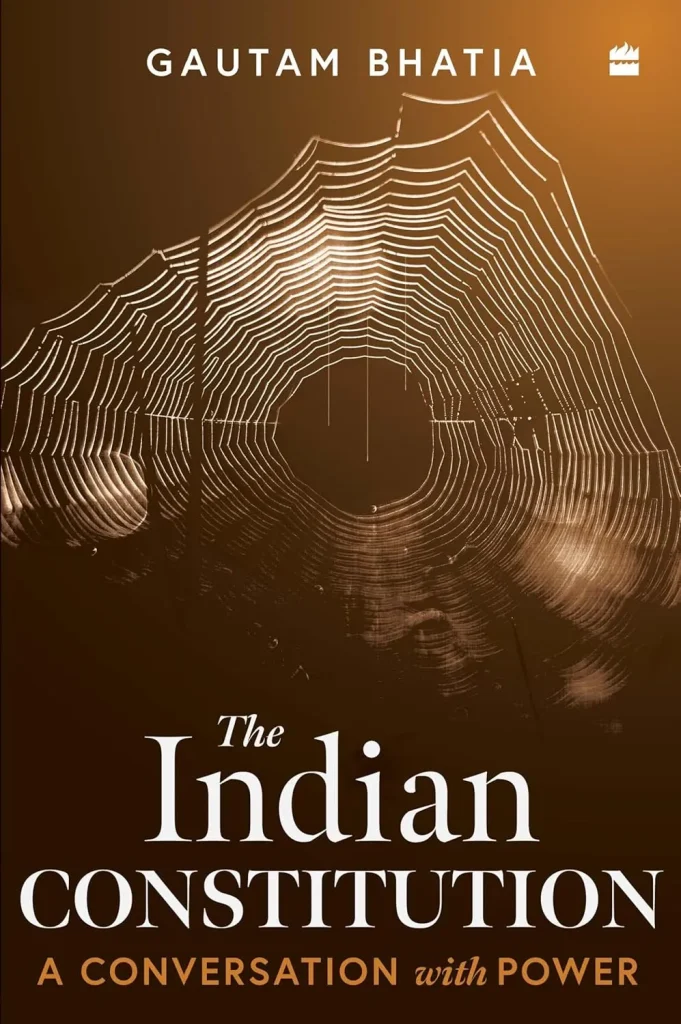
The Supreme Court advocate Gautam Bhatia’s book The Indian Constitution: Conversations with Power offers a compelling exploration of the Indian Constitution by examining how power operates and is contested within India’s federal structure. Rather than treating the Constitution as a static legal document, Bhatia frames it as a dynamic site of ongoing negotiation between state authority and individual rights, highlighting the ways in which power is wielded, challenged, and reshaped in the country’s democratic framework.The book also brings a rich global perspective, as Bhatia thoughtfully compares the Indian Constitution with those of other nations. Through these comparisons, he highlights both the uniqueness and the shared democratic struggles of constitutional frameworks worldwide, deepening our understanding of how India’s constitutional vision fits into a broader global context.
Bhatia examines how Indian federalism is shaped by colonial-era statutes that reinforced centralization, such as the Government of India Act of 1935. He highlights how the Supreme Court, through judicial pronouncements such asState of West Bengal vs. Union of India (1963), has furthered this centralizing tendency. Bhatia explores how federalism in India has leaned towards centralization across various domains, including human rights, revenue, and governance, citing acts such as the Armed Forces (Special Powers) Act, 1967 (AFSPA) and Enforcement Directorate (ED). He argues that constitutional gaps, ambiguities, and silences have contributed significantly to this trend, fostering a ‘centralizing drift’ in federal dynamics. Moreover, he underscores the role of the judiciary in perpetuating this centralization, particularly through its interpretations of constitutional provisions. This analysis reveals how historical and judicial factors have led to a concentration of power at the center, undermining the federal structure envisioned in the Indian Constitution.
Bhatia offers a trenchant critique of the structural and functional decay of India’s parliamentary democracy. He traces its roots to the colonial and postcolonial evolution of legislative institutions by dissecting the Government of India Acts, statutory frameworks, and entrenched office structures that continue to shape contemporary governance. He argues that India’s parliamentary model operates under the veneer of constitutionalism while reproducing a deeply centralised, executive-dominated regime. He highlights how instruments like the anti-defection law hollow out legislative deliberation, while the Speaker’s partisan conduct and the absence of formal recognition for the Opposition erode democratic accountability. The Rajya Sabha, envisioned as a federal check, is rendered institutionally feeble; with its chairperson often aligning with executive interests. He critiques the unchecked ordinance-making power and the use of Parliament as a rubber stamp, ultimately concluding that India’s system increasingly mirrors the “pathologies of presidentialism.” In this distorted framework, the Prime Minister emerges as the epicenter of authority, sidelining both cabinet responsibility and legislative oversight, and subverting the core principles of parliamentary democracy.
Power Dispersed and Power Confronted
Bhatia highlights the complex and often fraught history of asymmetric federalism in India. Drawing from the Constituent Assembly debates and a series of landmark judicial pronouncements, he critically examines the evolution and devolution of Article 370, paying particular attention to key inflection points such as the Sampat Prakash (1968) and Mohd Maqbool Damnoo (1972) cases. He extends his analysis to other constitutional provisions like Articles 371A to 371I, along with the Fifth and Sixth Schedules, using both historical context and judicial doctrine to expose the deeper tensions underlying what he terms “centrally managed asymmetric federalism.” It culminates in a comparative study with federal models in Ecuador and Bolivia, through which Bhatia compellingly argues that the framers of the Indian Constitution were more committed to building a nation-state than embracing the pluralist ethos of a state-nation.
Columbia University Professor Mahmood Mamdani in his book, Neither Settler and nor Native:The Making and Unmaking of Permanent Minorities,argues that the very concept of the nation-state poses a threat to democracy. Mamdani traces the origin of the nation-state to Iberia in 1492, where its agenda was summed up by the slogan, “One country, One people, and One religion.”He illustrates this through the experiences of African Americans and American Indians, showing how the rights of American Indians were systematically undermined by the nation-state framework. For Mamdani, the nation-state inherently promotes majoritarianism, often leading to the marginalization and expulsion of minority communities.
Bhatia underscores the institutional significance of non-elected bodies—such as the Central Bureau of Investigation (CBI) and the Central Vigilance Commission(CVC)—as vital components of the state’s enforcement and implementation apparatus. He argues, through judicial precedents and statutory analysis, that these bodies must be institutionally insulated from executive influence, as they serve a critical role in safeguarding individual rights and acting as a counterweight to state power. He expresses concern over the lack of constitutional entrenchment for such institutions, noting that their structural integrity is left to the vagaries of parliamentary discretion, which is frequently dominated by the executive. He emphasizes that although these bodies originate from statutory enactments and exist within the interstices of constitutional silences, they ought to be accorded constitutional status in both form and function, thereby immunizing them from executive encroachment.
He critiques the Indian Constitution for its inherently “executive-trusting” architecture, cautioning that this structural tilt facilitates a centripetal drift, weakening the autonomy and effectiveness of these quasi-constitutional entities over time.
Power Contained and Power Unbound
Bhatia interrogates the assertion of state authority over the individual body by critically engaging with the colonial and postcolonial trajectory of the Code of Criminal Procedure. He argues that the procedural framework of the CrPC remains structurally antagonistic to constitutionally enshrined civil liberties. Delving into Article 22, he offers a rigorous critique of preventive detention laws, exposing the broad, unchecked executive discretion underpinning them. Through detailed case analyses and comparative constitutional jurisprudence, he illustrates how India’s legal regime permits exceptionalism to override fundamental freedoms.
His examination of Article 20, particularly clauses (1) and (2), reveals judicial drift that increasingly consolidates power in the central government’s hands. Drawing a sharp contrast with Kenyan jurisprudence, he underscores how interpretive choices by courts in similar constitutional frameworks can yield vastly different outcomes. Bhatia further scrutinizes Article 21 in the context of bail, mapping its historical evolution, legislative frameworks, and key judicial landmarks to trace an erosion of individual autonomy. He ultimately concludes that Indian constitutionalism has skewed towards a statist paradigm at the expense of personal liberty and bodily integrity.
Furthermore, Bhatia critically examines the role envisioned for the people within the Indian Constitution in the realms of constitutional tempering, law-making, and administration. He begins with a conceptual and comparative analysis of Kenya and South Africa, underscoring the value of embedding participatory mechanisms within constitutional frameworks. Shifting focus to India, Bhatia interrogates the Constitution’s silence on deeper public participation beyond periodic elections, drawing on Nazmul Sultan’s scholarship. He revisits the Constituent Assembly debates on referendums and the right to recall mechanisms discussed but never actualized suggesting their deliberate exclusion. Bhatia also explores the judiciary’s mixed record on public participation, particularly in environmental governance and housing rights, where courts have at times empowered the public but often failed to institutionalize participatory norms.
Concluding with the work of Rohit De and Ornit Shani, he acknowledges that while the Constitution’s drafting was participatory, this spirit was not fully preserved in the final text or judicial interpretation. Bhatia ultimately calls for reviving these submerged traditions to re-center the people in constitutional life.
This book is a clarion call – bold, unflinching, and urgent. It lays bare the invisible threads of centralization that run deep through India’s constitutional fabric, inherited from colonial rule and subtly reinforced through judicial decisions and institutional design. With sharp insight, it warns that not all laws made “within the Constitution” are just; many are colonial relics smuggled into modern governance without being tested against the moral compass of the Constitution’s core values.
The author masterfully exposes how constitutional silences and ambiguities have become breeding grounds for central overreach. What emerges is a sobering realization: beneath the façade of cooperative federalism lies a creeping centralization. This book does not just inform—it alarms. It reminds us, as the great political thinker Hannah Arendt noted, that civic republicanism is not a luxury but a necessity, and that without active vigilance, India may march toward central dominance wrapped in the cloak of decentralization.
You can purchase the book here.