
Usawa Literary Review is headquartered in Mumbai, India.
PIN Code: 400050
Interested in working or collaborating with us?
Contact Us

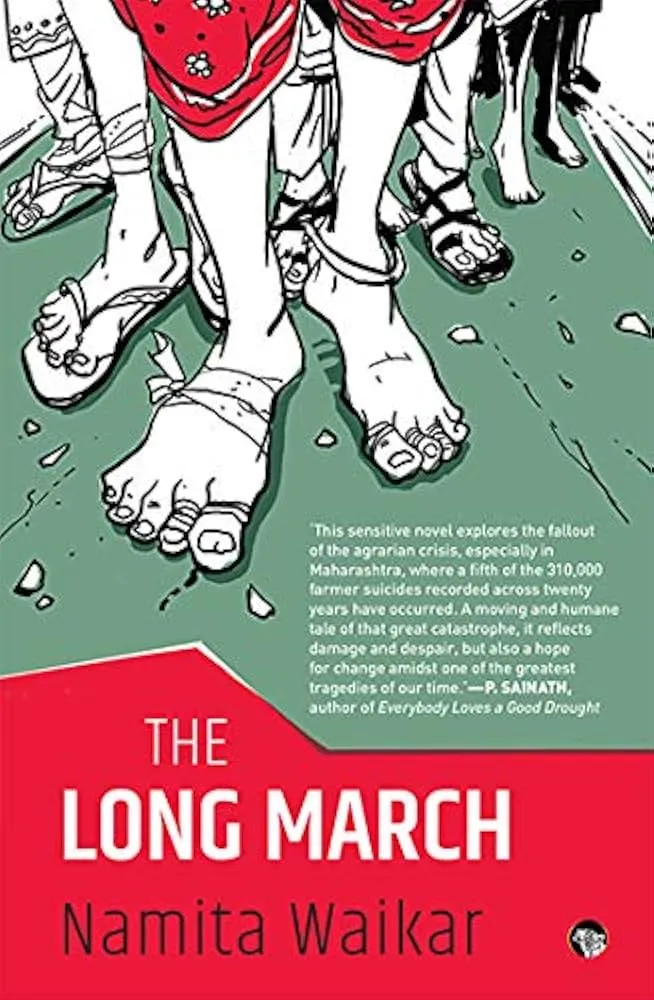
The Long March

By Namita Waikar


‘This sensitive novel explores the fallout of the agrarian crisis, especially in Maharashtra, where a fifth of the 310,000 farmer suicides recorded across twenty years have occurred. A moving and humane tale of that great catastrophe, it reflects damage and despair, but also a hope for change amidst one of the greatest tragedies of our time.’—P. Sainath, author of Everybody Loves a Good DroughtIn Vidarbha, yet another debt-laden farmer commits suicide. His death leaves his family—especially his twenty-year-old son, Vikram Sonare—devastated and furious. But Vikram’s work with the Agricultural Technology Centre and new-found knowledge of social media inspire him to build a network with youth across India and start a silent revolt. In Mumbai, twenty-six-year-old Mallika Joshi works with an NGO. While on assignment in Vidarbha, she meets farming families neglected by the government and suffering under the weight of increasing debts. Moved by the hardships they’ve faced, and inspired by Vikram’s efforts, she becomes an integral part of the movement.Together they embark on an epic mission to draw attention to the plight of farmers and other underprivileged sections of society, and finally mobilize millions of people to march into the major cities of India. After the success of the march, the group transforms into a revolutionary political party. But will the existing political forces allow it to succeed?Urgent and inspiring, The Long March is a necessary story for our time.

Review: The Long March

Fiction reveals the profound stakes of agrarian precarity, exploring collective agency as a defiant response to systemic injustice, political apathy, and profound human grief.

A Reminder that Fiction Never Lies

On March 19, 1986 Sahebrao Karpe, a farmer from drought-prone Yavatmal district of Maharastra mixes zinc phosphate in his food and serves it to his family before consuming it himself. In reality, this is the first recorded incident of farmer suicide in the state. Crop failure and an inability to pay off debts has brought Karpe to this decision. The Long March, Namita’s Waikar’s debut novel, takes us right into the hinterlands of Maharashtra where, even after three decades since the first farmer has taken his own life, the lives of many agriculturalists are as perilous as ever. Although a fictional take on the lives of farmers such as Karpe and the farmers since Karpe, The Long March serves as a continuous reminder that fiction is always born from kernels of truth, from the irreducible nature of human pain, loss and bereavement, and that the art of fiction is always informed by the perils of life, and therefore (and in the words of V.S. Naipaul) fiction never lies. Throughout the novel, Waikar unleashes discomfort and disquiet through depictions of the raw humanity and the precarity of the lives of those who have pledged themselves to the land, to the soil, to the farm and to food. Waikar takes us to the centre of this agrarian crisis and through the narratives of an ensemble cast of characters, readers traverse the geographies of death and anguish, pausing only to grieve.

Kashibai, the wife of the farmer Kailashnath Sonare must confront life and the responsibilities that follow after she finds her husband stretched out near a pile of hay, a can of pesticide beside him. Whatever happens to those who have been left behind?
“She was the head of the family now and they were all her responsibility,” writes author Waikar of her Kashibai Sonare. Her son Vikram Sonare, an employee of the Agricultural Technology Institute set up by the well-regarded agricultural scientist Dr. Kabir Rehman, finds both solace and warning in the writings of Babasaheb Ambedkar. Can you have economic reform without first bringing about a reform of the social order?

The depredations of the past and the present, and the seeming futility of the future provides Vikram an impetus to start a social movement, a revolt by those who have been damaged by the agrarian crisis, against a system diseased by political apathy, misgovernance and the ennui of the privileged. At a time when farm suicides have become mere statistics and a topic of political bickering, something that is easily dismissed by urban consciousness and urban citizenry as a ‘far-away event,’ Waikar’s portrayal of rural Maharashtra – from Wardha to Yavatmal to Vidarbha – all unfolding through the travails of Mallika Joshi, an NGO worker, illustrates the real, aching vulnerability of lives that face the ignominy of daily loss and bereavement.

On assignment to understand the magnitude of the problem, Mallika travels to the hinterlands of Maharasthra where she meets Vikram Sonare for the first-time. She also visits other families who have lost fathers and brothers to debt-induced suicide. From failure of harvests to drought-ridden dry lands and lack of irrigation, from rising costs of seeds, fertilizers and pesticides to manipulative policies set by international trade bodies, from lack of loan facilities to the traps of local moneylenders and mounting debts, farmers pay for their choices to be farmers, with their lives. As the extent of the farm crisis becomes evident to Mallika, she realizes that she must act. Along with her boss, the genial Dr. Sriram Kasbekar, Mallika plans a country-wide padhyatra, a long march of farmers, activists and volunteers. But the planning must wait for there is another walk that she must undertake – the vaari, a walking pilgrimage to the holy site of Pandhurpur, home to the god Vitobha. The arduous journey that takes 21 days to complete is a yatra by foot alongside a palanquin procession carrying padukas or footprints of the saints Dyaneshwar and Tukaram. While Dr. Kasbekar chides her for her decision to abandon the planning of the padhyatra, Mallika, who is mourning the tragic loss of her lover Iyer, seeks out the meditative space of the vaari. Upon her return, and after a series of travels across the state’s villages, Mallika’s and Vikram’s paths cross once again. What follows the yatra is a grand culmination of a co-operative movement – a people’s movement, a long march against neo-liberal capital’s nexus with political greed, something that has systematically destroyed the agrarian economy – that leads to the establishment of the Democratic Citizens Party. The epilogue tells us that seven members of the newly-formed party have been elected into the parliament and now sit in the Opposition.

In March 2018, more than 40000 farmers marched a distance of 180 kilometers from Nashik to Mumbai to gherao the Maharastra Vidan Sabha. The All India Kisan Sabha backed by the Communist Party of India (Marxist) brought about this grand collectivization to make a series of policy-related demands to the Government at large. In Waikar’s fictional world, the movement goes a step further – into the realm of governance itself, of people discarding the tag of subjection and elevating themselves within a defiant social order. Fittingly, The Long March begins with a quotation by M.K Gandhi on how democracy is the art and science of mobilizing the entire physical, economic and spiritual resources of various sections of people in service of the common good of all.

Looking for more Books?

Browse the Bookshelf →

Excerpt: The Long March

The arduous journey tests human limits, revealing profound resilience and the unwavering spirit required to endure protracted challenges and reach distant, uncertain futures.

At Lonand, Swati interviewed two police officials and they discussed the security arrangements for the procession during the vaari period: a special team managing the traffic to minimize congestion problems and police constables keeping watch for petty thieves and pickpockets. Swati noted down the officials’ names but they asked her not to use it in the article.
  ‘All this is in service of the varkaris. We cannot leave our jobs to join in this journey. But the varkaris do this every year, so at least helping them is our way of taking part in the pilgrimage.’
  On the twelfth day of the vaari, Sudha and Mallika sat together watching a group of the varkaris singing. Sudha held Mallika’s hand in hers and patted it, ‘I am so happy you came with me.’
  ‘Yes, I am too.’
  ‘Look at them. They are so completely immersed in their devotion of Vitthal. They have left all their worldly worries behind them. Their hearts must be so light.’
  ‘In anticipation of reaching Pandharpur?’
  ‘Yes. But also just being on this journey. The journey is more important than the glimpse of their deity in Pandharpur, you know?’

There was an eerie silence and spirits were dampened when two men breathed their last during the lunch break on the way to Phaltan. An eighty-year-old man died of heart failure, and the other, sixty-five-year-old, died while taking a nap after lunch. Everyone agreed that the two men were indeed fortunate to have died during vaari, for that means they are already with their beloved Vitthal.
  In Solapur district, the lady sarpanch of Dharmapuri and other officials welcomed the palkhi procession with the same gusto as in the places that they crossed earlier.
  The next day, the procession reached the Dhava-Bavi mound in the afternoon as the varkaris sang the abhanga ‘Sinchana karita moola, Vruksha olaave sakala.’ Which meant that when the roots are watered well, the entire tree is nourished.
  Following the melodious song, the managers called out the dindi numbers one by one and the varkaris ran down the hilly slope chanting, ‘Mauli, Mauli!’
Professor Bharadwaj turned to Mallika, who was watching everything intently,
  ‘Mallika, folklore tell us that when Sant Tukaram reached this hilly slope hundreds of years ago, he saw the temple dome in Pandharpur, even from this distance. His devotion attained such a peak at that moment that he ran down the slope to speed up his progress. The varkaris now follow this tradition, called dhava, which as you know simply means…’
  ‘Run!’
  When it was their turn, they charged down the slope.
  After that energetic dash down the hill, they rested on the grass in the open countryside where folk artists sang a bharuda with its soul-stirring lyrics tinged with humour and irony. One singer recited scenes from the joys and sorrows of everyday life. Men, women, and children listened in rapt attention. Some women formed small circles and danced gracefully while others sang couplets called ovi, a union of prose and verse. No break is complete without a round of phugdi. So the women paired up and played until they felt forced to break apart and hold their heads to stop the dizzying and spinning feeling. The other women laughed, one of them rather loudly. She was the same woman Mallika had chased after earlier. Mallika went and sat next to her and held her wrist as she tried to get up.
  ‘I remember you. You are Sita Madhe from Kosurla village near Wardha, ho na?’ Mallika asked her in Marathi.
  She was silent for a while and then whispered ‘hao’ in her Varahdi dialect.
  She now sat more comfortably, stretching her legs out a little and resting her elbows on her raised knees. When her sari pallu dropped from her head, she ignored it.
  ‘Have you run away?’ Mallika ask her cautiously.
  ‘Tu kon lagli majhi, asla ichraya?’ Who are you to me, to ask me such questions?
  ‘Chhoti bahin, Savitri saarkhi.’ A younger sister, Mallika told her, like Savitri. At the mention of her sister-in-law, she looked at Mallika. Her eyes flashed angrily, reminding Mallika of the way Savitri’s eyes had raged when they had met her.
  ‘Who are you to ask me anything? What makes you think I can run away from the miserable life back in my village? The perpetual work to heat the hearth, the toiling in mud… The constant need for money and the gaping lecherous avarice of that haraamkhor…saalaa…’
  Mallika silently listened to her abusing the moneylender.
  ‘This vaari is just an excuse for me to get away for a few days. I will have to go back there. I was like Savitri, too, when I was younger. Full of energy and anger, ready to fight any adversity, to work hard and rise against the world. But now I’m older and have seen much more hardship and sorrow than she has.’
  She paused. ‘How can I leave her alone to fend for the children, hers and mine? I will go back. I have not told her anything but she will understand that I have not gone forever.’
  Mallika merely watched her in silence, wondering how to apologize for having offended her.
  In a calmer tone, Sita added, ‘A group of people from my village have come for the vaari. I have come with them. Savitri will figure it out I’m sure, as she knows me and understands our common angst.’
  Mallika felt humbled and regretted asking her the question. Patronizing, yes, that was the tone of my questioning, she thought, just because she is poor and possibly semi-literate.
  Not knowing how to make amends, she simply held Sita’s wrist again, which prompted Sita to ask, ‘Kaaon pori? kaay zhala tula?’ Why girl, what’s happened to you?
  Before she could think of anything to say, Sita asked, ‘Ani tu hitha kaay karun rahili?’ And what are you doing here? ‘I’ve come to see what the vaari is all about.’
  ‘Ekti?’
  ‘No, I am with a small group. Just like you!’ She laughed. Standing up quickly, Sita walked away, leaving Mallika amazed at her strength.

Looking for more Books?

Browse the Bookshelf →
Back to Issue

Support Our Work

If you enjoy our content, consider supporting us.

Support Us

We are an unfunded, independent feminist publication. We need your support to continue our work.