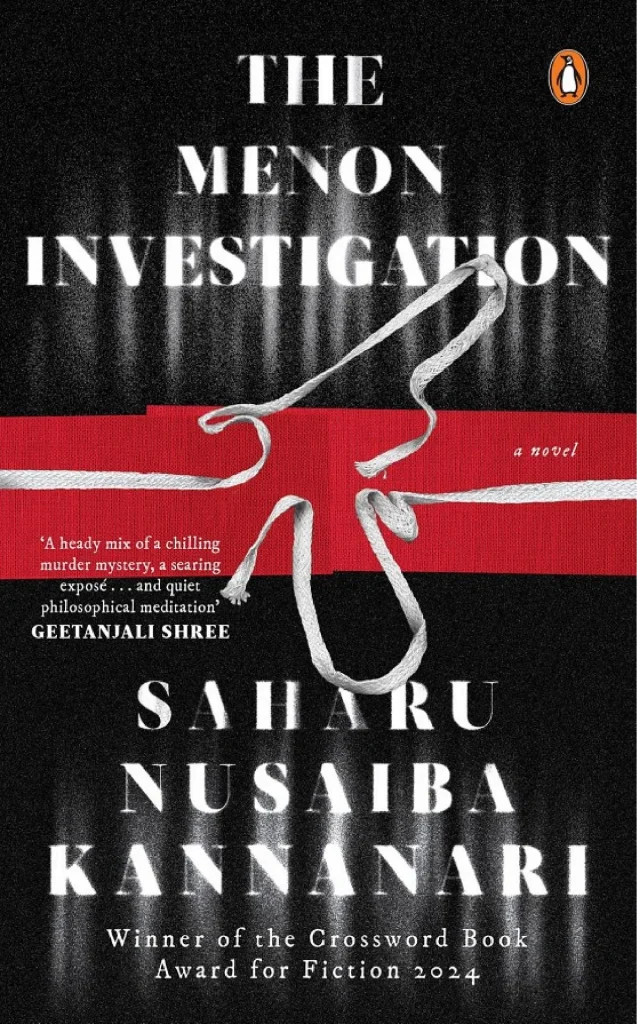
Kannanari dissects the detective genre to expose how patriarchal structures and caste hierarchies enable systemic corruption, denying justice and unmasking institutional faith.
A pivotal scene in the 2015 film Spotlight shows Boston Globe’s Sacha Pfeiffer interviewing Father Ronald Paquin and her own rising incredulity at the former priest’s curious rationale on how ‘fooling around’ with boys in the church never gave him any pleasure, how he would know the difference because he himself had been molested. The film, based on real life events in Boston, is a scathing indictment of how sexual predation exists within the church, the few rotten apples nurtured, sheltered, supported egregiously by the very system that should cast it out. Saharu Nusaiba Kannanari, in his second novel The Menon Investigation, takes the trope of the detective novel but infuses it with a serious rumination on the nature of systemic corruption existing in the state and civic institutions. In fact, the novel in various ways questions the institutionalized nature of things—be it the legal framework, religion, or marriage, all man-made constructs, all morally deeply-flawed.
The novel, divided into nine chapters of more or less equal length along with a prologue and an epilogue, is set at a very readable two hundred and thirty-five pages. It begins like a typical whodunit, in a very cinematically descriptive fashion, with all the elements of a taut murder mystery, and although the mystery of the state of affairs remains unresolved fully till the very end, the unravelling of both the protagonist and the case begins from the very first chapter. Vijay Menon, the inspector general at Kozhikode, is at the heart of investigating a cold case from 2009, in which Kannan Moses, a sub-inspector is killed, the case unresolved by a botched previous investigation. Vijay, who has a high ground in the police force due to his upstanding moral character and his checkered past as a ‘dark Menon’, is conflicted by his own attitude to the police force as well as to his family.
What we see in Vijay is a person who is aware of his limitations both within his home and his workplace and is always under performative pressure and in a series of situational humour, Kannanari interestingly shows Vijay being upstaged and emasculated not only by his successful wife who is upfront about her sexual needs in a monogamous love marriage, but also by his two daughters, each of whom rebel in their own way. What galls Vijay more than his younger daughter Roxanne’s more obvious adolescent rebellion, is the rebellion of his older daughter Kalyani, an obedient, slightly traditional child, who chooses a dark-skinned boy as her companion and this is the point of Vijay’s undoing. His ambiguity about his own dark skin and his guilt in giving his younger daughter an ebony visage is closely associated with his own experience of his skin colour being associated with a lower caste especially in his professional circle, a connection that he has routinely resented.
Vijay’s own anxious obsession with his skin colour and his caste pride as a half-Brahmin upper-caste and upper-class man runs alongside his disillusionment with the very system he is a part of. He knows his constraints as a police officer in this investigation, how honest officers are engulfed by the system and therefore chooses to keep his cards close to his chest, not only because “there are doors beyond which no investigation can progress as investigation. There are tables at which the law ceases to be law” (p.16), a knowledge that barely hints at the nature of systemic corruption that is disclosed as the novel progresses, but also because of his own pride as a “clean man” (p.10).
The first two chapters of the novel not only give us an insight into Vijay’s own understanding of the cold case but also takes us inside his fraught and anxious mind, a picture of soft paternalism that is the base and foundation of patriarchy. His discussions with the merry DGP bring about the realities of the typically caste-based ‘fixed’ Indian marriages that are replete with loneliness and dubious sexuality. Vijay sometimes regards his own family with the unease of an outsider. And as the case unravels, so does his mind, forcing him to do the very thing that had caused Kannan Moses’s murder all those years ago—Moses, a lower-caste Christian convert, an Arayan from a fishing background.
The one who emerges as the man with the most integrity in the narrative is Shyamu, a formidable adversary who is a half-Adivasi, a good-looking chap with sapphire blue eyes, unruly hair and fair skin, that makes him stand out in a crowd. In many ways he is an antithesis of Vijay. Parented entirely by his single widowed mother, largely displaced throughout his short life, Shyamu is sure-footed and unruffled. Like Vijay, he has an ambiguous relationship with his father, a mere wisp of history. In fact, Shyamu’s relationship with his mother Nelly, coerced by their lonely and undocumented circumstance, overshadowed by his father’s past, is highly intuitive, each looking out for the other. It is their collective fate that remains with the reader, long after the book is shut.
The novel broods on the notion of morality and justice, especially because it is very seldom to be had. Justice comes to those with privilege and here caste identity matters more than humanity. It is shown in the way in which the Maoists, the Adivasis and the Arayans are treated by the state in not only denying them justice but also not providing them with sustainable means of living and income, often forcing them to take to alternative means of sustenance. One wonders if Shyamu would have chosen path he took if he were formally educated, if the State understood his predicament, and that of his parents who were left to fend for themselves because the patriarchal system, of which both family and State are big parts, denied their inter-caste marriage a recognition.
The text, at several points, focusses on the hegemonic nature of power and exploitation through consent, often garbed under the cloak of egalitarianism. The bishop who helps Shyamu and Nelly find legitimacy in the eyes of law is also the one who preys upon both the mother and the son in various ways, his help always conditional and of course, opportunistic. The nakedness of power and entitlement, the greed and absolute nonchalance of privilege is conveyed through the unsavoury nexus between the agents of state and civic bodies that shut both Vijay’s and Shyamu’s mouths, albeit in very different ways, while freely pontificating from their position of power. It unmasks faith, what constitutes faith, and ultimately what unmakes faith.
The Menon Investigation has all the trappings of a detective drama—a conflicted, loner cop, the failing police, a tense interrogation scene, intrigue, the usual red herring, the lies and the elaborate machinations—but the cop here is deprived a moral win and that is a refreshing take. His weakness embodies the frailty of a system. The novel is a layered, gripping read which though satisfying, is not necessarily an easy one from the get go—primarily for is its prose, which gathers more fluidity from the fifth chapter as we untangle the mystery further, showing real lyrical glimmer and beauty in a few places, but appears clunky and verbose in the first half due to the use of unusual register that halts the flow.
It appears to be a deliberate choice to convey either humour or a depth of thought that is done more effortlessly in the second half. But the humour reads more situational than verbal. The plot of the novel is tight and Kannanari has a done a good job with the back stories of the characters and hasn’t brought in too many in the novel’s universe which keeps us focused on the story itself. The prose, especially in the first half, is full of dry wit, cynical and reflective of the novel’s premise, although the interrogation scene and especially the epilogue, a moving tribute to motherhood, are written with a rare honesty and heart, that suffuses one with a sense of wistfulness as the characters and the readers are left with “that distant and unforgettable sound of history” (p.221).