*The Struggle* dissects how patriarchal village economies and nationalist movements rendered peasant and women's agency expendable, leaving their foundational precarity largely unresolved.
Chill Penury repress’d their noble rage,
And froze the genial current of the soul.
– Thomas Gray
History seldom writes about the historically oppressed. That job is shouldered by literature and other art forms. Showkat Ali’s The Struggle, translated deftly by V. Ramaswamy with Mohiuddin Jahangir, documents the lives of the historically precarious peasants in the heart of the undivided rural North Bengal in the middle of 1940s somewhere in the Dinajpur district. The novel, divided into three sections, moves through the heart of rural Bengal and traces the events leading to the Tebhaga Andolan (1946–47), a brutal and bloody peasant uprising that unfolded alongside the national freedom struggle, yet received little attention and was swiftly suppressed. What this novel does superbly is that it takes its readers smack in the middle of village life and raises a few questions that continue to remain relevant after almost eight decades of freedom from the colonial yoke.
The novel highlights two historically precarious groups within patriarchy – women and peasants – moving from the intimate world of a family to the wider realities of village life and the project of nation-building. The struggle that lies at the heart of this novel begins with Phulmoti’s travails, a young widow left with two bighas of land, a young boy Abedali, a sickly bullock, a few milch goats, ducks and chicken. The first section of the novel, “A Ploughing Household”, lays down the context of Phulmoti’s precarity in the patriarchal economy of the village, where both the men and women cannot endure a single woman making her own economic decisions. Phulmoti is constantly reminded that a woman cannot exist without a man and must therefore marry. After her widowhood, she sleeps with a chopper and an axe beside her, not only to protect herself but also her young son, aware that her vulnerability stems not just from her gender but from her ownership of cultivable land and cattle. Hounded by men in the village, and often by well-meaning women, Phulmoti seeks to preserve a measure of freedom within her own home, knowing that marriage is not a solution to her troubles but may, in fact, be the prelude to more:
‘If you go and stay in this man’s house, will you have your own house?’ she asked herself. ‘Your own family? And household? Will even your son remain yours? When a woman goes to her husband’s house, does anything remain hers? Have you seen that anywhere?’ (pg. 86)
The novel is a testament to Phulmoti’s bravery and agency because instead of caving in to the collective village pressure to find herself a suitor and marry posthaste, Phulmoti chooses herself a ghor jamai, a house husband, for the well-being of the household she had created with much love and labour, for her son Abedali’s safety and to ensure her own freedom. The man she finally settles on is younger than her, Qutubali, a genial, simple-minded orphan, who though called an idiot all through the novel, often emerges as the man who is the wisest, shorn of any patriarchal conditioning. He is grateful, genuinely protective of Phulmoti, her son and her cattle, a hard-working farmer, who shares in Phulmoti’s chores, and though not educated in the ways of the world, his moral compass is in the right place.
The second section of the novel, “Home and Family” dwells on the reaction of the village to Phulmoti’s acceptance of Qutubali as her ghor jamai and her hasty marriage to him. While the womenfolk accept the marriage in relief and happiness, the menfolk, especially those who were interested in Phulmoti led by the Munshi of the village, begin to desert sharecropping her land, slander her, insult her son, sit in arbitration councils and plan to oust them from the village:
His complaint was an ancient one: how could a young woman roam around by herself? This was his constant refrain ever since she had become a widow. … They wanted her body first. But their desire wasn’t limited to that—there was also property that they wanted. There was a bullock and some goats, a few plots of cultivable land—they wanted all of that. But she knew that none of them wanted her boy. They probably wouldn’t allow him to stay alive. (pg. 131)
Qutubali undaunted takes on his share of fieldwork, sowing paddy on Phulmoti’s land and her sharecropped fields, and doing odd farm jobs. Over time, he earns the trust of the family and villagers and is no longer seen as an outsider. For a brief period, Phulmoti’s home and life attain a sense of wholeness. This section vividly captures the cyclical rhythm of peasant life—farming, sharecropping, and harvesting aligned with nature, village sayings, rituals, and celebrations. By detailing the roles of men and women in managing the produce, it draws even distant readers into agrarian life and prepares the ground for the final section, “We Must Fight!”, which examines the socio-political forces behind the Tebhaga Andolan and its meaning for the farming community.
The third section is the novel’s most vital. It exposes landlord atrocities against sharecroppers as a continuation of colonial extraction, but instead of centring on violence, it traces the movement’s foundations from the farmers’ perspective. In doing so, it situates Tebhaga within the larger struggle for nationhood, examines the spread of communism into remote villages, unpacks the role of caste in the parallel struggles, and reveals the early communal fissures that later erupted into the Hindu–Muslim riots of Partition.
In the wake of the Bengal famine of 1943, amidst the greater exigencies with the harvest and the rising tide of nationalism, the landlords began to extort greater share of the paddy from the peasants with random arbitrary calculations. Although the crop was meant to be divided equally between landlord and sharecropper, the reality was far harsher. Sharecroppers had to pay day labourers and cleaners from their own share, along with the landlord’s accountant and manager. The exploitation went further: paddy loans were repaid at one-and-a-half times the amount, and when crops failed, poor peasants were trapped in an endless cycle of debt.
Amid rising exploitation, peasants, organized by the local communists, demanded tebhaga: a three-way division of what is produced that granted cultivators two-thirds and landlords one-third in return for their labour. Comprising lower-caste Hindus, Muslims, and Santhals, the peasants were forced to grow vegetables and pulses in landlord’s kitchen gardens between seasons, a labour often unpaid since ‘there was no rule that governed sharing when it came to other cultivated produce’ (p. 240). The novel sharpens this injustice in a key moment when Qutubali demands payment for his labour in Madhu Ghosh’s kitchen garden.
As for the dals, after husking, they were filled into separate sacks, and taken to the veranda of the house. Nothing was kept aside for Qutubali, like the sack of potatoes.
Not expecting to get anything otherwise, he appealed with folded hands, ‘Mistress, won’t I get any dal?’
The woman laughed. ‘So, you wish to have dal?’ she said, reckoning that the lowly sharecropper had developed an appetite for the dal consumed by the bhadralok, the cultured gentlefolk. (pg. 240)
Caste operates here, like elsewhere, as a latent tool of exploitation. This is most evident in headmaster Nirmal Roy, a genteel city man, a supporter of Netaji’s ideals and a critic of Gandhian thought who has been sent to the village to mobilize support for the nationalist movement that had little meaning for peasants, who remained “largely witnesses to the euphoria and pomp” (p. 270). Living in the landlord’s house, Roy is sympathetic to the peasants yet dismisses them as unlettered, and their matters as “trivial”. He urges them to join the freedom struggle and perform the grunt work by sacrificing their own struggles – an attitude that ultimately reproduces Brahmanical patriarchy rather than challenging it.
The novel shows that the freedom struggle was largely urban, filtering into villages through landlords and elite zamindars of both the Congress and the Muslim League. While they promoted communal divisions, peasants sought only assurance over their share of the crop. The headmaster, without clear direction, fails to solve the peasants’ growing worry and, like other upper-caste men, leaves the onus of both labour and exploitation to the peasants. As Edgar Snow says in Red Star over China, communism gained ground among the poorest of the peasants because “peasants were not interested in revolution, Marxism or theories. They wanted peace, rice, parcels of land, relief from their agonies, freedom from crushing debts, usury and taxes, and a chance for their children to learn to read and write”. The novel also exposes communist failures in this movement—the rapid unionization and poor coordination that led to deadly delays. Acting alone, the peasants seized the harvest, only to be crushed by state–landlord collusion. It leaves a stark question – what of the peasants? History shows that peasants, lower castes, and women remain expendable within mainstream politics, their precarity unresolved even till this date.
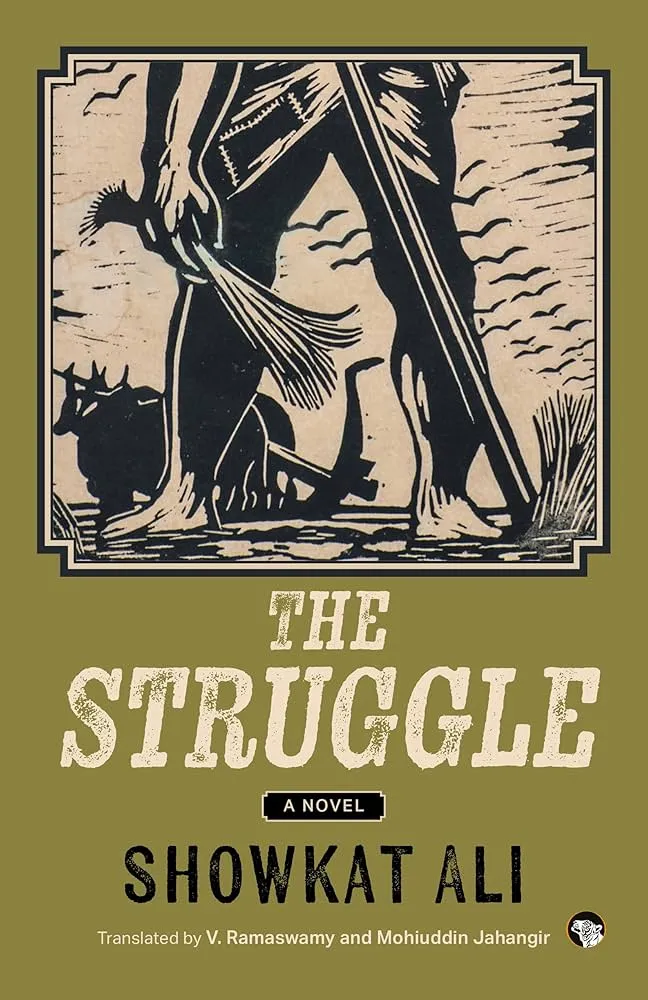
The translation from the Bangla original by V. Ramaswamy and Mohiuddin Jahangir deserves special mention for its fluidity and restraint. It’s simple, lyrical prose captures the atmosphere and tonality of rural Bengal with precision. Village adages are retained with English glosses, firmly rooting the novel in its locale, while the rhythm of onomatopoeic regional words preserves the mellifluous dialect and lends authenticity to the text. Maithili Doshi Aphale’s sludge-green cover, depicting a sharecropper with his tools, further enhances the novel’s appeal, making it a memorable read.