
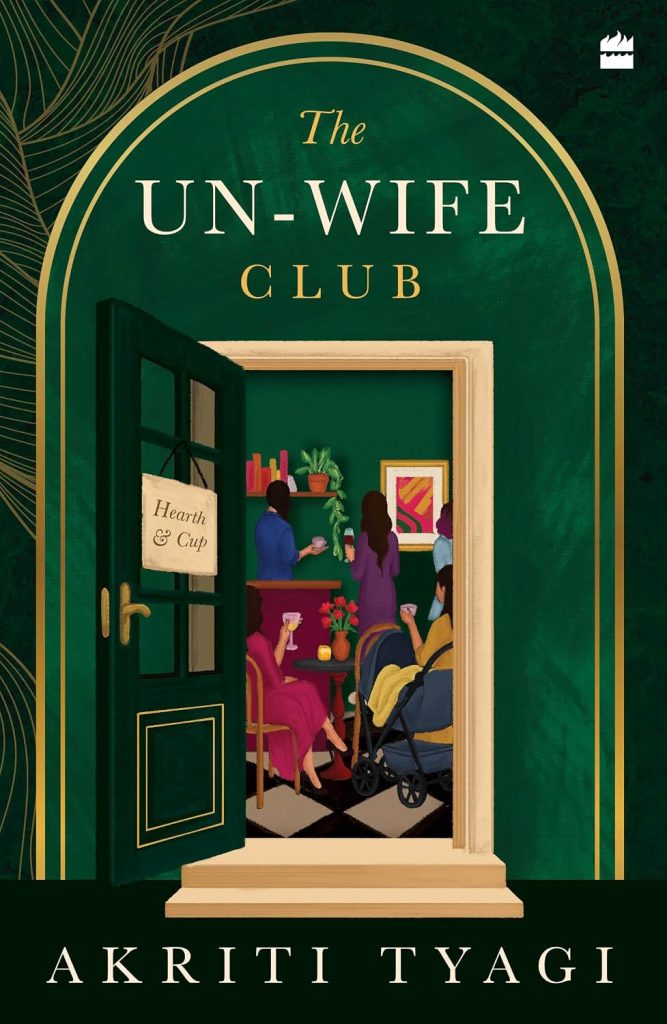
Whether one grows up surrounded by women or finds oneself among them later in life, it is difficult to overlook how often Indian society encourages women to regard one another as competitors rather than companions. Internalized misogyny, the perpetuation of cycles of entrapment and the policing of one another’s choices are among the ways in which this antagonism is sustained. While male friendships are often celebrated through even the smallest gestures of affection and camaraderie, female solidarity and the many nuances of women’s friendships remain comparatively underrepresented in our cultural narratives.
It is against this backdrop that The Un-Wife Club offers a refreshing portrayal of adult female friendships – one in which there is room for disagreement, learning and unlearning, as much as there is for growth and companionship. Through the intertwined lives of Mira, Simran, Tara, Amaya and Izna, Tyagi weaves a heartwarming narrative that offers the kind of representation we so often seek in Indian fiction. This is not to suggest that the novel is without conflict. Its complexities emerge instead through the women’s individual negotiations with romantic relationships, careers, family and self-worth, rather than through antagonism among themselves. Their friendships are not predicated on sameness, but on the willingness to keep showing up for one another despite it.
In The Un-Wife Club (HarperCollins Publishers India, 2026), choice almost assumes the dimensions of a character in its own right, following the protagonists through its many manifestations: the choices that have brought them to where they are, those they continue to grapple with and those that confront them at life’s inevitable crossroads.
In this conversation, Tyagi reflects on the many threads woven into her debut novel: the making of its characters, the nuances of female friendship, the influence of her years in publishing and, ultimately, what she hopes readers will carry with them after meeting these women.
AV. One of the many fascinating things about the title, The Un-Wife Club, is the way the prefix ‘un’ suggests both an undoing and a fresh start. When you set out to write this novel, was its heart about dismantling societal expectations or about the intimate, daily courage it takes to construct a self outside them? What do you hope the title promises a reader?
AT: I think the heart of it was the exhaustion of being a woman whose life is constantly measured against a set of expectations – ‘Are you married yet?’ ‘Have you tried harder to be happy?’ ‘Why don’t you have children yet?’ There is always another question, accompanied by an arduous expectation to produce a satisfactory answer. A woman could be divorced, single or a widow, and yet still want love, companionship or marriage again. Those two situations can comfortably coexist in any of us, even if they confuse other people. The end of a marriage does not signify that you have stopped believing in intimacy, nor does the loss of a partner mean you cannot seek partnership again. Wanting someone does not signal a failure to become independent. That is some of what the prefix ‘un’ holds for me: the room to be contradictory without the need to defend yourself.
I did not want to write about women who had already arrived at the ‘right’ blueprint for their lives, but rather about those who were still negotiating with themselves. You can know that something needs to change and still desperately wish that it wouldn’t have to. I hope the title promises some relief. You can come into this book without having sorted yourself out; no one is testing whether you’ve become brave enough before you dive into this story.
AV. The neighbourhood café functions as a crucial sanctuary for the protagonists. How did you ensure that five distinct voices could challenge each other without flattening into a shared monolith? Did the café help you orchestrate this dynamic?
|“To me, friendships become interesting when admiration is tested against something more difficult than shared opinions.”
AT. I don’t believe five women become interchangeable because they have all been hurt. Hurt doesn’t impart a personality to someone, or even necessarily improve our understanding of others. What might be sound advice to one woman could turn out to be disastrous for another. Someone who has fought for freedom from the shackles of patriarchy may struggle to understand why her friend still wants a marriage. Similarly, someone desperate for a child may find it difficult to hear a mother admit that she is unhappy. You can love a person and still be baffled by some of the things she says, without knowing what to say in response. To me, friendships become interesting when admiration is tested against something more difficult than shared opinions. The women in The Un-Wife Club want different things. Simran’s relationship with achievement is not similar to Amaya’s relationship with motherhood or Izna’s with her self-worth. Giving them distinct desires was as important as giving them distinct wounds.
The café gives them a place to keep showing up. The small rituals of friendship are often underrated. Another coffee. Another conversation. The chance to hear something from a renewed perspective because you know the person a little better now. You are allowed to be ordinary there. You can be going through something that is dismantling your life and still have an opinion about what to order. I find that coexistence very moving.
AV. Which character’s turning point was the most emotionally confronting or difficult for you to write?
AT. Izna’s was particularly difficult because emotional abuse can leave you unable to trust your own account of what has happened. You start offering justifications before anyone has challenged you. ‘He was under pressure’; ‘Perhaps I’m too sensitive’; ‘It wasn’t always like this.’ You can become extraordinarily articulate in someone else’s defence while struggling to finish a sentence of your own.
The question that stayed with me was how a woman begins to believe herself again. How does she stop needing someone else’s validation to believe that she is hurt enough to allow herself to react? I was conscious of how easily people judge women for their choices in relationships. They do not question what happened to their confidence, resources and self-esteem. I did not want to hurry her towards courage for the reader’s comfort. Understanding the complexities of your life doesn’t instantly give you the strength to change it. That distance can be painful to inhabit, and I wanted to respect it.
Having spent over eight years in publishing, leading marketing and communications at a publishing house, Tyagi knows what it means to navigate the anxieties and expectations that accompany the life of a book. Professional composure and enthusiasm often meant fielding authors’ calls late into the night, sometimes on the eve of a book’s release. Yet, during our conversation, she speaks of an ‘uncomfortable contradiction’: that experience does not make one immune to the need for reassurance. Having stepped into the world of authorship herself, she admits to becoming more tender towards authors, particularly those who tend to be more anxious.
AV. How did your experience in publishing shape your debut? And how has becoming an author changed the way you view the publishing process?
AT. I knew how to write a marketing plan for a book. But that did little to help me when a sentence in my own book wasn’t working. Publishing gave me an understanding of the journey a manuscript would eventually take. It couldn’t answer the much more private question of whether I was willing to let people read what I had written. For years, I had been able to talk about books professionally, with a certain distance. Then it was my name on the cover, and I understood the feeling that could be concealed inside a perfectly reasonable email asking for an update.
A publication date is just an ordinary date on several people’s calendars. For the author, however, it can become a date invested with enormous hope. You are aware that your book is one of many, and yet you wait to find out whether your words will make a difference in someone’s life. That has made me more tender towards authors, including those who tend to be more anxious. It has also exposed a rather uncomfortable contradiction in me: I know how unpredictable this business is, and I still want reassurance. Experience doesn’t exempt you from wanting someone to say, ‘Yes, your book is finding its people.’
AV. What do you hope a reader sitting alone in a neighbourhood café, carrying their own unnamed struggles, takes away from meeting these women?
AT. I hope she feels less compelled to make her life sound better than it feels. We get extremely good at voicing the acceptable version. ‘Work is busy.’ ‘Things are fine.’ ‘We’re figuring it out.’ Sometimes, you say these things because you want privacy; sometimes, because you fear the consequences of telling the truth. At other times, you want to escape the pity. Mostly, it is because you don’t want to face your own reality, and escaping feels safer.
I would love for this book to make an honest conversation feel possible. It might be with a friend or simply with herself: ‘I am lonely.’ ‘I want more.’ ‘I miss him, even though leaving was right.’ ‘I love my child and I am struggling.’ ‘I have achieved things I wanted and I still don’t feel the way I thought I would.’ I am interested in what happens after those admissions, when you have stopped spending quite so much energy disputing your own feelings. And I hope she takes away the possibility of being loved in the midst of it all – before the decision, the recovery or the point at which she has turned what happened into a story she can tell without crying. That is when your company makes all the difference – when you have very little to offer except the truth of where you are.