
It is around the year 2005 and I am in my late 20s. I still haven’t been properly introduced to my Dad. He left town while I was still a baby to seek his fortune in Montreal, the city of Jazz. This year, however, he decided to reach out. It’s time we met, he says.
My half-sister is dead against the idea. My mother is somewhat ambivalent. But my grandmother is adamant: Go, she says, you must meet this actor father we’ve all heard so much about. It will make so much sense to you. So, having only ever before flown East, I hop on a plane headed North-north West, into Hamlet-Godot-Lear-Gandolf land, the realm of my absent father.
As the plane circles above Montreal, I look down on a white and brown landscape so barren, I wonder if the apocalypse has already happened. Or perhaps the next ice age. Dad has promised to bring me a coat as thick as a duvet. You have no idea, he says, how cold it gets this far North.
The half-familiar stranger who bear-hugs me on the other side of Security for so long that I have time to imagine how strange it would be if this was actually the wrong Dad and I the wrong girl, holds me at last at arm’s length to survey me. Ah, he says, they were right. You have my blue eyes. I tell myself that it’s a wise child who can see herself reflected in the ice and snow.
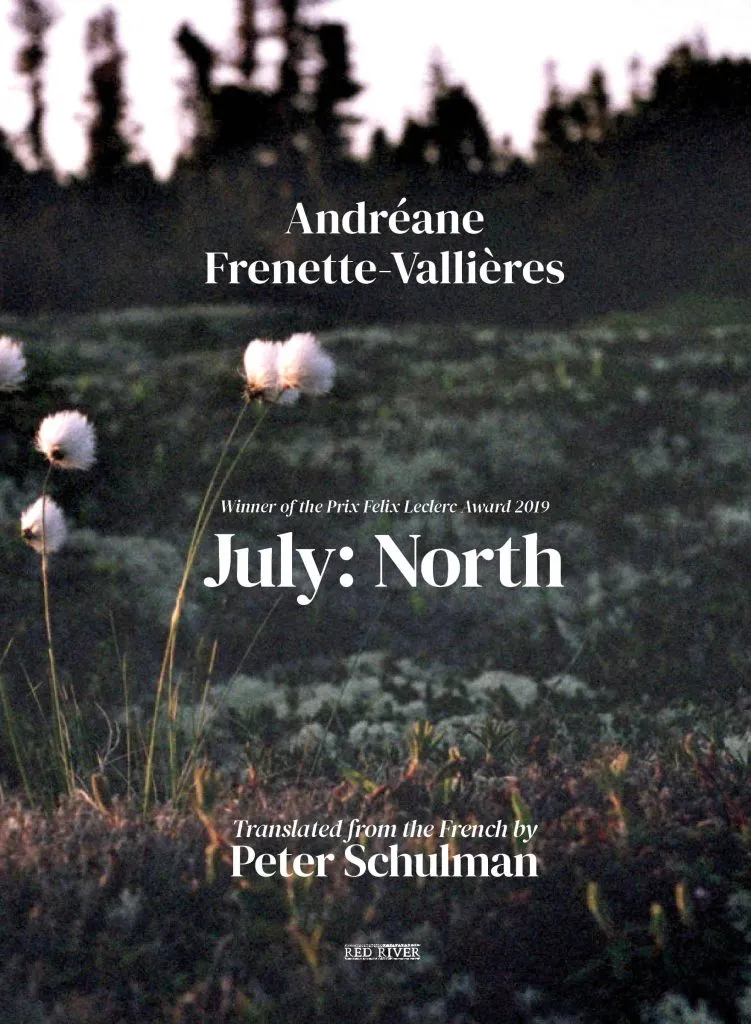
It’s twenty years later, January 2025 to be precise, and I am enjoying a considerably more clement winter in Delhi. I am opening a parcel of newly published poetry books, sent as a Christmas gift from my Indian publisher, Red River. July: North, by Andréane Frenette-Vallieres, translated by Peter Schulman, for all the reasons mentioned above, leaps out at me. From the cover, I see that it has already won the prestigious Prix Felix Leclerc Award (2019) and that Andréane herself has lived in Montreal. Having read the book as a continuous 49 page miniature epic, I want to know more about this testimonial to a summer spent on the North Coast of Québec, in Canada, where it is winter, even in July. In her own poetic preamble, Andréane reflects how through writing July: North,
‘…I reconnect with summer
I gulp the rivers
slide on snow.
In order not to die
I attempt a new type
of laziness
I search for a centre by pedaling
sleeping, drawing.’
It is this ‘search for a centre’ that connects me to the text, this searching in the clouds for auguries of best direction which most attracts me. The spirit of this poem speaks to me from across oceans and corresponds to this, our very own July here in the North Indian Himalayas. I email Andréane my questions in English and she replies in French. In the interview that follows, I translate her answers to the very best of my ability, hoping that I have caught the nuances of her mother tongue.
TT: I begin by asking Andréane about the ‘other’, the ‘drawn’ man the poem addresses, since he reminds me of The Green Man or Nature god of European illustration and sculpture from pre-and Christian eras (and thereafter): an archetype of the wild man with branches and leaves protruding from his mouth and ears (and quite possibly, my Dad). In the interview with her translator at the end of July: North, Andréane discusses how the man who ‘emerges from the branches’ is based on a real person who became a friend: but in a more metaphorical, metaphysical sense, I wonder how much she sees the feminine (and female protagonist’s) quest in July: North as that of rediscovering the Green Man, the Nature Lord, deity of the woods and wild places; the Pan of Ancient Greece and, in an Indian context, the horned deity depicted on seals as far back as 5,000 years ago by the Indus Valley peoples?
A F-V: These questions are necessarily ones that come after writing and reading. However, I do want to contribute to a bigger and collective quest, which is, as you way in the, because I think I write with the intention to capture feelings and landscapes I experience case of this book, a feminine quest. At the time when I wrote Juillet, le Nord, and to this very day, my priority was and is to manifest my creation to its full potential: that is to say, to be earthed in my body and soul, in alignment with my environment. The particular environment that summer was the nature of the North Coast (Canada). My emotional state was one of exile: having been driven from a city which had made me suffer by pressuring me (as a woman) to behave in a certain way, I now found myself in a new place of discovery, uncovering previous unknowns. I chose this new territory for its wild nature and my poetry began to converse with her. Here, I could forget my gender and be only a human living. If the spirit of this new terrain communicated itself to me through my senses, it was through conversation with its people that I could find the words to best describe it. It was in this way that the ‘man in the drawing’ was born. My poems needed to be addressed to a specific being, created by signs I was discovering in this new place…for me, this meeting, in the guise of the poetic, was inevitably a sacred one.
In the course of July: North, Andréane writes of how the ‘northern gannets meet and never leave each other’; Swiftly afterthis statement describing this avian monogamy, the shocking lines:
One night, hundreds of them plunged into the sunset like as many arrows, sank into the black oil, then ascended no longer.
In her post-script interview, Andréane discusses the legacy of forest fire, but I wonder if the lines in this particular verse refer to a specific oil slick? The sea as oil, written in italicsearlier in the book, also implies man-made disaster. I ask Andréane if she can say more abouthuman impact as she experienced it during your months in the North.
A F-V: The sea as oil is an English translation of a French expression which implies that the sea is so calm, not a wave disturbs it. It is also a phrase my friend who inspired the character of the man in the poem used to say often, looking far at the sea, thinking about whether or not the weather was clement enough to take his little boat out at the end of the day.
(‘Flat as a millpond,’ I say to myself as I read Andréane’s answer)
A F-V: The surface of the water, almost mirror-like, has the appearance of a sea of oil, reflecting the colours of the sky. In the English translation, we can see a connection between the human-caused environmental catastrophe and this phrase. The forest fires in the region of my poem’s geography, which happened in 2013, left visible traces of the drama. But at the same time, new flowers pushed through, mushrooms and blueberries sprouted and grew. The blackened trees against the bleached stones make a deep and dramatic impression: there is a beauty in destruction, a curious paradox, for of course, no one wishes for this habitat to be destroyed.
For several years now, it has become hotter and hotter in the region. Many villages have no access to a road and can only be reached by boat in the summer, by forest path in winter. But the time of year when the ‘white route’ (the path through the snow which goes through the territory) can be accessed, is for a shorter duration. This is a serious problem for these villages, which become cut off from the rest of the country.
While Peter Schulman (Andréane’s English translator)speaks of her form as having a connection to haiku and musicalcomposition, I wonder if there are any epic poems that Andréane particularly enjoys, or thatinspire her to tell stories too.
A F-V: In Quebec, we inherit a huge tradition of storytelling, through poetry, theatre and song. Many great writers and songwriters have imagined and preserved the memories of époques and characters, both grandiose and humorous, and these have inspired me. The work of Gilles Vigneault, Pierre Perrault and Gabrielle Roy springs to mind. There is a tradition of storytelling in my family and in many Quebecoise families, where the art of recounting a good anecdote is held in high esteem. This aural creation, this collective narrative thread keeps us laughing together, listening together. The story itself may be made of real facts, interpretation and a lot of feelings, it will be a poetic representation of many like-minded tales. In my own writing, I’ve adopted a more resolutely lyrical, melancholic tone, but I adhere to the same method of diving deep into living emotions.
Which brings us neatly to the next point. Andréane writes in her poem of how ‘we yield to erasure.’
As well as reading this line, this part of the story as romantic erasure of self and ego, a dissolution of two beings into one, I also feel this may have a more epic and final implication, as if the human species as a whole is preparing for its own erasure/extinction. Did living so closely to the elements make Andréane aware of the possibility – even probability- of human extinction and the relative insignificance of our physical presence on Planet Earth?
A F-V: I definitely feel there is a distinct possibility of human extinction. At the same time, I think there is also a possibility that humans will cross these centuries of destruction on the proviso that they find ways to adapt accordingly to our constantly changing world. I do not exactly lack hope in humanity, I just have a strong realization of our place in the universe. I find it very calming to think about our relative insignificance even within our own solar system, amongst the planets, stars. Everything we do comes to nothing in the end. Truly, that’s it. This is not to refute that we live in a world of injustice and cruel suffering. I’ve made the choice to interrogate this universe through language, storytelling and poetry.
One of my favourite lines in Andréanes’s work describes how her ‘words are in the service of dreams.’ With this in mind, I decide to revisit the text and count all the nouns in July: North, to work out how many of these are descriptions of something from the natural world and how many man-made or humanly constructed. I find that there are about double (approx 100) the number of ‘nature’ nouns to ‘man-made’ things, while about eight are sitting on the fence: voice, whisper, person, dreams, words, tenderness, age, fat could count as either-or. In my experience of contemporary voices, this is a really unusual poetic feature, as most writers are more influenced than even they themselves are aware by the increasing impingement of technology, urban surroundings and manufactured commodity. I’m intrigued as to whether at any point in her writing of July: North, Andréane had to deliberately delete/erase or recreate vocabulary which posited the action of the epic in too-human a realm; or whether the experience of the characters really was shaped through ‘storm vocabulary’?
A F-V: My response to this question might make you laugh, as it borders on the banal. I didn’t actually make any effort to compose in a ‘natural’ tenor. Nature was just something that surrounded me and that was the reason why I chose this place. I lived in Natashquan, a coastal village of 260 inhabitants that opens on Saint-Lawrence Gulf (which we call the sea). This village has an equally small neighbor 25kms to the west and after that, another even smaller 50kms to the east. There the road ends. We are 1,300kms from Montreal. When it snows in winter, the roads close, the internet and phone lines shut down and sometimes there are power cuts too. We humans are totally isolated. But the birds never stop flying, the tides never cease to ebb and flow, the rain never forgets to fall. All these ‘elemental’ forms of life continue to speak, whatever the weather. To write these poems, all I had to do was look around me and speak from my everyday heart.
Andréane’s answer reminds me of the terrain of my husband’s remote Zanskari village which until four years ago, had no road over the 1,750 foot high Shinku La pass. The first time I visited ‘home’ with him in 2016, we walked for three days up hill and down dale, through fields and across glacial rivers before we reached his village. With this in mind, I ask Andréane how she feels July: North relates to the contemporary Indian ecological and geographic experience. I tell her about how the high Himalayan regions also experience very freezing winters (although possibly not quite so freezing now), living through months of snow and ice, as must the inhabitants of Natashquan.
A F-V: This is such an interesting note on which to end our conversation, since I wrote Juillet, le Nord after returning from a stay in the Himalayas in 2014. Later, in another book You Will Choose the Mountains, I write about how I’d felt the exact same sentiments in the Indian Himalayas of Ladakh and Sikkim and in the Nepali Anapurna Range as when I was in Natashquan. There is the same call to slowness, the same grandeur: both environments represent, quite literarily, the same breath of fresh air, the same antidote to the cacophony of the city, where the seasons are increasingly out of synch and where temperatures are constantly rising. The Himalayas and the NorthCoast of Québec share not only a remote wildness, but also similar threats to their delicate ecological balance, human activity being the greatest threat of all. How can we protect the treasures of our planet while continuing to destroy them? By now, the damage is practically irreversible. Yet I continue to feel that these remote expanses of semi-wilderness also teach us how to be better human beings. We learn from their austerity, learn to evolve.