
The 25th of November 2024 dawns like any other Monday.
At a quarter to eight, Mr Thomas, puffing past the gate on a second stately circuit, notes with rising irritation that the mob awaiting the school bus is more dishevelled than usual. Next to their offspring so spruced and sleek, the parents in their crumpled slouch seem enroute to the bathroom. They are dressed in what Mr Thomas calls pyjamas, unlike the athletic young men and women who whiz past him in lurid versions of underwear.
In Mr Thomas’s vision of Hell, its denizens burn enrobed in athleisure. Mr Thomas will present himself immaculate in a white bush shirt and grey trousers at the Pearly Gates, when the time comes. But it is a long way off yet, he’s made sure of that. His blood pressure is perfect, his blood sugar commendable and he walks the prescribed 3,000 steps every day. No man can do more at seventy-four. He would prefer to walk half an hour earlier, but that’s the dangerous hour when grandparents infested with pink backpacks and dinosaur water-bottles coax, bribe or scold sleepy, sulky inconsolable kids into the school bus, and then hold up traffic, waving madly from the middle of the road, till the bus rounds the corner.
Were he to walk half an hour later there would be the depressing spectacle of the elderly put out to sun themselves on benches and water tanks until it is feeding time again.
But now, at a quarter to eight, beginning his third and final circumambulation, Mr Thomas is confident of another fifteen minutes of peace.
Yet something nags for attention.
He checks his pockets: phone, keys, fifty buck note for bananas.
No, it is something else.
Somebody is tapping on metal. He turns, but quickly irons out his frown.
It is old Mrs Figueredo, tapping on the veranda railing to get his attention.
Mr Thomas stops, encouragingly. He loathes her, with all the venom the ageing hoard towards the really old. But he doesn’t want to jeopardise the felicitation of Nalanda’s first centenarian planned for next week.
At the first cry of ‘Speech!’ whom else can Nalanda turn to, but orotund Mr Thomas?
With swelling chest, he begins in imagination: Friends! Nalandans All! Brothers, Sisters, and my dear children.
But he has missed Mrs Figueredo’s words. He smiles, radioactive with a benevolence that irritates Mrs Figueredo. Her face leaps out of her wrinkles. In angry focus, surprisingly youthful. ‘Tell her it is important, will you?’
‘Tell whom?’ Mr Thomas tilts his head, waggishly twiddling his eyebrows. The old, no matter how silly, must be humoured.
‘Gone deaf in your old age or wot?’ snaps Mrs Figueredo.
Mr Thomas draws back indignantly and Mrs Figueredo cackles. ‘And you just a baby! How old are you? Eighty?’
Eighty? The nerve of it!
‘Seventy,’ Mr Thomas avers with quiet dignity.
‘Pah. Till your collar. Seventy-five, if a day. But never mind that. Tell Molly it is important.’
‘What’s important?’
‘God give me patience! Tell your Molly to call me the minute you get home.’
‘Why don’t you call her yourself?’
‘Because.’
‘I see.’ Mr Thomas has a sudden vision of Francis the Spy confiscating his mother’s phone. Moved to kindness, he assures her he will ensure that Molly calls her directly.
‘Bless you, dear boy. May the Lord forgive your sins. Easily done, I suppose, eh?’
Mr Thomas permits himself a smug smile.
‘Seek it.’
‘Seek what?’
‘Forgiveness,’ says Mrs Figueredo. ‘Today of all days.’
Mad, of course. Alzheimer’s.
What else can you expect at 99 going on 100?
But Mr Thomas, speeding towards Molly, is distracted by the sight of a crowd outside Salman’s Bakery. He wonders what’s keeping them there, shuffling with impatience for the shutter to open. Then he sees the notice on the blackboard:
Anniversary discount
50% off between 9 am and 12 noon on all Biscuits and Bakes.
‘Whose Anniversary?’ he asks Nitin Pai who is hurrying past, eco-friendly bag in hand.
Nitin shrugs. He is not a man of much conversation. That he leaves to his wife.
Mr Thomas lets him go. The Pais, still shy of fifty, have three grandchildren. All clamouring, no doubt, even at this early hour, for Biscuits and Bakes.
But when Mr Thomas gets home, all thought of Mrs Figueredo’s message is erased by the news.
Alexander has had a heart attack. Alexander! A mere boy!
Mr Thomas crumples into a chair, clammy and uncomprehending, as his wife tells him Molly has left already for the hospital. Bombay Hospital.
‘Why Bombay Hospital?’ Mr Thomas has recovered the usual irritation he feels at the mention of his brother. ‘Why not some place close by?’
‘It is close by.’ His wife is puzzled. ‘They live five minutes away.’
‘Why?’ roars Mr Thomas. ‘Why does he live there? Why not some place close by? How does he expect me to get there in time?’
‘She said —’
‘DON’T MENTION HER NAME!’ thunders Mr Thomas, for undependable Alexander has married again.
‘I did not mention her name,’ Mrs Thomas retorts. ‘Stop blaming her for everything.’
‘Why shouldn’t I? What do you think brought on his heart attack?’
‘What?’
‘What?’ Mr Thomas is furious. Has the woman no imagination?
‘Don’t be silly. Not at their age.’
It is beneath Mr Thomas’ dignity to argue that point. He simply slumps back into gloom.
A thought shapes up, unwillingly in words: Somewhere out there, Alexander is dying. What is he doing here?
‘I better hurry,’ he mumbles, making no effort to move.
‘Molly will phone as soon as she gets there.’
There is at the other end of the town.
Somehow, he waits out the hour.
The phone rings.
‘He’s is in the ICU,’ Molly says. ‘It is bad but not hopeless.’
‘I’ll ring for an Uber,’ Mrs Thomas says.
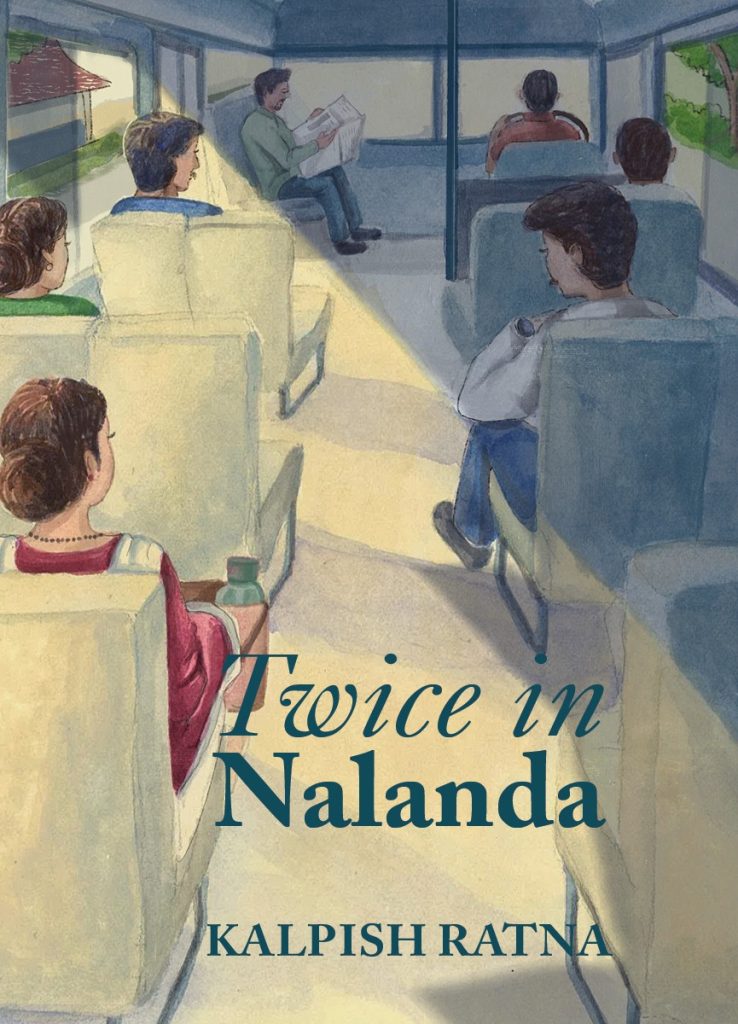
But Mr Thomas remembers, just in time, that he can take the bus.
Excerpted with permission from Twice in Nalanda by Kalpish Ratna published by Red River 2026