
Usawa Literary Review is headquartered in Mumbai, India.
PIN Code: 400050
Interested in working or collaborating with us?
Contact Us

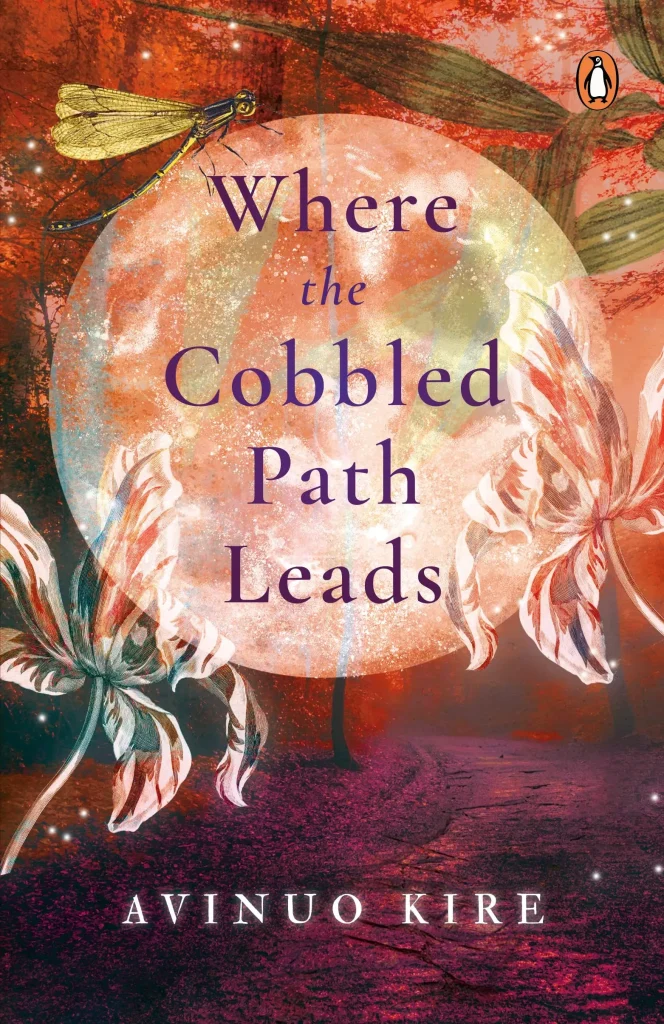
Where the Cobbled Path Leads

By Avinuo Kire


Where the Cobbled Path Leads is a folk fantasy novel, interweaving fantasy fiction with Naga spirit stories and folklore. Eleven-year-old Vime is struggling to come to terms with the demise of her beloved mother. She has a special place she frequents-a cobbled footpath near her house which leads to a forest. On the day of her mother's death anniversary, not wanting to return home, Vime follows the cobbled footpath all the way to the deep end of the woods and discovers that the trail leads to a magnificent tree. She falls asleep under it only to wake up and find that the footpath has disappeared. Tei, a forest spirit, helps her relocate the missing pathway. Vime is soon to discover that this tree is no ordinary tree. It is a portal between the human and spirit world, and Vime keeps finding her way back to it. Distressed that her father might remarry, she decides to leave her earthly life and join her mother in the spiritual world. As she travels to, from and through these realms, she understands what it is to embrace and survive grief, and what it means to surrender herself to these old spirits, not all of whom are good.

Avinuo Kire in Conversation with Namrata Pathak

The conversation critically examines how decoloniality challenges established Anglophone literary norms by centering indigenous trauma, linguistic identity, and child perspectives.

NP: Where the Cobbled Path Leads tells a story from an eleven years’ old child, Vime’s perspectives who is struggling to come to terms with the demise of her beloved mother. What is the prime reason behind choosing a child protagonist?

AK: I find it liberating as well as eye opening, telling a story through a child’s worldview. Children are untouched by prejudice and free from any sense of biasness that adults carry, and so their observations are their own- fresh, original and objective. Vime, the protagonist in my novel is 11 years old. I felt that perhaps 11 years seemed ideal- a threshold age when a child still retains the purity and innocence of childhood but can also be incredibly wise.

NP: There is an interesting linguistic play in the novel which comes from the use of Tenyidie words in the book. These words are scattered across the novel, but their meanings are not explained in footnotes, nor they are italicised. This creates a polyphonic blend, a cultural and linguistic mix, an amalgamation that is special and unique. What is the intention behind this act?

AK: Thank you for noticing this.

I think the greatest challenge of a non English writer writing in English is to seek and assert one’s own identity. An effective way to do this is by infusing local inflections and native colourings while narrating the story or creating dialogue and so in this particular book, led to the incorporation of Tenyidie, my native dialect. While going through the manuscript with my editor, I requested that the Tenyidie words should not be italicized because I wanted to allow the words to blend into the overall narration as opposed to being conspicuous italics. As for footnotes, I feel that unless absolutely essential, they are better done away with. I think we should not underestimate readers and that as long as the reader is engaged, he or she should be able to follow the story without unnecessary interruptions in the guise of footnotes or italics. These may seem little things perhaps but I think it helps to retain authenticity and are instrumental in creating a voice that is the writer’s own.

NP: In the subterranean layer, the novel runs a narrative of loss and hurt, violence and conflict at multiple levels in a Naga society. The Naga life, plump with rites and rituals, mores and values, cuisines and food habits—we come across the everyday life, the daily ongoing in a Naga household. Is there a motive to make the political personal?

AK: There wasn’t a conscious motive as such. But I do believe that the personal is political. I think we restrict politics when we confine it to an ideology, a creed or movement- It is of course, all these things but most importantly, politics is about people and at its core lies the personal. For an indigenous writer with an oral history, writing, more often than not, becomes a complex exercise as whether consciously or otherwise, we are blending the personal and political, individual as well community, private and shared experience.

NP: Coming to the deft switching of reality in your debut novel or rather the novel being a place where alternate realities jostle together, how did you infuse an indigenous Naga tale with an universal appeal, the local with the global?

AK: While writing this story, I drew much inspiration from my roots- particularly our folklore, myths, history, also nature and contemporary life, my everyday reality. Conflict also forms a backdrop to the story. In this sense, it is very much an indigenous Naga tale which places the Naga hills in the centre of the world. However, although the root of the story remains indigenous, the larger story is universal, one of love, loss and hope, about transformation. Ultimately, it is about the human experience. And so I would like to believe that this is a local tale with universal relativity.

NP: What are the advantages and pitfalls of writing from/about the North East of India? As writers, where does this tag of identity take us?

AK: I think an obvious advantage is our our huge repository of folklore, myths and legends to draw inspiration from. It’s wonderful that writings from the North East is fast evolving and is now recognized as an important sub genre of Indian literature. Our history, politics, culture and traditions, worldviews- our experiences are distinct from the rest of the country and hence, so are our concerns. This is powerfully reflected in our literature. At the same time, always confining our writings to the site of production, as writings from the North East, can also hold us back sometimes. Also, not every writer from the NE writes in a manner typically characteristic of writings from the region. I think this is quite marvelous.

NP: How would you define the process of writing? Can it be labeled as a craft that is meditative, strenuous, frustrating at times, fulfilling at times, epiphanic? Tell us more about your resplendent way with words, how do you mould and chisel them, colour them with your subjective moorings?

AK: You’ve defined it so very well. Writing is indeed all of the things you mentioned. As for my writing process, I really don’t have one. It’s actually quite a boring answer in that the process begins and ends with writing, with endless editing in between.

Looking for more Books?

Browse the Bookshelf →

Review: Where the Cobbled Path Leads

Avinuo Kire’s narrative transcends conventional grief by blurring reality's borders with Naga spirit lore, radically reconfiguring agency and self-actualization amidst historical margins.

Avinuo Kire’s Where the Cobbled Path Leads is anchored in a familiar terrain, Nagaland, a place that bore bruises and scars of a violent history. A landlocked state in the North East of India, Nagaland is mostly known for insurgency and allied counter insurgency movements, internecine warfare and ethnic conflicts that slowly creep into the writings that are produced here either knowingly or in a subconscious way. From Zapu Phizo’s radical ideas of statehood, the political assertions of Naga National Council to the imposition of the Armed Forces Special Powers Act in 1958, Nagaland saw turbulent transitions of varied kinds. With the enactment of the State of Nagaland Act in 1962 in the parliament of India and the subsequent dissolving of the interim body on 30th November 1963, the state of Nagaland was formed on 1st December 1963. In 1963 Nagaland got an independent identity and Kohima was declared as the state capital. The chequered political history of the land ridden with episodes of violence, ceasefires, negotiations at multiple levels are revisited by writers like Temsula Ao, Easterine Kire, Monalisa Changkija and Nini Lungalung in their powerful verses and stories. When I picked up Avinuo Kire’s debut novel, Where the Cobbled Path Leads, given the novel’s site of production, Nagaland I anticipated a retaliatory vein, the resistance of a patch of land called the periphery that was immersed in somber darkness and gory genocides for a while. I looked for the victim’s anguished cry, the sound and fury of a writer whose pen seeks to set right the untoward sagas of the past. I was, however, pleasantly surprised. Avinuo Kire not only gave us an incisive slice of contemporary Naga life, plump and ripe in its varied manifestations, but she also created an alchemy of a different kind by interweaving multiple life worlds and biospheres with Naga spirit tales and folklore. In the novel, the human and the non human meet to create a space of shared love and grief. The unknown dimension, call it a magical world of the spirits and other worldly creatures, gives a robust metaphorical potential to the narrative by expanding and building an interesting discourse of ‘what is sought beyond the ‘real’, the accepted and the normative’. Kire uncovers a vista of surprising encounters and discoveries by adding layers to perceptive reality. Not that the concept of ‘reality’ is in a tailspin and requires a thorough interrogation, but she successfully installs alternative window views in the novel through which we as readers could partake of a new way of life, a life lived in all its shades and exuberance. The fact that she took us to the other side of the known, seen and heard, made us ponder on the viability of blind, one-sided generalizing statements of life, on the efficacy of truths. Is not every moment a construct, not an ossified finality, but a cobbled path that sets us on a wandering journey into the edges of the forest? The vagabond soul walks past vales and dales, riverine villages, the misty hills resting on the panoramic sky, the bushes skirting the lonely path— to seek what nourishment, to excavate what treasure trove? What are these wily, elusive ways of losing ourselves and finding ourselves?

The cobbled path that the eleven year old child protagonist Vime takes symbolically segments the journey of life into— initiation, mobility, detour and the final destination, roughly the moment of self actualization. The child, Vime who was unable to come to terms with her mother’s untimely death, is seen to frequent a cobbled path near her house which leads to a forest. Her trails one day led her to a magnificent tree at the heart of a forest. She made this unusual discovery on a special day, on her mother’s death anniversary when grief-ridden, the little girl set on a hunt for a less crowded, solitary spot just to tend to her broken heart. There she met Tei, a forest spirit, who, to Vime’s chagrin, does not fall under the confines of any gender. Tei is gender fluid, is neither masculine nor feminine. Vime’s subsequent disenchantment with her relatives and friends, her life in general after her mother’s departure, made her take an abrupt decision. She wanted to join her mother in the world of the spirits, primarily propelled by the fear that her father might remarry and her life would spiral down into a pit of uncertainties.

The resplendent tree with jutted out branches, a canopy of green foliages, and sturdy roots has a name, Kijubode. It is a recurrent image in Avinuo Kire’s Where the Cobbled Path Leads. Vime trips upon a stray tree root, falls down just to be cushioned in “a nest of vines at the foot of the tree”. Posited at the interstices between the human and spirit world, the tree serves as a portal, an entry point to other dimensions. Vime’s desires become coterminous with the tree, be it a constant craving to shun the fatal and morbid closures of life or to create a special communion with the world of the spirits, however inhabited by both good and bad entities. Interestingly, the tree creates an organic grammar of transgression as it blurs the borders between internal and external spaces, physical terrains and mental landscapes. The question is, what happens when one chooses to get out of the traps of a world that all the time pushes its limits? A conjunction of reality and fantasy, the tree opens up a non-restrictive, ever proliferating space, more inward than outward, for Vime to discover herself.

Vime’s decision to leave her earthly life to join her mother in the other world incurs new understandings and awakenings. A traveler in time, Vime enters and exits many labyrinthine realms in search of a moment of exactitude and clarity. This ostensible reformulation of her identity as an enunciator and trespasser makes her a self-aware author of her own life. Her passage into a different category of social membership is embodied in radical shifts in the narrative, which further installs interesting frameworks in the text.

Vime’s failure to adhere to the dichotomy of reality and utopia gives birth to a heady concoction of both. This spurs us to question the rationale behind categorization and systemic rigidity of boundaries of all kinds. Like Vime, Avinuo Kire plays with the taxonomies of existence, of order of things. There is a penchant for splicing up the strict patterns of life. Hence, the potent evocation of the cobbled path in the novel to which Vime always turns to. The path is a palpable freeway to the spectacle of nature, to an unbound space of communion and shared nourishment. However, with it we come across the genesis of a new Vime who finally accepts life as it is, with its sieved light, bitter sorrows, afflictions coupled with the woes of losing a dear one and the scares that death leaves behind. In the concluding part of the novel, a resourceful Vime acknowledges her role as a self-aware member of the place and community. The novel captures Vime’s growth through love and loss, grief and joy and most importantly, it maps the vitality of change and transformation that myriad phases of life demand, also, a willingness to embrace life in its totality.

Looking for more Books?

Browse the Bookshelf →
Back to Issue

Support Our Work

If you enjoy our content, consider supporting us.

Support Us

We are an unfunded, independent feminist publication. We need your support to continue our work.