
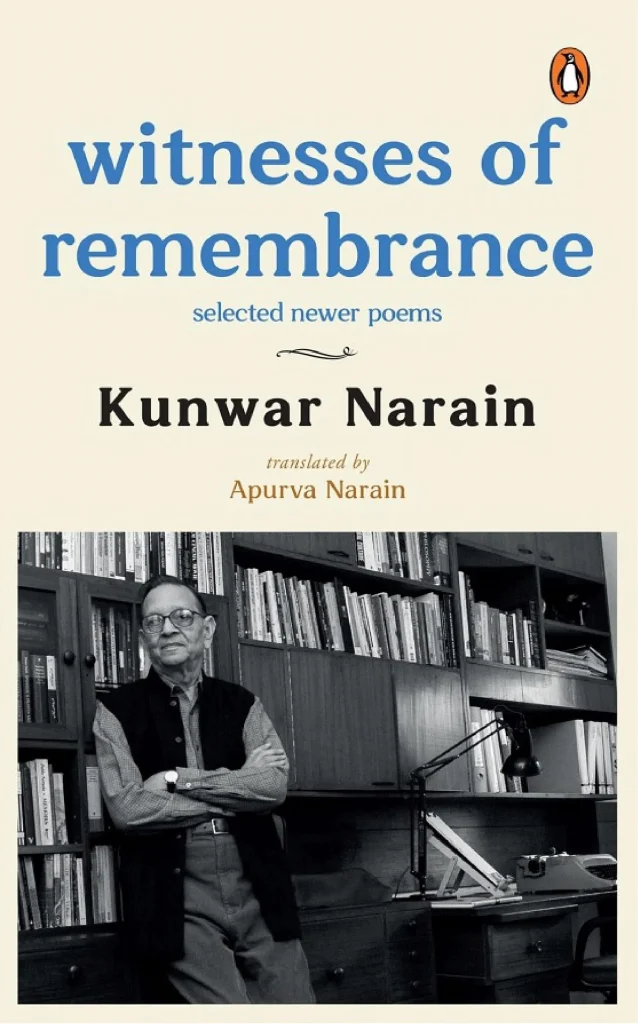
The poems in the collection, Witnesses of Remembrance, take a hard look at the primeval question of what it means to survive in a co-inhabited world. Carefully chosen by his son Apurva Narain, this bilingual edition comprising almost 100 poems, presents a rich collection of prescient poems, hinting towards Kunwar Narain’s poetic prowess—his ability to compress expansive worlds.
Succeeding No Other World: Selected Poems, Kunwar Narain’s first book-length collection of translated poems, which was launched in 2008 by Rupa Publications in India, and subsequently by Arc Publications in 2010 in the UK, the book under the review, gives an easy passage into the diverse themes that impacted Kunwar Narain’s poetic persona. Moreover, as also pointed in the Foreword, one observes the influence of age and deepening maturity—his poems getting smaller and simpler—laying bare the ‘truths’ without any embellishments.
Straddling the world of imagination, the poems are divided into 8 sections—each beginning with a picture of his personal commodity and an excerpt of his poem. However, despite the dreamlike quality of these poems, they skillfully merge personal with the political. The realization that poetry should reflect the eccentricity of the modern world and, thus, act as an antidote to it—contrary to the romantic lens of Chhayavad poets—can be easily understood by one of the often-quoted lines from one of his poems in the collection, “I reached this world a little late.”
Kunwar Narain often humanizes the natural world, where trees and birds and even buildings can be heard talking to us of their pleasures and pains, highlighting the concept of ‘Vasudhaiv Kutumbakam’, while also sensitizing the reader about the destruction of the ecosystem in the most organic way.
Fond of journeys, this collection has poems that are referenced to the various places Narain visited. Quite a few poems are influenced by artists and poets whose work inspired him including Brecht, Cavafy, and Muktibodh.
Love and mortality, the two forces feeding into any writer’s creative process, guide even Kunwar Narain. Most of these poems concentrated in the latter part of the book are mostly visceral, yet maintain that peaceful tender quality of his voice. The collection, with an erudite translation by his son, Apurva Narain, in most parts, does justice to these poems.
Kunwar Narain writes clearly, so the poems might also look superficial to an amateur reader, but if one spends enough time with these almost prophetic poems, these poems written at least four to five decades earlier, are windows to the despotic, dystopian world we are living in.
The book also features the last poem by Kunwar Narain that he asked somebody to write for him because of his failing eyesight, which will always haunt me, not only because of Kunwar Narain’s commitment to the form, but because it is a compelling reminder that the person might die, but the poet—and his enthralling, haunting and deceptive worlds—continue to exist.
Some poems from the collection:
Postscript: So Close to Me
Time is short, and still
I wish to live with you
for a few days
and thus attach a sub-world
to this narrative of life
Like a rare interlude
suddenly remembered, postscript:
In the August days
a sojourn to the hills,
in the hushed pitter-patter of rain
by a half-forgotten lake
in some nameless retreat,
I wish to beguile
the remaining days of this ending epoch;
to bathe in your musky fragrance
to live in complete captivation
of something intoxicating
and even more exhilarating
than the first love in life…
Oh, why has this tiny patch of sunlight
that was about to leave the room
now suddenly moved
so close to me
Before Getting Drenched in the Rain
I met her
not in a poem of mine
but in a story
and not in the beginning either,
but somewhere in the middle
of an ordinary homely story, suddenly…
By then half her beauty had ebbed
and the remainder of her life
had been registered like land
in the name of her family.
The two of us, hand in hand,
were descending down
a craggy, roundabout mountain slope
From summit to sky
dense caliginous clouds impatient to rain
had hemmed in the limits of flight.
Before getting drenched in the rain
she was in a hurry to return home.
The Pandemic of Numbers
He once began to vomit up numbers
uncontrollably, counting,
when the toll began to cross millions
he slipped into a coma, then
woke up in a hospital where blood was
being transfused, oxygen was being given…
that he screamed out—
Doctor, I’m bursting with laughter,
this is laughing gas, not life-saving gas,
you can’t compel me to laugh
in this country, all have a birthright
to live in remorse, else what’s the meaning
of our freedom, democracy, republic…
Don’t talk, said the nurse, you’re weak,
it was a feat to control your blood pressure,
the doctor explained—this virus of numbers
is unfurling like wildfire these days,
it affects the brain straightaway,
you’re fortunate to have been saved,
anything could’ve happened to you.
Delirium, and you would’ve gone on blathering,
or paralysis, and you could’ve ceased
talking forever,
any vein in your head could’ve ruptured
under pressure from such a titanic count:
we’re passing through friable times,
excitement over data can be fatal,
no medicine works on it. Stay calm,
if you’re saved, you’d be one in a million…
Suddenly he felt
the doctor’s face had transformed
into a red alert, warning
against some imminent danger.
And he, lacerated by numbers,
was screaming away—we are
people even now, not numbers…