
Excerpt: CogVerse
College air thick with forbidden knowledge. Scene books mask pulsing landscapes. Shame…
Read more →Voices rise like hell-broth, poetry bubbles: witches gather in the Covid-shadow, words weaving science and well-being. Fear of women unbound, defiant against
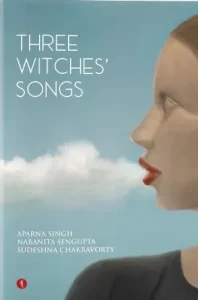
FOREWORD
Women talking, women together, women voicing their observations — one can safely say that from time immemorial it all has been frowned upon by a society that is largely patriarchal. Khana had her tongue slashed for correctly predicting the weather much before meteorology became a science. Akka Mahadevi and Lal Ded were viewed with reservation and thought to be ‘mad’. Andal was an aberration in her times. Meera Bai was simply not an honourable woman for claiming Krishna to be her lover. Imagine then what happens when women call themselves witches and come together to speak — in poetry. We know how quick one would be, as an uninformed individual, to categorise these women as given to diabolism, or Satanism, or what is commonly called magic and witchcraft. While the truth perhaps is that women were exploring science, society, and their own and others’ well-being via logic and language since centuries.This is why in this book, where three women gather to discuss life and loves, especially in the shadow of Covid-19 pandemic, they call themselves witches and make their voices heard.
Patriarchy has created this fear of women where ‘witches’ historically are located as errant women pitted against the controlling male. Theology was used to keep the divide — women being on the dark side, in the realm of the absurd and often demoniac, and hence, as the gendered evil enemy of God. While the latter bit has been documented well in the West — theology, morality texts, demonology, etc. — the Indian society too, particularly in the modern times, has deemed the very notion of ‘witches’ as moral disruptors and a challenge to the feudal Brahmanical structure in place. The spirit of the oppressive Malleus Maleficarum therefore, existed among us for long: women unsupervised are undisciplined, requiring trial and penalty, and so on and so forth. Women are goddess, women are Hidimba, women are also the repository of mysteries such as childbirth, agriculture, cooking, and foresight — all of them change agents. For the male partner stricken with awe and fear, women talking mostly means
“…a charm of powerful trouble,
Like a hell-broth boil and bubble.”
The three witches in this delightful book of ditties — for these verses are rhymes and songs that flow freely — remind us of what was bountiful before the pandemic struck and what is lost, and yet to be gained back. They talk of bodies, transgression, and the creative lockdown that has been a woman’s experience almost exclusively down the ages. To listen to them is liberating.
It is a world now where “Birds — still there —”, beats gently yet persistently as a reminder. The articulation, “To read or to unread” is what drives our intellect, the witches chant. Kali, Eve, and the Wife are there to alert the reader that it is not a novel sickness or plague, but the stricken human mind that has long wronged the woman.
We might chuckle at what Arthur Miller had written in The Crucible — “Until an hour before the Devil fell, God thought him beautiful in Heaven” We will turn it around from the androcentric tales we’ve been reading — our beautiful devils, our talking, chatting women are in fact the architects of a heaven, saving it from falling apart.

Nabina Das is a poet and writer based in Hyderabad. Her very recent poetry collection is titled Anima and the Narrative Limits (Yoda Press, 2022). Her other poetry volumes are Sanskarnama (Red River, 2017), Into the Migrant City (Writers Workshop, 2013), and Blue Vessel (Les Editions du Zaporogue, 2012). Her debut book is a novel titled Footprints in the Bajra (Cedar Books, 2010), and her short fiction volume is titled The House of Twining Roses: Stories of the Mapped and the Unmapped (LiFi Publications, 2014). Her first book of translations titled Arise out of the Lock: 50 Bangladeshi Women Poets in English (curated by Alam Khorshed, Chittagong) appeared in early 2022 from Balestier Press, UK. A Rutgers-Camden MFA alumna, Nabina is the editor of WITNESS, The Red River Book of Poetry of Dissent (Red River, 2021), and co-editor of 40 under 40, an Anthology of Post-globalisation Poetry (Poetrywala, 2016).