
Excerpt: The Seven Queens: Sindhi Folktales Retold in English Verse
Sindhi verses echo, tales of seven queens. A king's heart chooses Noori,…
Read more →There must be fire in the language and music in the words." Menka Shivdasani on the poet who lived exactly by that credo
My first encounter with Keki Daruwalla, whom I had heard of as the ‘policeman-poet’, was when he wrote asking me to send him a poem for an anthology he was editing. I was still a teenager, and this was thrilling. Though I knew a few poets thanks to Nissim Ezekiel, I had not yet had the pleasure of meeting Keki, who wrote some marvellous poetry despite the pressures of his job in the Indian Police Service (IPS).
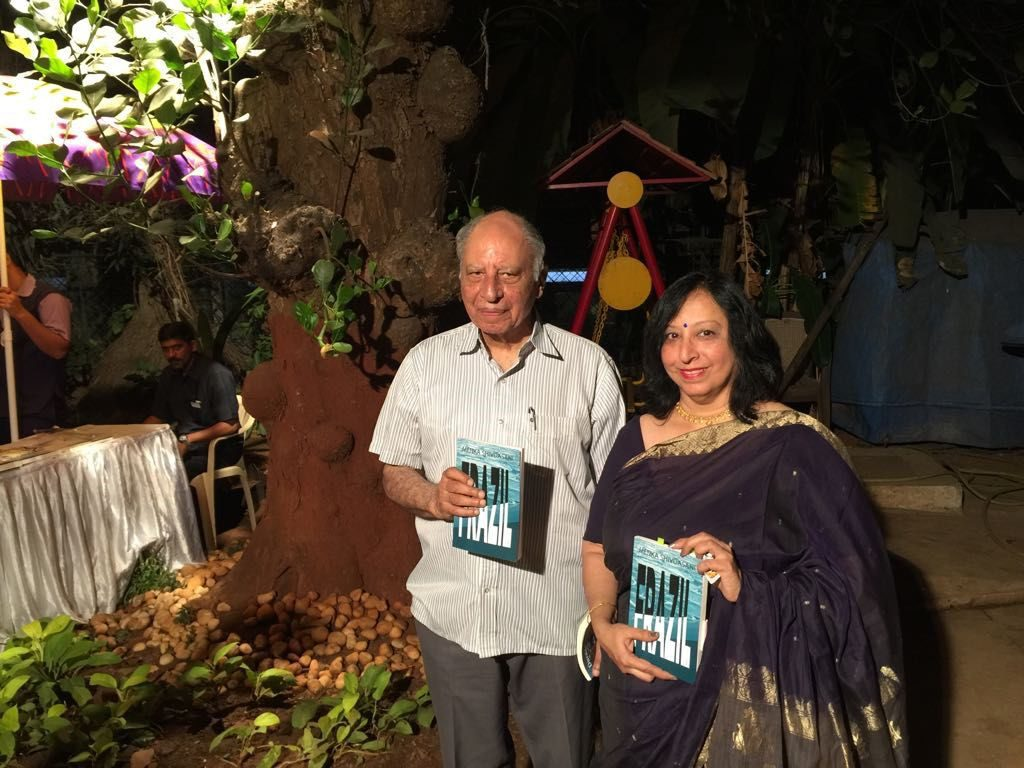
When Keki and I met at a conference some years later, two things stayed with me. The first was that he was a thorough gentleman, offering to help me with my bags. The second was the way he read a book on the flight – brows furrowed, pencil in hand, notes in the margins. “Will you be reviewing it?” I asked, and he said: “No, but I always read every book as though I will be doing so.” Keki could be a formidable critic, and I remember thinking – Gosh, I hope he never reads any of my work in this way! As it happened, in 2017, I did ask him to write a blurb for my book Frazil, and he wrote some wonderful words. The fact that he launched it at the Kala Ghoda Arts Festival made it doubly special.
There was another conference a few years later, in which he was Keynote speaker. The organisers provided accommodation in a boys’ hostel, telling us jocularly that we would be reliving our college days. As the senior-most poet, Keki was given the largest room while the rest of us shared smaller rooms with the filthiest toilets we had ever seen. We joked – though some of us meant it – that we should head for the nearest market for cleaning supplies and do the job ourselves. When Keki learned how bad our rooms were, he was furious. He first gave the organisers a piece of his mind for putting up women in such dirty facilities; then he fired us for keeping quiet about it. When we said it would have been rude to say anything, he disagreed. “The organisers should know so that it doesn’t happen again,” he declared.
My most heartwarming experience was when Keki learned I was visiting Delhi for an award function and offered to organise a reading for me at his home. “I have four bottles of wine,” he repeatedly said, and being a generous host, was disappointed that there was some left at the end of the evening. It was a heady gathering, warm and convivial. I had asked him to turn it into an adda, rather than a reading just for me, so we had poetry by stellar poets such as Savita Singh and Mangalesh Dabral; in those pre-COVID times, I could not have imagined it would be the last time I would see Mangalesh. Keki’s reading, of course, was the highlight, as it usually is.
When we met in April 2022 at poet and editor Bina Sarkar Ellias’ home in Mumbai, I was appalled to find him losing his balance when I hugged him. “I’ve become a little frail now,” he remarked, and I responded, “Your voice is as powerful as ever.” In his 80s, Keki is still amazingly prolific, and that evening he read from an upcoming collection.
This is a man from whom I have a lot to learn. While Keki’s enormous talent is his alone, here is someone who wears his achievements lightly. Always modest despite his many prestigious awards and innumerable books, Keki Daruwalla is a writer who speaks up against injustice, and often does it with humour or biting satire. He also tries his hand at different genres, including dramatic verse and novels, which I find truly inspiring.
Though I have never asked him for feedback on specific poems – as I used to do with Nissim Ezekiel – something he said back in October 2008 has always been a guiding light. Speaking in New Delhi at the Asia-Pacific Festival of Writing – he said: “Poetry should not become only a political instrument even if you are fighting for a cause. There must be fire in the language and music in the words.”
Keki Daruwalla, who would have had a ringside view of the political world as Secretary and Chairman, JIC (Joint Intelligence Committee), is someone who combines these effortlessly. He is a true poet and, for all his fire, one of the gentlest people I have ever met. Knowing him has been an honor.
Excerpt from A House of Words edited by Usha Akella, published by Sahitya Akademi
Menka Shivdasani is the author of four collections of poetry, with her most recent being Frazil (1980 – 2017). She has edited two anthologies of contemporary Indian poetry for the American e-zine www.bigbridge.org, and an anthology of women’s writing, If the Roof Leaks, Let it Leak (SPARROW). She is co-translator of Freedom and Fissures, an anthology of Sindhi Partition poetry (Sahitya Akademi). She has been conducting a four-day poetry festival in Mumbai for the global movement 100 Thousand Poets for Change since 2012, and in 1986, she had played a key role in founding the Poetry Circle in Mumbai. Her work as a journalist includes 14 books as co-author/ editor.