
In Memoriam — Jayanta Mahapatra: A Life in Photographs
Before the words, there was the man. This collection of photographs from…
Read more →He travelled in a general compartment with no reservation and no plan — just a book of poems and the need to meet the man who wrote them. What followed was a lifelong apprenticeship in poetry and tenderness
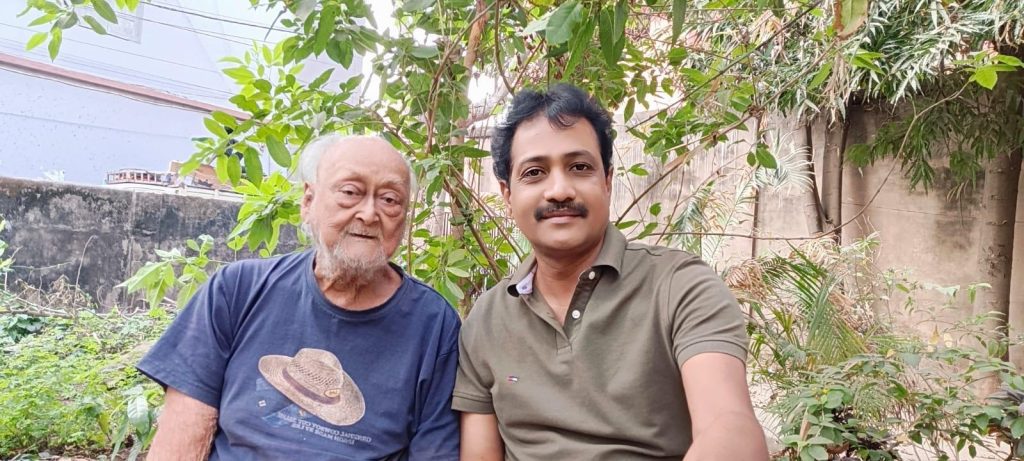
I last met Jayanta uncle in June this year. Then his last words were, “please do not take pains to come all the way. I may not recover this time.” A tragic self prediction, isn’t it? Actually I planned to celebrate his birthday (October 22) at his home in Cuttack this time. But “our thoughts are ours, there ends none of our own” (Hamlet).
I first met Jayanta in January 2006. In the infant years of my writing, one morning while browsing for new poetry arrivals at a bookstall in Vijayawada, I bumped into an arresting title A Whiteness of Bone and read a poem “All the Poetry there is”. The images and metaphors were brilliant, alluring and cryptic that I was so tempted to buy the book and finished a few of them that evening. They were exactly the kind of poems I dreamt of writing but failed. I heard his name but never read him seriously before except for a mechanical academic reading. I passionately fell in love with his poetry. The next morning I started off to Cuttack to meet him. I didn’t know in fact why I was going at all but just wanted to see him. I didn’t even have any reservation;
I travelled in the general compartment. I reached Cuttack and boarded an auto rickshaw to Tinkonia Bagicha. That was where he lived. I saw his address on the book I bought. When the auto rickshaw was nearing, my heart started to pound with awe imagining my meeting of the great poet. When I was wondering what to speak with him fear gripped me. I didn’t know anything about him or his poetry. I reached his home. Beside one of the huge gates was inscribed Chandrabagha on a marble plaque but when I later asked whether it was the name of the journal he runs, he said he meant the river.
Entering the compound I saw the culms of huge bamboo that reminded the lines “…carry the silent air in the bamboos / to the roots of our small cries” from his A Whiteness of Bone. There was a beautiful garden in the compound with a concrete bench in the middle where Jayanta used to sit to enjoy the solitude. On the entrance door a beautiful golden yellow rice sheaf was hung. It evoked the image of rice which was like a motif in his poetry.
When I reached the door, his wife Mrs Runu Mahapatra received me. I joined my hands and said I came to meet Mr Jayanta Mahapatra. She said he went out for groceries and would be back in a while and showed me a chair. He came after a while; stood in the door staring at me in a surprise wondering who I was. In a little stammering voice I said “I came from Vijayawada to see you.” He asked what brought me. I said I read A Whiteness of Bone and fell in love with his poetry. And he asked “What can I do for you?” I didn’t really know what to answer and I knew I was neither intellectually nor creatively matured enough to speak anything about poetry.
And both laughed affectionately at my innocence. Then I told him I too wrote a few poems and asked him whether I could show. Smiling, he asked just one which I thought was my best. I didn’t even know which one was my “best” but gave one. He read and asked for one more. I gave. Then what he said had just unsettled me with a shattering blow; collapsed my castle of cards. He said, “Sreekanth! Try to write some poetry.” Pale-faced and with a broken smile I nodded “Yes Uncle.” He asked me, “do you have some pain in your life?” I said “yes.”
Then he told, “poetry should never drag you further into grief; do not burden poetry with all your grief. Poetry should more be a source of healing from grief with a sort of catharsis, must squeeze the grief off the heart, but should not pull further into it.”
Then what he did to me the next moment transformed my writing, thinking and even reading. He asked me to sit on the floor (divan bedding) and rewrite my 40-line poem by compressing it in its size without spoiling the meaning and said, “You came from very far, you should not go empty handed”. He said he would return in half an hour. It was really an ordeal. I tried and could redo it only to 30 lines. He returned and read, took my poem, sat beside me on divan and spent half an hour doing it in just 15 lines without spoiling an iota of the theme and said “You can now send this poem to some good magazine, it may publish.”
And later it was. He had also curly-bracketed five lines and said that they were very good. They were, “Democracy on its last journey / to the burning ghat / drags its wounded feet on the / hot sandy dunes / of the deserted nation.” I can never forget this emotional moment when my eyes were moist with hope. I strongly recorded those changes in my memory. Jayanta and my poem in his hand were like Michelangelo carving a stone. Before I met him I was not sure whether I was writing poetry or some sentimental scribbles and almost every journal used to reject my poems.
By the time this tutorial episode was over, it was 11o clock in the morning. He then said “I have some writing work, feel free to spend some time with aunty.” He told aunty to talk to me. And I shyingly went inside and was surprised that I felt very homely and motherly with her. After a while, he said, “We’d be very happy if you please have lunch with us”. Do I deserve it? ; and never dreamt would dine with one of the greatest writers of the era.
Then at lunch he said with a smile, “I’ll give you a pleasant surprise now” and he called someone “Sarojini, Sarojini”, twice. An elderly woman came from Kitchen. He introduced, “Meet Sarojini, she’s from Srikakulam, AP, speaks Telugu”. It was another great surprise. She’s a helper, came 30 years ago and remained with them like their daughter. Her son Issac also grew up there.
I developed a native kind of association with her since she is a Telugu woman. It was she or Issac who always used to pick up my phone. After lunch, we had a long conversation about many things. During our lunch he shared his memories with AK Ramanujan and even showed me a sealed champagne bottle which Ramanujan gave him as a gift before his death. He shared his memories and photographs with Allen Ginsberg famous American poet and Prof. CB Cox, the then editor of Critical Quarterly. During lunch he said, “Sreekanth I’m sorry I’m using spoon, you please feel free to use hand.” In every bit of our conversation I could see love in him. Except for a few minutes initially I could soon become homely with both uncle and aunty.
That evening when I was about to leave to stay at a lodge, aunty told that uncle asked her to tell me to stay with them that night. Evening while helping her at the dinner table she said “uncle generally doesn’t speak intimately with a stranger like you.” And when I asked then why with me, she said “Seems he has taken a liking for you”. I was so overwhelmed and felt so proud of those words. And the next day I left. Ever since, we met many times, had a volume of sweet memories.
After a few years, Runu aunty died. Sarojini told me that he cried like a child when she died. It was after aunty’s death we became more intimate, had correspondence through letters. Sarojini and her Son Issac had been uncle’s caretakers. Sarojini looked after him with utmost care for many years. He used to say he owed her a lot. Uncle has one son Mohan who also died. Uncle seriously suffered from Covid and had its after-effects also. And another tragedy was recently Sarojini also died of a stroke. Her death took him into deep depression.
He wrote to me, “It was good having you here. Am still unwell. And Sarojini’s passing has left such a chasm that it can’t be filled. I haven’t been my normal self after her death, and you must have noticed that.” After her death Issac and his wife took care of him till his death.
But for uncle, I wouldn’t have written poetry. Uncle and auntie were like my (grand) parents. That’s why I dedicated my maiden book Poems of the Void to uncle and aunty. When I sent the first copy, he called and excitedly thanked me over the phone for dedicating it to them. He said, “I loved the poem ‘The Last Birthday’ it has moved me”. This compliment was like a Ph.D. Till then I didn’t have much confidence or regard for my own poetry. But this compliment gave lot of hope.
Actually, that poem I wrote on my father’s last birthday we celebrated in the hospital itself a week before he died in Cancer ward in ICU, CMC Vellore in 2014. It was this death episode he said that touched him. It’s a fact that the theme of death was a kind of obsession in many of his poems. It was published in Burrow Journal Australia.
I honestly attribute this honour to what uncle did sitting beside me on our first meet.
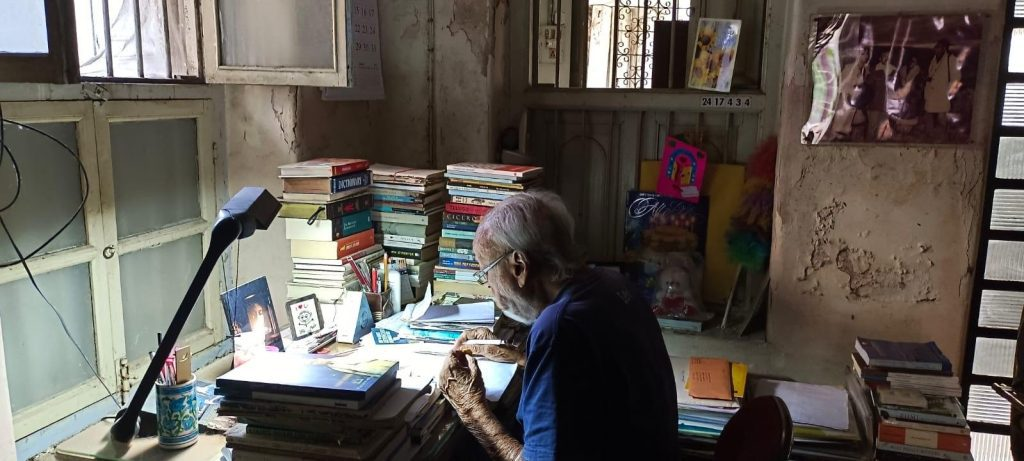
Lastly I am pressed to share a few of my memories from our last meet. I was always fascinated by Jayanta’s reading table. It was my favourite place at his home. He used to pore over something, writing or reading always bent over the table. He was half engulfed by a tall and U-shaped dense wall of books. I used to sit near him silently reading something picked from his library. In the middle of his reading he used to take unwrapped lemon flavoured chocolates and eat from a tin beside.
He usually loved to read under a lamplight encircled by darkness. His home was pleasantly silent all the time, a perfect ambience for a writer which I long again and again to be in. On my last meet I asked him what he was reading. He said he had a big task to complete. It was the 20th edition of Chandrabhaga (his last one) to be ready soon and asked me to send five of my poems. In the letter he wrote to me “Auschwitz” was a poem I’ll use. It is so honestly done. So revealing.” I was so excited because previously he rejected my poems writing a gentle note what I had to improve.
Later once I asked him how he was submitting poems to the foreign journals. He said, “I don’t have a computer. And I know nothing about the technical things you mention in your SMS”, and I told him, “If you have any poems to be submitted to the journals you wish to, please don’t hesitate to send me. I’ll submit them online to as many journals as you wish. It takes less than five minutes for submitting. What all you have pending and if you wish them to be sent to any particular ones of your choice, I will.” And this was what he wrote to me,
“It is so kind of you, Sreekanth, to say you would submit my poems which you would try to get publish in US journals. I will try to send you a group soon by postal mail and will leave it to you to do what you can. This eases me a lot, Sreekanth, and I am fortunate that God has put this concern in your mind. Am grateful both to Jesu and to you.
Uncle”
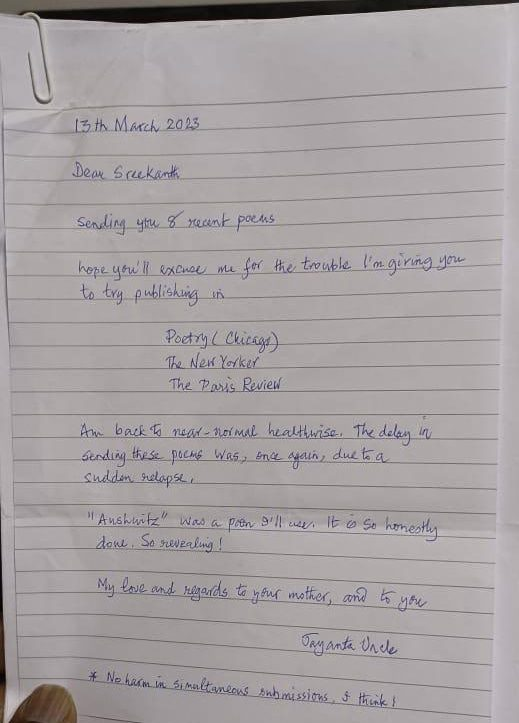
The last poems he sent to me were, “Starting Point’, “Road”, “Not This Love”, “Night”, Bird and Sky” “Eager for Love”, “Poem”, “The End of Something”. I created an Email for him and sent them to Poetryfoundation (Chicago) and Paris Review and New Yorker through submittable.com. These were his last poems. I feel it was God’s most precious opportunity to me.
Uncle!
You often used to speak about aunty. Now I am very happy that you are on your way to her – your long-dreamt destination, and will always be with her in the eternity where there are will be neither tears nor “Hunger” nor “Indian Summer”. We all will certainly meet one day.
Happy journey Uncle.

Sreekanth Kopuri, Ph.D. is an Indian poet from Machilipatnam. He is the Current poetry editor for The AutoEthnographer Journal Florida, and was a Professor of English at Dravidian University. He is a pushcart nominee for 2023. He recited his poetry in Oxford, John Hopkins, Heinrich Heine, Caen, Banja Luka, and many. His poems appeared in Two Thirds North, Arkansas Review, San Antonio Review, Tulsa Review, Expanded FieldPlants & Poetry, Oddball Magazine, to mention a few. His book Poems of the Void won the Golden Book of the year 2022. Kopuri lives with his mother in Machilipatnam. He may be reached at sreekanthkopuri@gmail.com.