
✨ LATEST ISSUE •
From
Matchbox – November’26
Marginalization of the Mad Woman: Liminality of the Discarded Being
What happens when a woman loses her ability to contribute to daily chores? What happens when she can’t send her child to school on time, or cook breakfast and dinner before her husband goes to work on a Monday morning?
Explore the Usawa Bookshelf
Discover the books that shape our times
Ramakanta Sanyal, an eighty-one-year-old resident on South Dumdum Road, states that when a woman becomes unstable, the first sign is that “she doesn’t do her daily chores.” Ramakanta’s wife complained that her daughter-in-law couldn’t heat water for her son’s bath and burnt herself while straining rice. “Then the laziness got out of hand. She didn’t want to get out of bed. How will she function as a mother and a wife if she is lying like a log all day?” I heard this unsettling account when I was interviewing the urban slum areas to collect data for a group project on the multi-layered patriarchal oppression faced by working-class women. Shiuli had worked as a domestic worker when her husband had lost his job during lockdown. After that, she became pregnant for the third time and complications related to childbirth altered her bodily appearance forever. Her uterus was protruding out from a part of her stomach, and postpartum depression made it impossible for her to serve her two daughters, her new-born son, her husband and her in-laws. The amount of domestic labour expected from the recovering mother amazed me and horrified me simultaneously. However, nothing was more appalling than when her husband stepped in to say, “She was not even working anymore after the baby. There – she was working in that apartment. They ousted her because she fainted. How can we function like this?” While he talked with his sacred threat tucked under his arm and his left leg resting on his right, his newly-wedded wife Malati silently served us tea.
What Shiuli needed – even more than therapy for postpartum depression – was family support; she needed the love and care which she had poured into crafting the perfect family life for her husband and children. Instead, her family abandoned her in front of the Sitala Mandir in their native village of Murshidabad, hoping that the goddess would cure her.
What Shiuli needed – even more than therapy for postpartum depression – was family support; she needed the love and care which she had poured into crafting the perfect family life for her husband and children. Instead, her family abandoned her in front of the Sitala Mandir in their native village of Murshidabad, hoping that the goddess would cure her. Prabh Asra’s digital website reports that field workers describe specific patterns of abandonment: women dropped off near temples in the hope of a “divine cure.” Cultural beliefs play a pivotal role in making families believe that a daughter or daughter-in-law with such a “condition” is a “stain” on the family honour. Ruma Pramanik, a domestic house-help who had worked for a short time in our house was discarded by her family near a crematorium. After losing her child, she used to have violent mood swings; her family believed that the mental disorder was a “karmic debt” (kormofol) and the only way to remove the curse was to abandon her.
Similarly, upon visiting Pavlov Hospital while pursuing a course called Women, Writing and Madness coordinated by Professor Paromita Chakravarti, I alarmingly noted the huge number of women who were abandoned by their families without explanation. A workshop was held by members of the Anjali Mental Health Rights Organization where the students and the inmates drew images, and in most of the pictures, there was a heart-breaking yearning for home. Raksha Kumar, while penning an article for BBC, admitted that women are forced to give up their familial ties when discarded without choice. While talking about a patient named Ramaa, the author found that even after being discarded by her husband, she yearned to see him and her sons once more.
”He said he is going to buy medicine.”
With this excuse, Ramaa was refused entry into the family she had nurtured. The BBC article further noted that when men suffer from mental disorders, there is a wife, a daughter, a mother, or a sister who is bound to look after them.
A workshop was held by members of the Anjali Mental Health Rights Organization where the students and the inmates drew images, and in most of the pictures, there was a heart-breaking yearning for home.
The gendered lens shows us that nearly 98% of women patients in Ranchi have been abandoned there. The BBC article “India’s forgotten and abandoned patients” traces the profoundly traumatizing journey of an old woman, Laxmi Jaiswal, whose brother-in-law abandoned her forever in Ranchi. She has forgotten what excuse he used to dump her there. Several letters to her family remained unanswered, and she has tearfully accepted that her husband has taken his second—or third—wife. Now, whenever she is asked about her life before coming to the institution she says:
“It is a pain. Locked deep down.”
Dr. Amul Ranjan Singh states that the pain of rejection impacts healing minds heavily and causes severe damage when they understand that they cannot integrate themselves into the world around them ever again. I witnessed this first-hand when I was an amateur researcher in my first year of graduation and had gone to interview the senior citizens residing in a Half-Way Home as a part of my internship with Help-Age India. There, I met Shanta di for the first time. A profound innocence in her eyes captivated my attention as I moved towards her bed, accompanied by the nurse, with my notepad and pen. She was childlike as she nuzzled into the nurse’s embrace.
“What has happened to her?”, I asked, my eyebrows raised.
“Nothing.”
I stared at her with my mouth half-open and my eyes searching for something critically wrong in Shanta di’s face.
The nurse sighed.
“Her husband beat her for aborting their baby. It was not an abortion; it was a miscarriage. She could not take the loss of her child and the wrath (paglami) of her husband. Her mental health worsened. She returned to her paternal home which was not hers when she returned back (her father had gifted it to her younger brother without her knowledge). Her brother dropped her here. She wanted to be a writer. Rekha di, our oldest matron, told me that when she came, she was thin as a blade.”
I saw the book Meghe Dhaka Tara by Suchitra Bhattacharya beside Shanta di’s bed. It was a very well-loved copy with marks and annotations. After she had warmed up to me, she showed me the dog-eared pages. A few words were circled using her red sketch pen – like “bhalobasha” (love), “shongshar” (family), “prem”(love). Beside each word, she had written “Samanta”, the name of her husband.
The nurse later reported that she had sent poems, poetries and apology notes to her husband’s home. She never received a reply, which worsened her health. One day her husband had sent an official letter to the home stating that it would be impossible for him to take back a “mad wife”. After that, whenever Shanta di wrote her letters, the nurses hid it and placated her by saying that they were going to post it.
On a similar note, Jasmine Kalha, from the Centre for Mental Health Law and Policy, points out: “Once labelled, you forever stay that way; there is no un-labelling mechanism.”
The question arises: Will the abandoned women always remain marginalized?
Historically, the psychiatric treatment of the “rest cure” in the Victorian era required women to be completely stripped of identity and selfhood, as they had to depend on the nurse for their regular tasks like bathing or eating.
The Swaddle has taken the initiative to delve deep into the question regarding these abandoned women to record how they lose autonomy over their own bodies when admitted under institutional care. Like one has seen before in seminal novels like The Yellow Wallpaper or Maria: or, The Wrongs of Woman, the system of care firstly takes away the woman’s control over the treatment that she is being subjected to. Historically, the psychiatric treatment of the “rest cure” in the Victorian era required women to be completely stripped of identity and selfhood, as they had to depend on the nurse for their regular tasks like bathing or eating.
This pattern is being undone by movements which aim to construct spaces of shared identities where these women can come together—from economically backward and marginalised classes—to process their trauma and discuss their struggles in individual or group sessions. Debayani Sen, who works with Iswar Sankalpa to assist homeless people with psychosocial needs, opines that deinstitutionalization is about centering people’s choice and dignity rather than saving them. Organizations like Iswar Sankalpa and Anjali arrange drop-in centers for women which include bathing and food facilities as well as therapy and vocational training sessions. The creation of a community leads to the construction of a safe-space which will not rush to pathologically label the woman as “mad” but give her a voice to explore, to express and be heard.
An effort towards de-institutionalization does not assert that all forms of institutional care are negative. There are institutions which have successfully reintegrated women into society. The Swaddle reports the cases of two formerly institutionalized women, Devi and Jaya, who now work in a Hot Bread Factory attached to the Kilpauk Institute. However, the question is, are these women—who were once discarded— truly reintegrated into the same reality which once refused to accept them? Don’t they forever lie in a liminal space between abandonment and reintegration?
An effort towards de-institutionalization does not assert that all forms of institutional care are negative.
The woman loses her own drive and, as Laboni Roy from Iswar Sankalpa states, “from a clinical perspective, they don’t cause trouble but they just do what you tell them to do; there is no growth.” Of course, it is natural for a woman to lose her selfhood after facing what we can term as a “refusal cascade”:
- First, the woman faces a refusal of her own family to house her.
- Then she faces a refusal when she says she is not mad. Many women, upon being labelled as “mad” by their families, decide to move out and live on the streets. While homelessness is not a desirable form of life, even the choice of living on the streets is refused to the woman, as they are forcefully brought to institutions by the police based on complaints that they “look” mad. As Dr. KV Kishore states, when women are merely depressed and perform their household chores slowly, they may be cast out and labelled as “mad” i. Later it is seen that they do not need any medical intervention, but living with other mentally ill members has affected their identity severely.
- Lastly, she faces a refusal again when she wants to discuss her treatment procedure. As noted by a 2014 report by Human Rights Watch, the women inmates do not know what will happen to them; they are kept in extremely violent and insanitary conditions with false promises of being cured.
After the “refusal cascade”, if you tell the woman, “Okay, this time we will believe you. We will listen to your needs. Tell us how you feel,” she will not react.
The key to accepting lies in giving access—access to justice, access to respect, access to individuality, access to pleasure and sexuality.
Renowned clinical psychologist and mental health activist Ratnaboli Ray states, “deinstitutionalization is a state of mind as well.” To build that state of mind, it is important to break down the infrastructure of institutions—not the brick walls, but the boundaries of otherization. If we refuse to accept them as one of us, how can we reintegrate them? The key to accepting lies in giving access—access to justice, access to respect, access to individuality, access to pleasure and sexuality.
As a woman, it is important to ask ourselves: am I that different from the woman behind the walls of the Lumbini Park Mental Hospital? Are we not both carrying the melancholic burden and emotional brunt of navigating a suffocating patriarchy? As soon as the border between us and them blurs, it will help us to question not what mental illness is, but who defines what is illness and what is normal?
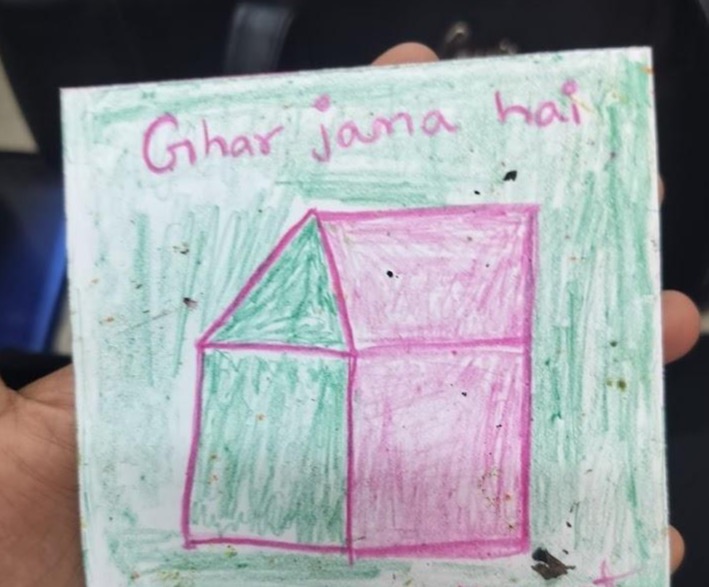
A picture clicked by Sweta Singh as a part of the Women, Writing and Madness course coordinated by Professor Paromita Chakravarti. This drawing was made by her and another resident in Pavlov Institute which clearly shows their yearning for home.
Works cited:
Prabha Asra. (n.d.). Mentally ill women abandoned in India. https://prabhaasra.org/mentally-ill-women-abandoned-india/
Kumar, Raksha. “The Indian women abandoned because of mental illness,” BBC News, October 16, 2018.
Panday, Geeta. “India’s Forgotten and Abandoned Patients”, BBC News, August 13, 2009
Gilman, Charlotte Perkins. “The Yellow Wall-paper.” The New England Magazine, 1892
Wollstonecraft, Mary. Maria: or, The Wrongs of Woman. J. Johnson, 1798.
Bhattacharya, A., Camacho, D., & Lukens, E. (2024).“These Places are Easy to Get into but Impossible to Get Out of”: Women’s Pathways to Psychiatric Institutions and Barriers to Community Re-entry. Community Mental Health Journal, 60 (2), 317-329

Sthitirupa Mukherjee
Sthitirupa Mukherjee graduated with a first-class distinction and the gold medal from Jadavpur University’s Department of English. After pursuing her Master’s degree, she contributed to CBSE curriculum design at CB Classes before joining Trivium Education. An experienced educator, she has tutored students across the United States and the United Kingdom, and possesses specialized expertise in guiding dissertation reviews for Grand Canyon University. Her research has been presented at international conferences, including the International Latin American Conference and Queer Political Assemblages. The author of two published papers, she is currently developing her doctoral proposal focusing on women and madness in India.